Deng Nanyan, Grassini Patricio, Yang Haishun, Huang Jianliang, Cassman Kenneth G, Peng Shaobing
National Key Laboratory of Crop Genetic Improvement, MARA Key Laboratory of Crop Ecophysiology and Farming System in the Middle Reaches of the Yangtze River, College of Plant Science and Technology, Huazhong Agricultural University, Wuhan, 430070, Hubei, China.
Department of Agronomy and Horticulture, University of Nebraska-Lincoln, PO. Box. 830915, Lincoln, NE, 68583-0915, USA.
Nat Commun. 2019 Apr 12;10(1):1725. doi: 10.1038/s41467-019-09447-9.
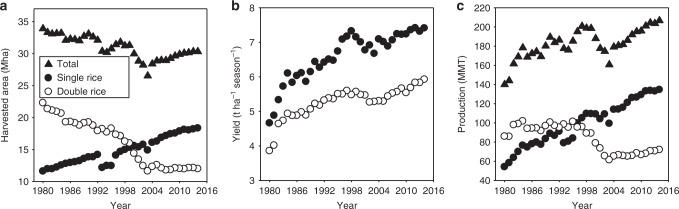
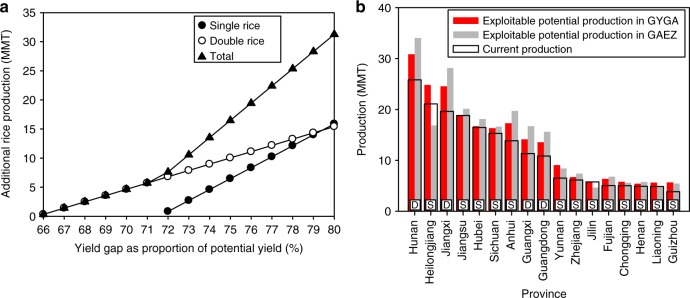
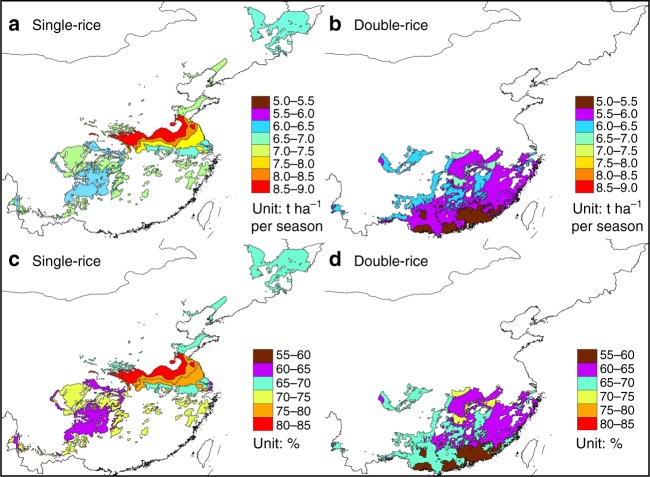
China produces 28% of global rice supply and is currently self-sufficient despite a massive rural-to-urban demographic transition that drives intense competition for land and water resources. At issue is whether it will remain self-sufficient, which depends on the potential to raise yields on existing rice land. Here we report a detailed spatial analysis of rice production potential in China and evaluate scenarios to 2030. We find that China is likely to remain self-sufficient in rice assuming current yield and consumption trajectories and no reduction in production area. A focus on increasing yields of double-rice systems on general, and in three single-rice provinces where yield gaps are relatively large, would provide greatest return on investments in research and development to remain self-sufficient. Discrepancies between results from our detailed bottom-up yield-gap analysis and those derived following a top-down methodology show that the two approaches would result in very different research and development priorities.
中国的水稻产量占全球供应的28%,尽管大规模的农村人口向城市转移引发了对土地和水资源的激烈竞争,但目前中国仍能实现自给自足。问题在于中国能否继续保持自给自足,这取决于提高现有稻田产量的潜力。在此,我们报告了对中国水稻生产潜力的详细空间分析,并评估了到2030年的各种情景。我们发现,假设目前的产量和消费轨迹不变且种植面积不减少,中国很可能继续保持水稻自给自足。总体而言,重点提高双季稻系统的产量,特别是在三个单季稻省份,这些省份的产量差距相对较大,将为保持自给自足的研发投资提供最大回报。我们详细的自下而上的产量差距分析结果与自上而下方法得出的结果之间存在差异,这表明两种方法会导致截然不同的研发重点。