Gastroenterology, Cancer Center Amsterdam, Amsterdam UMC, University of Amsterdam, Amsterdam, The Netherlands.
Department of Gastroenterology and Hepatology, Radboud University Medical Center, Nijmegen, The Netherlands.
Gut. 2020 Jan;69(1):112-121. doi: 10.1136/gutjnl-2018-318134. Epub 2019 Apr 13.
Serrated polyposis syndrome (SPS) is associated with an increased risk of colorectal cancer (CRC). International guidelines recommend surveillance intervals of 1-2 years. However, yearly surveillance likely leads to overtreatment for many. We prospectively assessed a surveillance protocol aiming to safely reduce the burden of colonoscopies.
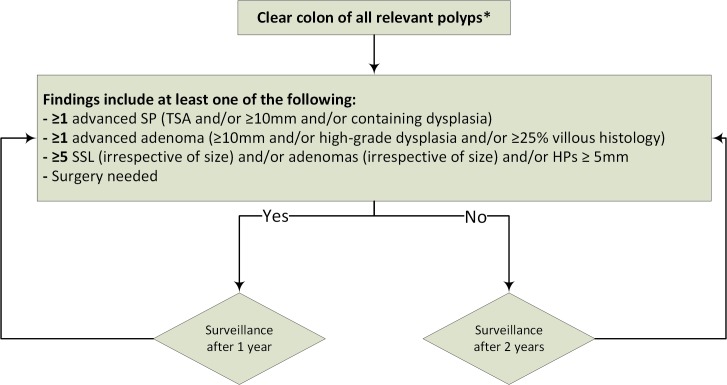
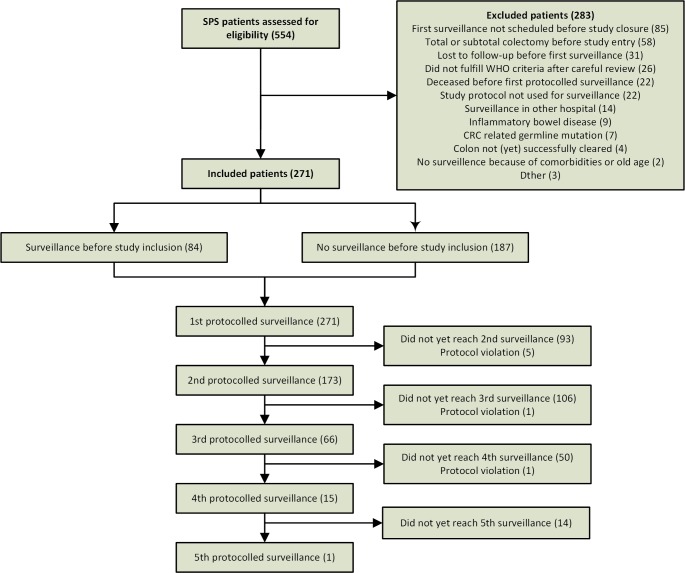
Between 2013 and 2018, we enrolled SPS patients from nine Dutch and Spanish hospitals. Patients were surveilled using a protocol appointing either a 1-year or 2-year interval after each surveillance colonoscopy, based on polyp burden. Primary endpoint was the 5-year cumulative incidence of CRC and advanced neoplasia (AN) during surveillance.
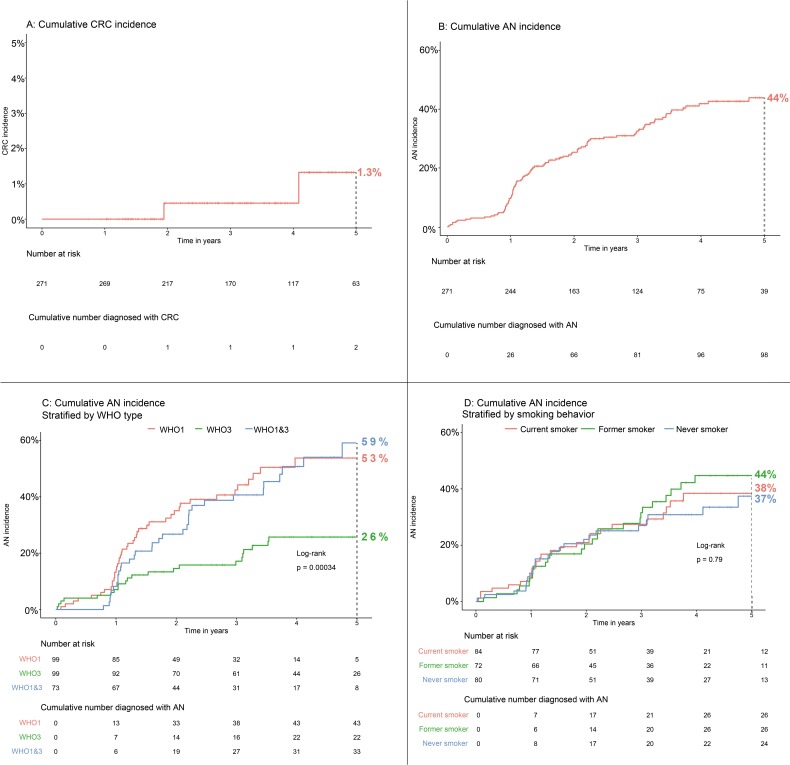
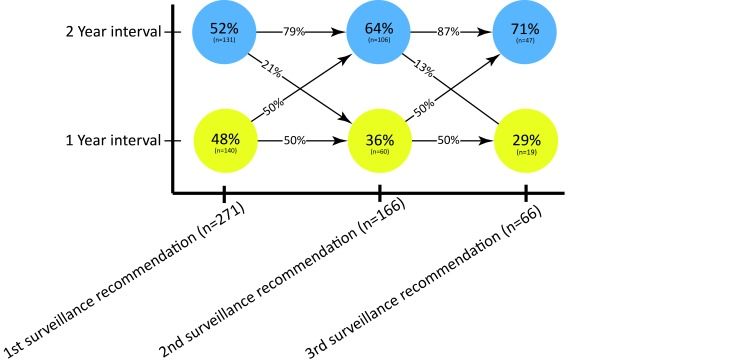
We followed 271 SPS patients for a median of 3.6 years. During surveillance, two patients developed CRC (cumulative 5-year incidence 1.3%[95% CI 0% to 3.2%]). The 5-year AN incidence was 44% (95% CI 37% to 52%), and was lower for patients with SPS type III (26%) than for patients diagnosed with type I (53%) or type I and III (59%, p<0.001). Most patients were recommended a 2-year interval, and those recommended a 2-year interval were not at increased risk of AN: AN incidence after a 2-year recommendation was 15.6% compared with 24.4% after a 1-year recommendation (OR 0.57, p=0.08).
Risk stratification substantially reduced colonoscopy burden while achieving CRC incidence similar to previous studies. AN incidence is considerable in SPS patients, but extension of surveillance intervals was not associated with increased AN in those identified as low-risk by the protocol. We identified SPS type III patients as low-risk group that might benefit from even less frequent surveillance.
The study was registered on http://www.trialregister.nl; trial-ID NTR4609.
锯齿状息肉综合征(SPS)与结直肠癌(CRC)风险增加相关。国际指南建议的监测间隔为 1-2 年。然而,每年的监测可能导致许多人过度治疗。我们前瞻性评估了旨在安全减少结肠镜检查负担的监测方案。
在 2013 年至 2018 年间,我们从九家荷兰和西班牙医院招募了 SPS 患者。根据息肉负担,患者在监测时采用方案,在每次监测结肠镜检查后分别安排 1 年或 2 年的间隔。主要终点是在监测期间 CRC 和高级别瘤变(AN)的 5 年累积发生率。
我们对 271 名 SPS 患者进行了中位数为 3.6 年的随访。在监测期间,两名患者发生 CRC(5 年累积发生率为 1.3%[95%CI 0%至 3.2%])。5 年 AN 发生率为 44%(95%CI 37%至 52%),SPS 类型 III 的患者(26%)低于诊断为类型 I(53%)或 I 和 III(59%,p<0.001)的患者。大多数患者被推荐 2 年的间隔,被推荐 2 年间隔的患者发生 AN 的风险没有增加:2 年建议后 AN 发生率为 15.6%,1 年建议后为 24.4%(OR 0.57,p=0.08)。
风险分层大大减少了结肠镜检查的负担,同时达到了与以前研究相似的 CRC 发生率。SPS 患者的 AN 发生率相当高,但根据方案确定为低风险的患者延长监测间隔与 AN 发生率增加无关。我们确定 SPS 类型 III 患者为低风险组,可能受益于更不频繁的监测。
该研究在 http://www.trialregister.nl 上注册;试验编号 NTR4609。