Department of Pediatrics, Indiana University School of Medicine, Indianapolis, Indiana, USA.
Academic Model Providing Access to Healthcare (AMPATH), Eldoret, Kenya.
J Int AIDS Soc. 2019 Apr;22(4):e25275. doi: 10.1002/jia2.25275.
With the increasing number of children exposed to HIV or antiretroviral therapy in utero, there are concerns that this population may have worse neurodevelopmental outcomes compared to those who are unexposed. The objective of this study was to systematically review the clinical and preclinical literature on the effects of in utero exposure to HIV and/or antiretroviral therapy (ART) on neurodevelopment.
We systematically searched OVID Medline, PsycINFO and Embase, as well as the Cochrane Collaborative Database, Google Scholar and bibliographies of pertinent articles. Titles, abstracts, and full texts were assessed independently by two reviewers. Data from included studies were extracted. Results are summarized qualitatively.
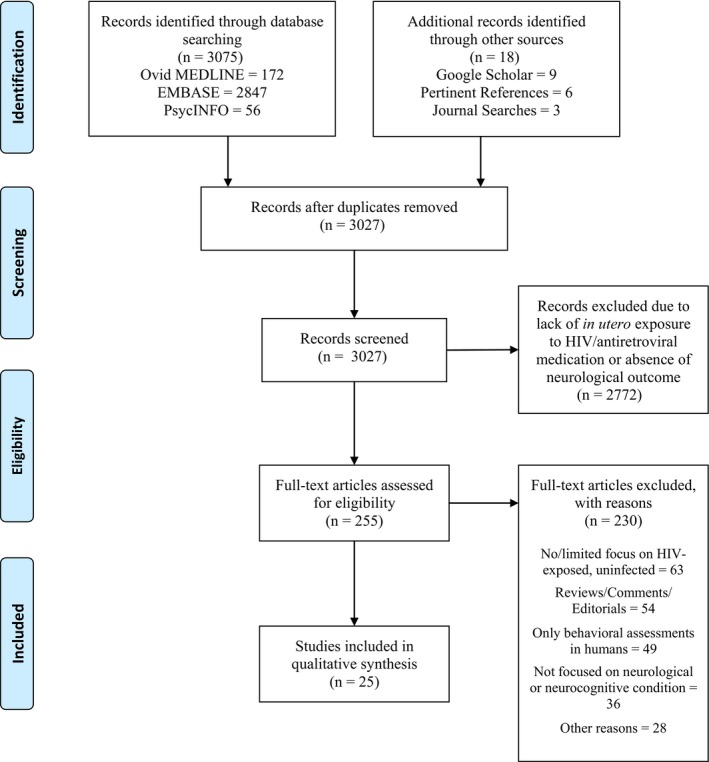
The search yielded 3027 unique titles. Of the 255 critically reviewed full-text articles, 25 met inclusion criteria for the systematic review. Five articles studied human subjects and looked at brain structure and function. The remaining 20 articles were preclinical studies that mostly focused on behavioural assessments in animal models. The few clinical studies had mixed results. Some clinical studies found no difference in white matter while others noted higher fractional anisotropy and lower mean diffusivity in the brains of HIV-exposed uninfected children compared to HIV-unexposed uninfected children, correlating with abnormal neurobehavioral scores. Preclinical studies focused primarily on neurobehavioral changes resulting from monotherapy with either zidovudine or lamivudine. Various developmental and behavioural changes were noted in preclinical studies with ART exposure, including decreased grooming, decreased attention, memory deficits and fewer behaviours associated with appropriate social interaction.
While the existing literature suggests that there may be some neurobehavioral differences associated with HIV and ART exposure, limited data are available to substantially support these claims. More research is needed comparing neurobiological factors between HIV-exposed uninfected and HIV-unexposed uninfected children and using exposures consistent with current clinical care.
随着越来越多的儿童在子宫内接触 HIV 或抗逆转录病毒治疗,人们担心与未接触的儿童相比,这一人群的神经发育结局可能更差。本研究的目的是系统地回顾关于 HIV 和/或抗逆转录病毒治疗(ART)宫内暴露对神经发育影响的临床和临床前文献。
我们系统地检索了 OVID Medline、PsycINFO 和 Embase,以及 Cochrane 协作数据库、Google Scholar 和相关文章的参考文献。两名评审员分别评估标题、摘要和全文。从纳入研究中提取数据。结果以定性方式总结。
搜索产生了 3027 个独特的标题。在对 255 篇经过严格审查的全文文章中,有 25 篇符合系统评价的纳入标准。有 5 篇文章研究了人类受试者,观察了大脑结构和功能。其余 20 篇是临床前研究,主要集中在动物模型中的行为评估。少数临床研究结果不一。一些临床研究发现白质没有差异,而其他研究则指出 HIV 暴露未感染儿童的大脑中部分各向异性分数更高,平均弥散率更低,与异常神经行为评分相关。临床前研究主要集中在单一使用齐多夫定或拉米夫定治疗引起的神经行为变化上。在有 ART 暴露的临床前研究中观察到各种发育和行为变化,包括梳理减少、注意力减少、记忆缺陷以及与适当社会互动相关的行为减少。
虽然现有文献表明,HIV 和 ART 暴露可能与某些神经行为差异有关,但可用的数据不足以充分支持这些说法。需要更多的研究比较 HIV 暴露未感染和 HIV 未暴露未感染儿童之间的神经生物学因素,并使用与当前临床护理一致的暴露。