Department of Rehabilitation Sciences, The Hong Kong Polytechnic University, Hung Hom, Hong Kong.
Clin Rehabil. 2019 Aug;33(8):1298-1309. doi: 10.1177/0269215519840392. Epub 2019 Apr 15.
To determine the effectiveness of physiotherapy interventions for postprostatectomy erectile dysfunction and climacturia.
Multiple databases were searched from database inception to February 2019.
Randomized controlled trials comparing physiotherapy interventions to control were included.
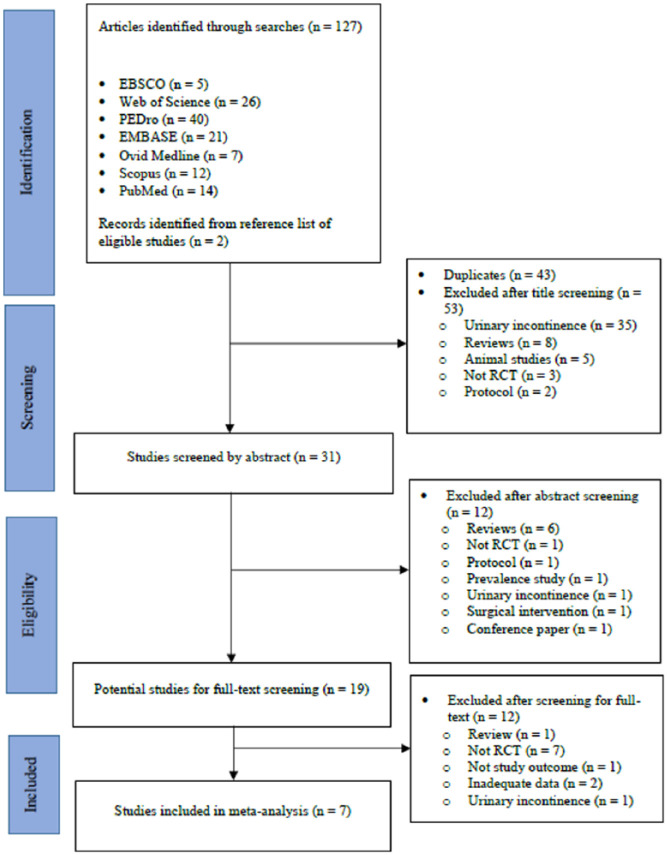
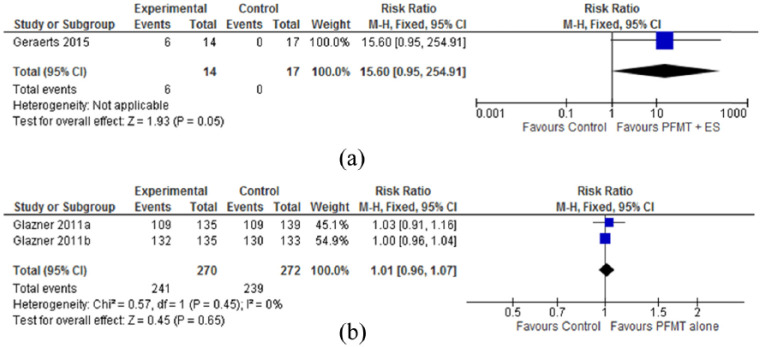
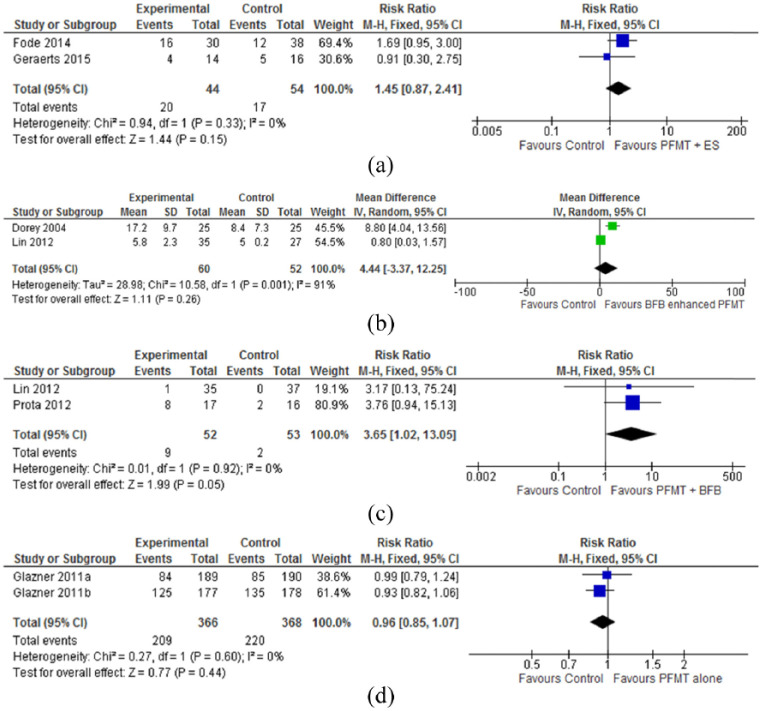
The search yielded 127 potentially relevant articles; seven met the inclusion criteria and were included in the review. Meta-analysis of two studies revealed a statistically significant effect of pelvic floor muscle training (PFMT) plus biofeedback compared to the no treatment control group for erectile function at the12-month follow-up period (risk ratio (RR) = 3.65, 95% confidence interval (CI) = 1.02-13.05; = 0.05). Data from one small study ( = 31) identified a greater number of men reporting improved climacturia in the PFMT plus electrical stimulation group compared to the no treatment control group, and the overall effect was significant (RR = 15.60, 95% CI = 0.95-254.91; = 0.05). Meta-analyses of two studies found no statistically significant differences between groups receiving PFMT and no treatment control for erectile function or climacturia at long-term follow-up.
PFMT augmented with biofeedback improves erectile function after prostatectomy. Data from a single study found PFMT combined with electrical stimulation to be beneficial for postprostatectomy climacturia. However, electrical stimulation is recommended for terminally ill people only. The effect of PFMT alone on postprostatectomy erectile dysfunction and climacturia remains inconclusive. However, this is likely to be affected by the participant adherence and physiotherapy supervision. High-quality trials providing intensive supervision and due consideration of adherence factors are recommended.
确定物理疗法干预前列腺切除术后勃起功能障碍和绝经后尿失禁的效果。
从数据库创建开始到 2019 年 2 月,对多个数据库进行了搜索。
纳入了比较物理疗法干预与对照组的随机对照试验。
搜索结果产生了 127 篇潜在相关文章;有 7 篇符合纳入标准并包含在综述中。对两项研究的荟萃分析显示,在 12 个月的随访期间,与不治疗对照组相比,盆底肌肉训练(PFMT)加生物反馈对勃起功能有统计学意义上的显著效果(风险比(RR)=3.65,95%置信区间(CI)=1.02-13.05; = 0.05)。一项小型研究( = 31)的数据表明,与不治疗对照组相比,PFMT 加电刺激组有更多的男性报告绝经后尿失禁改善,总体效果显著(RR=15.60,95%CI=0.95-254.91; = 0.05)。对两项研究的荟萃分析发现,接受 PFMT 组与不治疗对照组在长期随访时,勃起功能或绝经后尿失禁方面无统计学差异。
PFMT 加生物反馈可改善前列腺切除术后的勃起功能。一项研究的数据发现,PFMT 联合电刺激对前列腺切除术后的绝经后尿失禁有益。然而,仅建议对临终患者使用电刺激。PFMT 单独对前列腺切除术后勃起功能障碍和绝经后尿失禁的影响仍不确定。然而,这可能受到参与者的依从性和物理治疗监督的影响。建议进行高质量的试验,提供强化监督,并充分考虑依从性因素。