Dearlove David J, Faull Olivia K, Rolls Edward, Clarke Kieran, Cox Pete J
Department of Physiology, Anatomy and Genetics, University of Oxford, Oxford, United Kingdom.
Nuffield Department of Clinical Neurosciences, University of Oxford, Oxford, United Kingdom.
Front Physiol. 2019 Mar 29;10:290. doi: 10.3389/fphys.2019.00290. eCollection 2019.
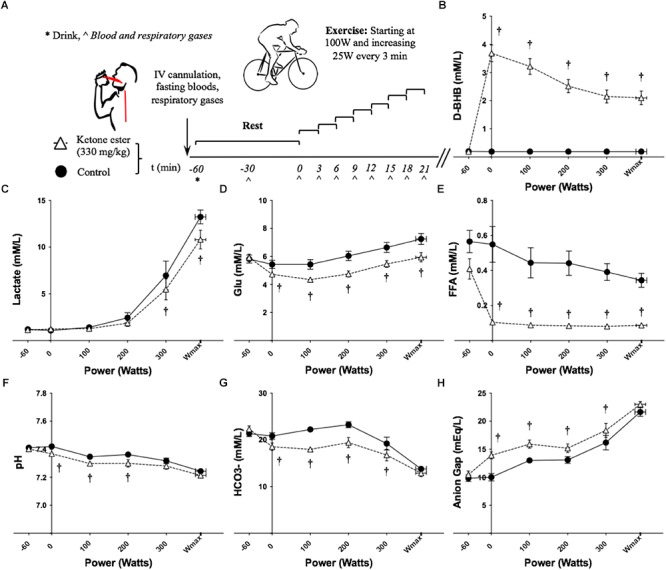
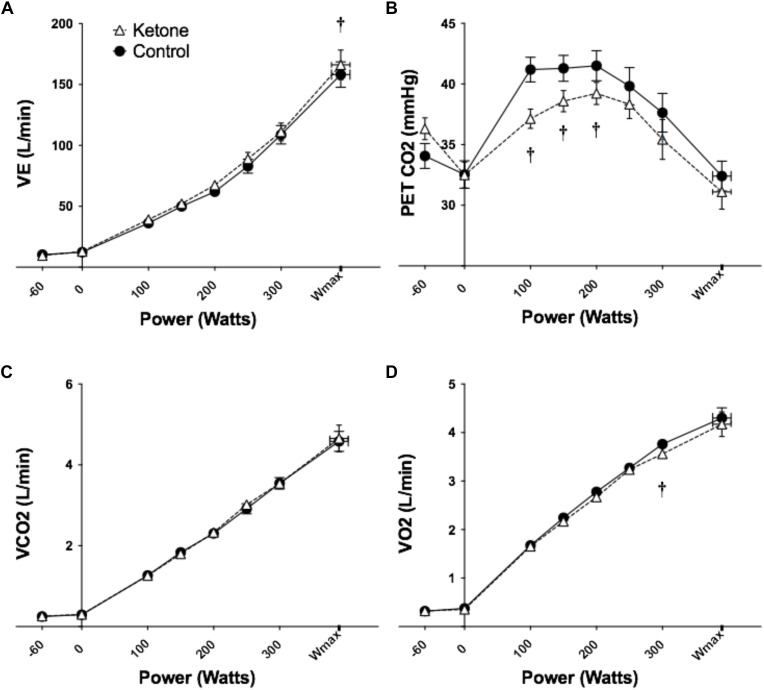
Ketosis, achieved through ingestion of ketone esters, may influence endurance exercise capacity by altering substrate metabolism. However, the effects of ketone consumption on acid-base status and subsequent metabolic and respiratory compensations are poorly described. Twelve athletically trained individuals completed an incremental bicycle ergometer exercise test to exhaustion following the consumption of either a ketone ester [-3-hydroxybutyrate--1,3-butanediol] or a taste-matched control drink (bitter flavoured water) in a blinded, cross-over study. Respiratory gases and arterialised blood gas samples were taken at rest and at regular intervals during exercise. Ketone ester consumption increased blood D-β-hydroxybutyrate concentration from 0.2 to 3.7 mM/L ( < 0.01), causing significant falls versus control in blood pH to 7.37 and bicarbonate to 18.5 mM/L before exercise. To compensate for ketoacidosis, minute ventilation was modestly increased ( < 0.05) with non-linearity in the ventilatory response to exercise (ventilatory threshold) occurring at a 22 W lower workload ( < 0.05). Blood pH and bicarbonate concentrations were the same at maximal exercise intensities. There was no difference in exercise performance having consumed the ketone ester or control drink. Athletes compensated for the greater acid load caused by ketone ester ingestion by elevating minute ventilation and earlier hyperventilation during incremental exercise.
通过摄入酮酯实现的酮症,可能通过改变底物代谢来影响耐力运动能力。然而,关于酮类消耗对酸碱状态以及随后的代谢和呼吸代偿的影响,目前描述甚少。在一项双盲交叉研究中,12名受过运动训练的个体在饮用酮酯[-3-羟基丁酸-1,3-丁二醇]或口味匹配的对照饮料(苦味水)后,完成了递增式自行车测力计运动测试直至力竭。在休息时和运动期间定期采集呼吸气体和动脉化血气样本。饮用酮酯后,血液D-β-羟基丁酸浓度从0.2毫摩尔/升增加到3.7毫摩尔/升(<0.01),导致运动前血液pH值与对照组相比显著下降至7.37,碳酸氢盐下降至18.5毫摩尔/升。为了代偿酮症酸中毒,分钟通气量适度增加(<0.05),运动通气反应(通气阈值)的非线性出现在低22瓦的工作负荷下(<0.05)。在最大运动强度时,血液pH值和碳酸氢盐浓度相同。饮用酮酯或对照饮料后运动表现没有差异。运动员通过在递增运动期间提高分钟通气量和更早出现过度通气来代偿由酮酯摄入引起的更大酸负荷。