The Department of Physiology, Anatomy and Genetics, The University of Oxford, Oxford, UNITED KINGDOM.
Oxford Centre for Diabetes, Endocrinology and Metabolism, and the Oxford NIHR Biomedical Research Centre, The University of Oxford, Oxford, UNITED KINGDOM.
Med Sci Sports Exerc. 2021 Mar 1;53(3):505-516. doi: 10.1249/MSS.0000000000002502.
Exogenous ketones potentially provide an alternative, energetically advantageous fuel to power exercising skeletal muscle. However, there is limited evidence regarding their relative contribution to energy expenditure during exercise. Furthermore, the effect of blood ketone concentration and exercise intensity on exogenous ketone oxidation rates is unknown.
Six athletes completed cycling ergometer exercise on three occasions within a single-blind, random-order controlled, crossover design study. Exercise duration was 60 min, consisting of 20-min intervals at 25%, 50%, and 75% maximal power output (WMax). Participants consumed (i) bitter flavored water (control), (ii) a low-dose β-hydroxybutyrate (βHB) ketone monoester (KME; 252 mg·kg BW-1, "low ketosis"), or (iii) a high-dose βHB KME (752 mg·kg BW-1, "high ketosis"). The KME contained a 13C isotope label, allowing for the determination of whole-body exogenous βHB oxidation rates through sampled respiratory gases.
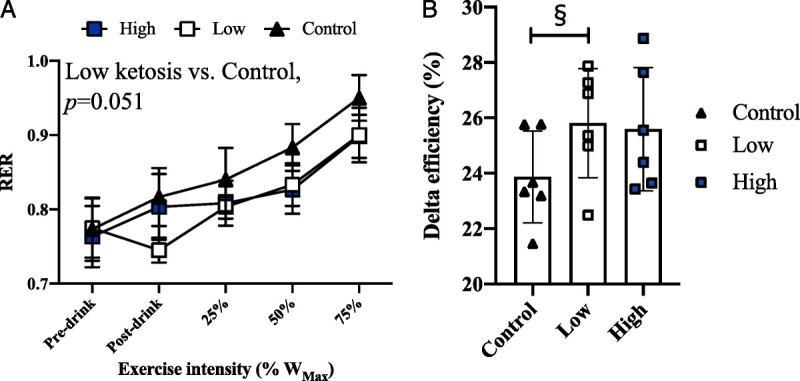
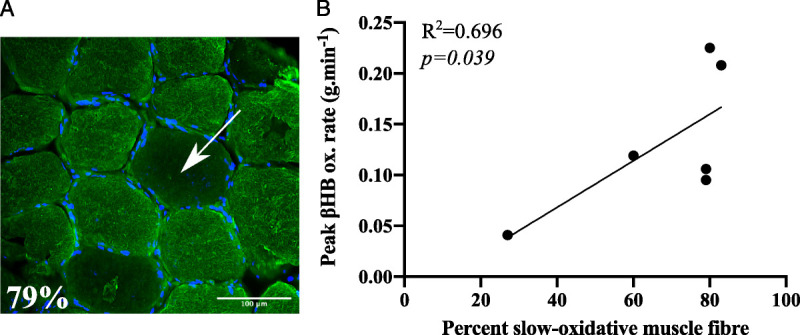
Despite an approximate doubling of blood βHB concentrations between low- and high-ketosis conditions (~2 mM vs ~4.4 mM), exogenous βHB oxidation rates were similar at rest and throughout exercise. The contribution of exogenous βHB oxidation to energy expenditure peaked during the 25% WMax exercise intensity but was relatively low (4.46% ± 2.71%). Delta efficiency during cycling exercise was significantly greater in the low-ketosis (25.9% ± 2.1%) versus control condition (24.1% ± 1.9%; P = 0.027).
Regardless of exercise intensity, exogenous βHB oxidation contributes minimally to energy expenditure and is not increased by elevating circulating concentrations greater than ~2 mM. Despite low exogenous βHB oxidation rates, exercise efficiency was significantly improved when blood βHB concentration was raised to ~2 mM.
外源性酮类物质可能为运动骨骼肌提供一种替代的、能量优势的燃料。然而,关于它们在运动中对能量消耗的相对贡献的证据有限。此外,血酮浓度和运动强度对外源性酮氧化率的影响尚不清楚。
6 名运动员在一项单盲、随机、交叉设计的研究中,在三次不同的情况下完成了自行车测力计运动。运动持续 60 分钟,由 25%、50%和 75%最大输出功率(WMax)的 20 分钟间隔组成。参与者摄入(i)苦味水(对照)、(ii)低剂量β-羟基丁酸(βHB)酮单酯(KME;252mg·kg BW-1,“低酮症”)或(iii)高剂量βHB KME(752mg·kg BW-1,“高酮症”)。KME 含有 13C 同位素标记物,允许通过采样呼吸气体来确定全身外源性βHB 氧化率。
尽管低酮症和高酮症之间的血液βHB 浓度近似增加了一倍(约 2mM 对约 4.4mM),但在休息和运动过程中外源性βHB 的氧化率相似。外源性βHB 氧化对能量消耗的贡献在 25%WMax 运动强度时达到峰值,但相对较低(4.46%±2.71%)。在低酮症(25.9%±2.1%)与对照条件(24.1%±1.9%;P=0.027)相比,自行车运动期间的 Δ效率显著更高。
无论运动强度如何,外源性βHB 氧化对能量消耗的贡献极小,并且不会因将循环浓度升高到超过约 2mM 而增加。尽管外源性βHB 氧化率较低,但当血液βHB 浓度升高到约 2mM 时,运动效率显著提高。