Nicula Cristina, Pop Radu, Rednik Anca, Nicula Dorin
University of Medicine and Pharmacy "Iuliu Hatieganu", Cluj-Napoca, Romania.
Oculens Clinic, Cluj-Napoca, Romania.
J Ophthalmol. 2019 Mar 7;2019:8285649. doi: 10.1155/2019/8285649. eCollection 2019.
The purpose of the current study was to evaluate the long-term functional results based on keratometric measurements, spherical and cylinder equivalent in patients with progressive keratoconus treated with conventional "epi-off" corneal collagen cross-linking (CXL).
We conducted a retrospective study in which 113 eyes from 90 keratoconus-treated patients with CXL between 2006 and 2008 in Oculens Eye Clinic from Cluj-Napoca, Romania, were included. The diagnosis of keratoconus was based on corneal topography and its clinical signs. All patients were evaluated preoperatively, and a follow-up was performed at 1, 3, and 6 months and every year from 1 to 10 years after conventional CXL.
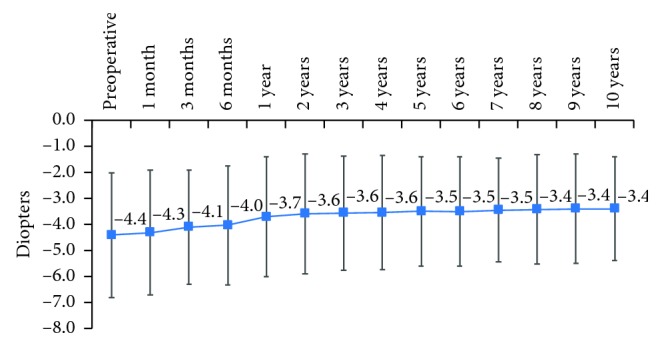
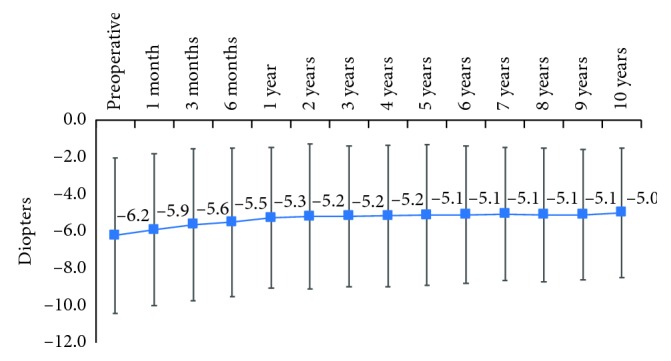
All keratometry measurements improved significantly during the follow-up. Compared to preoperative values, the improvement of become statistically significant at 1 year after CXL (mean change compared to baseline -0.9 D, < 0.001) and remained statistically significant thereafter up to 10 years (mean change compared to baseline -2.3 D, < 0.001). As compared to preoperative values, mean spherical equivalent and mean cylinder improved during the follow-up, from a mean of -6.22 D before CXL to a mean value of -5.0 at 10 years, following CXL for spherical equivalent and from -4.4 D at baseline to -3.4 D at 10 years for cylinder ( < 0.05 for both). Uncorrected visual acuity increased, remaining statistically significant, by 0.104 logMAR at 10 years after CXL (=0.0015), and best-corrected visual acuity increased by 0.135 logMAR at 10 years after CXL (=0.015). We did not observe any case of severe complication.
Our results show that CXL has a favorable effect on the progression of KC. The reduced values, cylinder and spherical equivalent, and increased visual acuity remained the same 10 years after the procedure.
本研究旨在评估采用传统“上皮移除”角膜胶原交联(CXL)治疗的圆锥角膜患者,基于角膜曲率测量、等效球镜和柱镜的长期功能结果。
我们进行了一项回顾性研究,纳入了2006年至2008年期间在罗马尼亚克卢日-纳波卡市奥库伦斯眼科诊所接受CXL治疗的90例圆锥角膜患者的113只眼睛。圆锥角膜的诊断基于角膜地形图及其临床体征。所有患者均在术前进行评估,并在传统CXL术后1、3和6个月以及术后1至10年每年进行随访。
在随访期间,所有角膜曲率测量值均有显著改善。与术前值相比,CXL术后1年时 的改善具有统计学意义(与基线相比平均变化-0.9 D,<0.001),此后直至10年仍具有统计学意义(与基线相比平均变化-2.3 D,<0.001)。与术前值相比,随访期间等效球镜平均值和柱镜平均值均有所改善,CXL术后等效球镜从术前平均-6.22 D改善至10年时的平均-5.0 D,柱镜从基线时的-4.4 D改善至10年时的-3.4 D(两者均<0.05)。未矫正视力提高,在CXL术后10年时提高了0.104 logMAR,差异有统计学意义(=0.0015),最佳矫正视力在CXL术后10年时提高了0.135 logMAR(=0.015)。我们未观察到任何严重并发症病例。
我们的结果表明,CXL对圆锥角膜的进展具有良好效果。术后10年时, 值、柱镜和等效球镜降低,视力提高,情况保持不变。