Bharti Aman, Chawla Sumit Pal Singh, Kumar Sandeep, Kaur Sarabjot, Soin Divya, Jindal Neerja, Garg Ravinder
Department of Medicine, Guru Gobind Singh Medical College and Hospital, Faridkot, Punjab, India.
Department of Microbiology, Guru Gobind Singh Medical College and Hospital, Faridkot, Punjab, India.
J Family Med Prim Care. 2019 Feb;8(2):539-543. doi: 10.4103/jfmpc.jfmpc_403_18.
Asymptomatic bacteriuria (ASB) is common in neonates, preschool children, pregnant women, elderly, diabetics, catheterized patients, and patients with abnormal urinary tracts or renal diseases. Though there is currently no consensus on treatment of ASB in various population groups, it is advisable to treat the same in patients with diabetes mellitus (DM).
To determine the prevalence of ASB in patients with type 2 DM and to study the spectrum of uro-pathogens causing ASB along with their antibiotic susceptibility profile.
This prospective, observational study was conducted in the department of Medicine of a tertiary care teaching hospital.
The study was conducted on 100 patients with type 2 DM. Urine wet mount and gram stain examination was done for all to detect the presence of pus cells and bacteria in urine. Antibiotic sensitivity testing was performed in patients with significant bacteriuria to determine the sensitivity profile of isolated uro-pathogens. The data were analyzed to determine the association between diabetes and ASB.
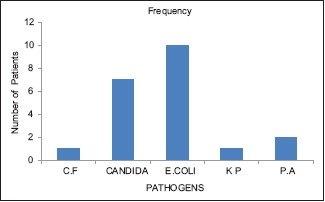
ASB was common among diabetics, as evident by a prevalence of 21%. Presence of ASB showed positive correlation with poor glycemic control. () was the most common organism causing ASB followed by , , , and isolated from study patients was most sensitive to imipenem and nitrofurantoin (NFT).
ASB is common among diabetics, with poor glycemic control being a significant risk factor. E. coli is the most common organism causing ASB in diabetics, and it is most sensitive to imipenem and NFT.
无症状菌尿(ASB)在新生儿、学龄前儿童、孕妇、老年人、糖尿病患者、留置导尿管患者以及尿路或肾脏疾病异常的患者中很常见。尽管目前对于不同人群中ASB的治疗尚无共识,但对于糖尿病(DM)患者建议进行治疗。
确定2型糖尿病患者中ASB的患病率,并研究导致ASB的尿路病原体谱及其抗生素敏感性特征。
这项前瞻性观察性研究在一家三级护理教学医院的内科进行。
对100例2型糖尿病患者进行研究。对所有人进行尿沉渣和革兰氏染色检查,以检测尿液中脓细胞和细菌的存在。对有显著菌尿的患者进行抗生素敏感性测试,以确定分离出的尿路病原体的敏感性特征。对数据进行分析,以确定糖尿病与ASB之间的关联。
ASB在糖尿病患者中很常见,患病率为21%,这一点很明显。ASB的存在与血糖控制不佳呈正相关。(此处原文括号内容缺失)是导致ASB最常见的病原体,其次是(此处原文缺失),从研究患者中分离出的(此处原文缺失)对亚胺培南和呋喃妥因(NFT)最敏感。
ASB在糖尿病患者中很常见,血糖控制不佳是一个重要的危险因素。大肠杆菌是糖尿病患者中导致ASB最常见的病原体,并且它对亚胺培南和NFT最敏感。