Section for Social Policy and Social Economy, Faculty of Social Sciences, Ruhr-University Bochum, Universitätsstr. 150, 44801 Bochum, Germany.
Department of International Health, Faculty of Health, Medicine and Life Sciences, Maastricht University, Duboidomein 30, 6229 CT Maastricht, The Netherlands.
Int J Environ Res Public Health. 2019 Apr 2;16(7):1178. doi: 10.3390/ijerph16071178.
The initial and intermediate-term access of refugees to healthcare in Germany is limited. A previous study showed that the obligation to request healthcare vouchers at the social security offices decreases the asylum seekers' consultation rate of ambulant physicians. The introduction of the Electronic Health Insurance Card (EHIC) for asylum seekers is considered skeptically by some municipalities and federal states, among other reasons due to the fear of an overuse of health care services by asylum seekers. The aim of this study is to further evaluate the data of the authors' initial study with a new focus on inpatient care as well as a differentiation of the ambulant consultation rate into general practitioners and outpatient specialists.
The now-differentiated consultation rate of the initial study as well as the asylum seekers' use of inpatient care are compared to the values of the sex- and age-corrected autochthonous population as given by the German Health Interview and Examination Survey for Adults (DEGS1). A mean difference test (student's t-test) is used for comparison and significance testing.
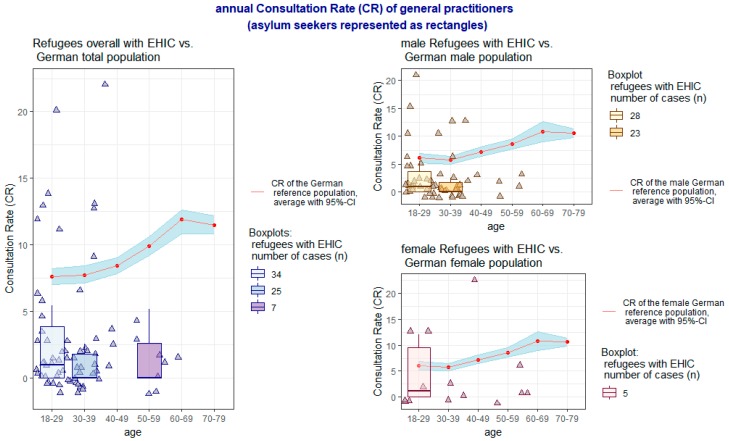
Asylum seekers who were in possession of the EHIC were significantly less likely to visit their ambulant general practitioners and specialists than the German autochthonous population. Simultaneously, this difference is partly compensated for by their more frequent use of impatient care.
There is no indication that the EHIC leads to an overuse of healthcare services.
难民在德国获得医疗保健的初始和中期机会有限。先前的一项研究表明,在社会保障办公室申请医疗券的义务降低了寻求庇护者咨询门诊医生的比例。一些市政府和联邦州对为寻求庇护者引入电子健康保险卡(EHIC)持怀疑态度,除其他原因外,还担心寻求庇护者过度使用医疗服务。本研究的目的是进一步评估作者最初研究的数据,重点关注住院治疗,并将门诊咨询率细分为全科医生和门诊专家。
将初始研究中现在区分的咨询率以及寻求庇护者的住院治疗使用情况与德国健康访谈和成人体检调查(DEGS1)中给出的性别和年龄校正的本地人口进行比较。使用均值差异检验(学生 t 检验)进行比较和显著性检验。
持有 EHIC 的寻求庇护者就诊于门诊全科医生和专家的频率明显低于德国本地人口。同时,这种差异部分被他们更频繁地使用急诊护理所弥补。
没有迹象表明 EHIC 导致医疗服务过度使用。