Cortellini Alessio, Cannita Katia, Parisi Alessandro, Lanfiuti Baldi Paola, Venditti Olga, D'Orazio Carla, Dal Mas Antonella, Calvisi Giuseppe, Giordano Aldo V, Vicentini Vincenzo, Vicentini Roberto, Felicioni Lara, Marchetti Antonio, Buttitta Fiamma, Russo Antonio, Ficorella Corrado
Medical Oncology, St Salvatore Hospital, University of L'Aquila, L'Aquila, Italy,
Department of Biotechnological and Applied Clinical Sciences, University of L'Aquila, L'Aquila, Italy,
Onco Targets Ther. 2019 Mar 25;12:2159-2170. doi: 10.2147/OTT.S194745. eCollection 2019.
Several trials evaluated the role of intensive regimens, made of triplet chemotherapies plus bevacizumab, as first-line treatment for patients with metastatic colorectal cancer (mCRC). We previously reported, in a Phase II prospective study, the efficacy and the tolerability of FIrB/FOx regimen, reporting interesting results in terms of received dose intensities (rDIs) and safety.
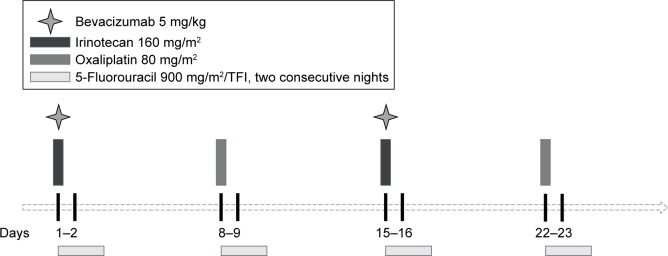
We reported a retrospective update of 85 patients treated with FIrB/FOx, an intensive regimen of 5-fluorouracil, bevacizumab, and weekly alternate irinotecan and oxaliplatin, to confirm its feasibility in "real life". Subgroup analyses were performed, particularly among patients treated with standard and modified FIrB/FOx (based on age, performance status, and/or comorbidities).
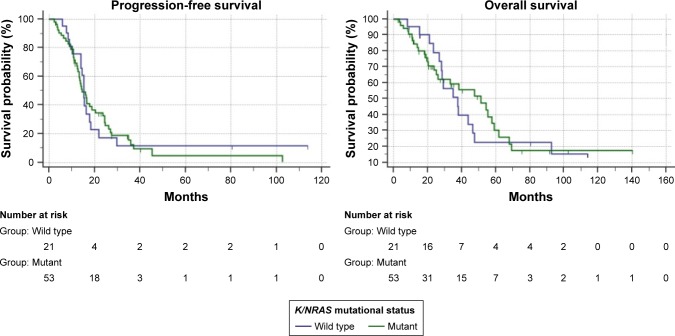
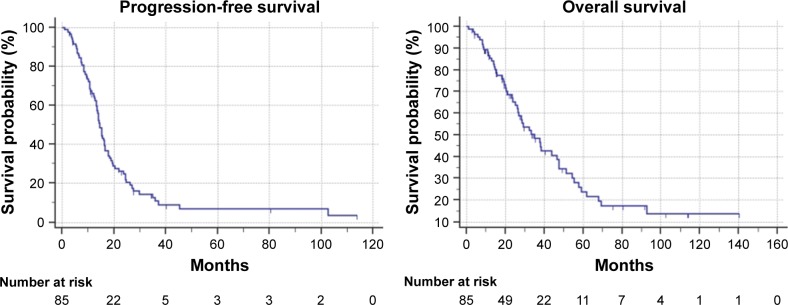
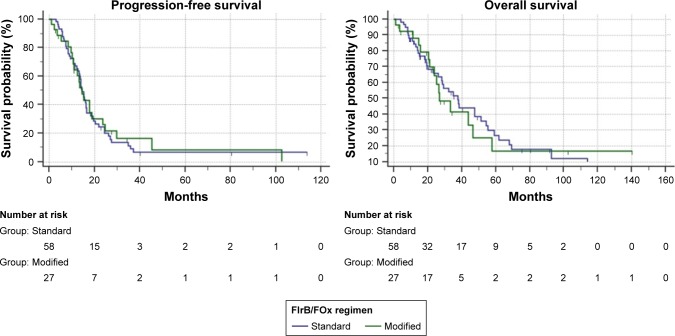
Overall, 3-month objective response rate (ORR) and 6-month ORR were 75.9% and 55.3%, respectively. Median progression-free survival (PFS) and median overall survival (OS) were 14.4 and 34.9 months, respectively. Among the patients treated with standard and modified regimens, 3-month ORR, PFS, and OS were 75.8% and 76% (=1.0000), 14.4 and 14.4 months (=0.8589), and 37.8 and 26.6 months (=0.7746), respectively. Among the wild-type and mutant patients, 3-month ORR, PFS, and OS were 95.2% and 74.5% (=0.0526), 15.3 and 14.4 months (=0.8753), and 37.8 and 51.4 months (=0.8527), respectively. The rDIs were ≥80% of full doses both in the standard and in the modified regimens subgroups. Cumulative G3/4 toxicities were neutropenia (14.1%), diarrhea (17.6%), asthenia (9.4%), vomiting (5.6%), and hypertension (16.5%).
This update shows that intensive regimens such as FIrB/FOx are also feasible options for first-line treatment of mCRC patients in the "real-life" setting.
多项试验评估了由三联化疗加贝伐单抗组成的强化方案作为转移性结直肠癌(mCRC)患者一线治疗的作用。我们之前在一项II期前瞻性研究中报告了FIrB/FOx方案的疗效和耐受性,在接受剂量强度(rDIs)和安全性方面报告了有趣的结果。
我们报告了对85例接受FIrB/FOx治疗患者的回顾性更新,FIrB/FOx是一种由5-氟尿嘧啶、贝伐单抗以及每周交替使用伊立替康和奥沙利铂组成的强化方案,以确认其在“现实生活”中的可行性。进行了亚组分析,特别是在接受标准和改良FIrB/FOx治疗的患者中(基于年龄、体能状态和/或合并症)。
总体而言,3个月客观缓解率(ORR)和6个月ORR分别为75.9%和55.3%。中位无进展生存期(PFS)和中位总生存期(OS)分别为14.4个月和34.9个月。在接受标准和改良方案治疗的患者中,3个月ORR、PFS和OS分别为75.8%和76%(=1.0000)、14.4个月和14.4个月(=0.8589)以及37.8个月和26.6个月(=0.7746)。在野生型和突变型患者中,3个月ORR、PFS和OS分别为95.2%和74.5%(=0.0526)、15.3个月和14.4个月(=0.8753)以及37.8个月和51.4个月(=0.8527)。标准和改良方案亚组中的rDIs均≥全剂量的80%。累积3/4级毒性包括中性粒细胞减少(14.1%)、腹泻(17.6%)、乏力(9.4%)、呕吐(5.6%)和高血压(16.5%)。
本次更新表明,如FIrB/FOx等强化方案在“现实生活”环境中也是mCRC患者一线治疗的可行选择。