Parisi Alessandro, Porzio Giampiero, Pulcini Fanny, Cannita Katia, Ficorella Corrado, Mattei Vincenzo, Delle Monache Simona
Department of Life, Health and Environmental Sciences, University of L'Aquila, 67100 L'Aquila, Italy.
Medical Oncology Unit, St. Salvatore Hospital, 67100 L'Aquila, Italy.
Biomedicines. 2021 Feb 1;9(2):140. doi: 10.3390/biomedicines9020140.
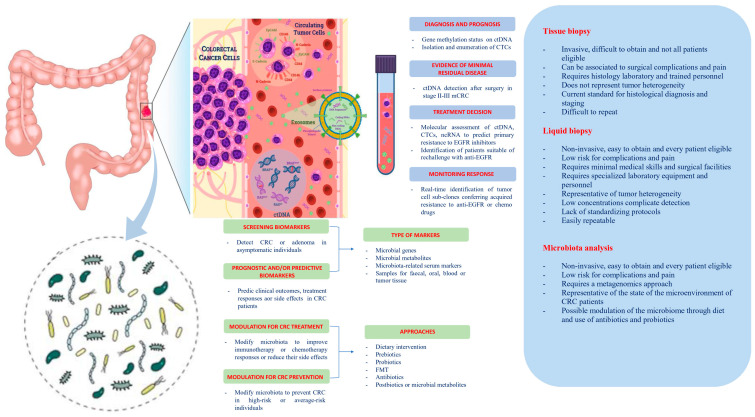
Despite the paradigmatic shift occurred in recent years for defined molecular subtypes in the metastatic setting treatment, colorectal cancer (CRC) still remains an incurable disease in most of the cases. Therefore, there is an urgent need for new tools and biomarkers for both early tumor diagnosis and to improve personalized treatment. Thus, liquid biopsy has emerged as a minimally invasive tool that is capable of detecting genomic alterations from primary or metastatic tumors, allowing the prognostic stratification of patients, the detection of the minimal residual disease after surgical or systemic treatments, the monitoring of therapeutic response, and the development of resistance, establishing an opportunity for early intervention before imaging detection or worsening of clinical symptoms. On the other hand, preclinical and clinical evidence demonstrated the role of gut microbiota dysbiosis in promoting inflammatory responses and cancer initiation. Altered gut microbiota is associated with resistance to chemo drugs and immune checkpoint inhibitors, whereas the use of microbe-targeted therapies including antibiotics, pre-probiotics, and fecal microbiota transplantation can restore response to anticancer drugs, promote immune response, and therefore support current treatment strategies in CRC. In this review, we aim to summarize preclinical and clinical evidence for the utilization of liquid biopsy and gut microbiota in CRC.
尽管近年来转移性结直肠癌的治疗已从定义分子亚型发生了范式转变,但在大多数情况下,结直肠癌(CRC)仍然是一种无法治愈的疾病。因此,迫切需要新的工具和生物标志物用于早期肿瘤诊断并改善个性化治疗。于是,液体活检应运而生,它是一种微创工具,能够检测原发性或转移性肿瘤的基因组改变,实现患者的预后分层、手术或全身治疗后微小残留病的检测、治疗反应监测以及耐药性监测,为在影像学检测到病变或临床症状恶化之前进行早期干预创造机会。另一方面,临床前和临床证据表明肠道微生物群失调在促进炎症反应和癌症发生方面发挥着作用。肠道微生物群改变与对化疗药物和免疫检查点抑制剂的耐药性有关,而使用包括抗生素、益生元、益生菌和粪便微生物群移植在内的微生物靶向疗法可恢复对抗癌药物的反应,促进免疫反应,从而支持当前CRC的治疗策略。在本综述中,我们旨在总结CRC中使用液体活检和肠道微生物群的临床前和临床证据。