Institut de Biologie Structurale, Université Grenoble Alpes-CEA-CNRS, Grenoble, France.
Institute of Complex Systems (ICS), ICS-6: Structural Biochemistry, Research Centre Juelich, Juelich, Germany.
Sci Adv. 2019 Apr 10;5(4):eaav2671. doi: 10.1126/sciadv.aav2671. eCollection 2019 Apr.
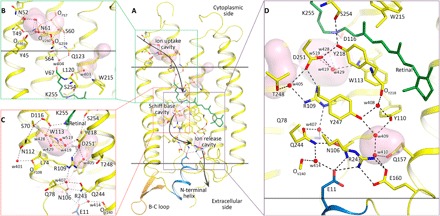
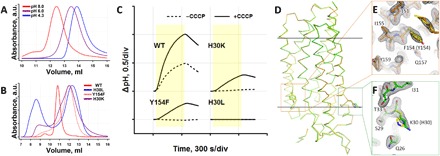
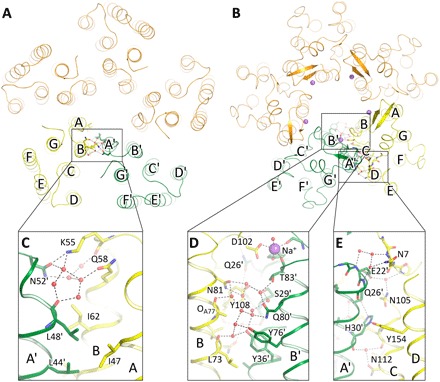
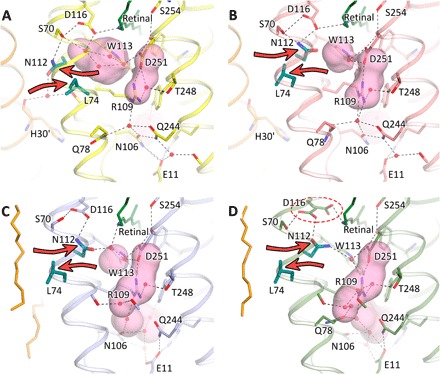
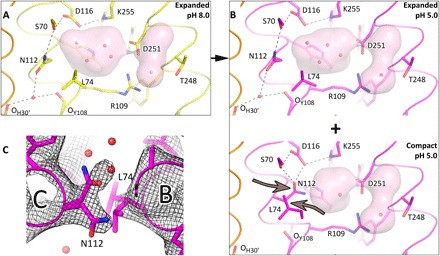
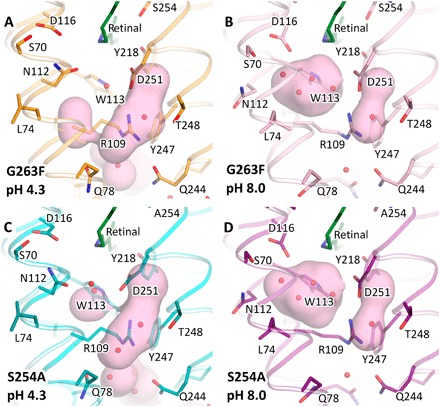
Rhodopsins are the most universal biological light-energy transducers and abundant phototrophic mechanisms that evolved on Earth and have a remarkable diversity and potential for biotechnological applications. Recently, the first sodium-pumping rhodopsin KR2 from was discovered and characterized. However, the existing structures of KR2 are contradictory, and the mechanism of Na pumping is not yet understood. Here, we present a structure of the cationic (non H) light-driven pump at physiological pH in its pentameric form. We also present 13 atomic structures and functional data on the KR2 and its mutants, including potassium pumps, which show that oligomerization of the microbial rhodopsin is obligatory for its biological function. The studies reveal the structure of KR2 at nonphysiological low pH where it acts as a proton pump. The structure provides new insights into the mechanisms of microbial rhodopsins and opens the way to a rational design of novel cation pumps for optogenetics.
视紫红质是最普遍的生物光能转换器和丰富的光能合成机制,它们在地球上进化而来,具有显著的多样性和生物技术应用的潜力。最近,从 中发现并表征了第一个钠离子泵浦视紫红质 KR2。然而,KR2 的现有结构存在矛盾,Na 泵的机制尚不清楚。在这里,我们展示了在生理 pH 值下以五聚体形式存在的阳离子(非 H)光驱动泵的结构。我们还展示了 KR2 及其突变体的 13 个原子结构和功能数据,包括钾泵,这些数据表明微生物视紫红质的寡聚化对于其生物学功能是必需的。这些研究揭示了 KR2 在非生理低 pH 值下作为质子泵的结构。该结构为微生物视紫红质的机制提供了新的见解,并为光遗传学中新型阳离子泵的合理设计开辟了道路。