Assistance Publique-Hôpitaux de Marseille (AP-HM), Marseille, France.
Hôpital Européen Marseille, Marseille, France.
PLoS Negl Trop Dis. 2019 Apr 16;13(4):e0007263. doi: 10.1371/journal.pntd.0007263. eCollection 2019 Apr.
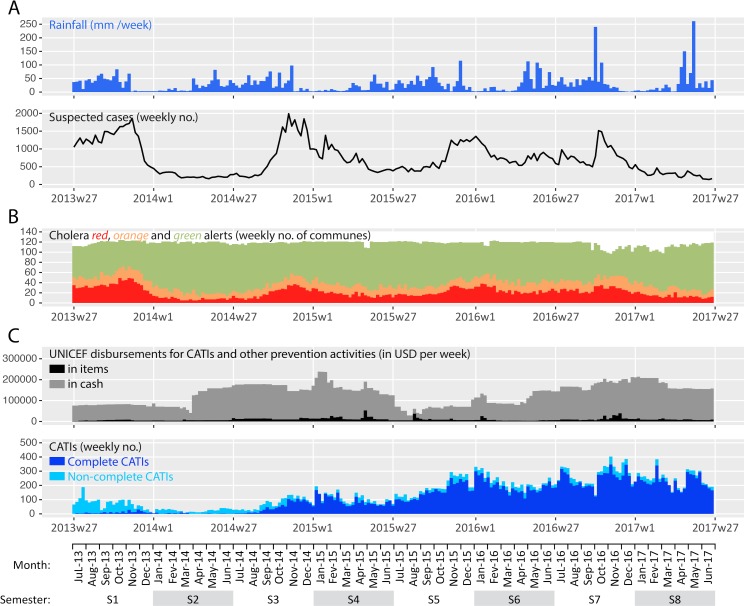
In October 2010, Haiti was struck by a large-scale cholera epidemic. The Haitian government, UNICEF and other international partners launched an unprecedented nationwide alert-response strategy in July 2013. Coordinated NGOs recruited local rapid response mobile teams to conduct case-area targeted interventions (CATIs), including education sessions, household decontamination by chlorine spraying, and distribution of chlorine tablets. An innovative red-orange-green alert system was also established to monitor the epidemic at the communal scale on a weekly basis. Our study aimed to describe and evaluate the exhaustiveness, intensity and quality of the CATIs in response to cholera alerts in Haiti between July 2013 and June 2017.
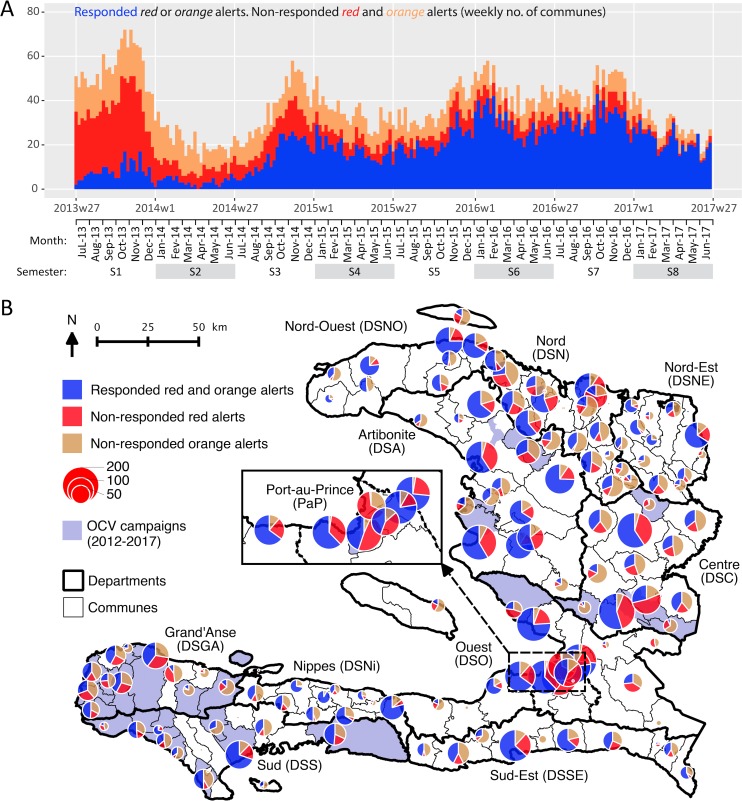
METHODOLOGY/PRINCIPAL FINDINGS: We analyzed the response to 7,856 weekly cholera alerts using routine surveillance data and severity criteria, which was based on the details of 31,306 notified CATIs. The odds of CATI response during the same week (exhaustiveness) and the number of complete CATIs in responded alerts (intensity and quality) were estimated using multivariate generalized linear mixed models and several covariates. CATIs were carried out significantly more often in response to red alerts (adjusted odds ratio (aOR) [95%-confidence interval, 95%-CI], 2.52 [2.22-2.87]) compared with orange alerts. Significantly more complete CATIs were carried out in response to red alerts compared with orange alerts (adjusted incidence ratio (aIR), 1.85 [1.73-1.99]). Over the course of the eight-semester study, we observed a significant improvement in the exhaustiveness (aOR, 1.43 [1.38-1.48] per semester) as well as the intensity and quality (aIR, 1.23 [1.2-1.25] per semester) of CATI responses, independently of funds available for the strategy. The odds of launching a CATI response significantly decreased with increased rainfall (aOR, 0.99 [0.97-1] per each accumulated cm). Response interventions were significantly heterogeneous between NGOs, communes and departments.
CONCLUSIONS/SIGNIFICANCE: The implementation of a nationwide case-area targeted rapid response strategy to control cholera in Haiti was feasible albeit with certain obstacles. Such feedback from the field and ongoing impact studies will be very informative for actors and international donors involved in cholera control and elimination in Haiti and in other affected countries.
2010 年 10 月,海地爆发了大规模霍乱疫情。海地政府、儿基会和其他国际合作伙伴于 2013 年 7 月启动了一项前所未有的全国范围预警应对策略。协调的非政府组织招募了当地快速反应机动队,在霍乱警报地区开展针对性干预行动,包括教育课程、家庭氯消毒和氯片剂发放。还建立了一个创新的红-橙-绿预警系统,每周在社区层面监测疫情。我们的研究旨在描述和评估 2013 年 7 月至 2017 年 6 月期间海地对霍乱警报的针对性干预行动的全面性、强度和质量。
方法/主要发现:我们使用常规监测数据和严重程度标准分析了对 7856 次每周霍乱警报的应对情况,这些标准基于 31306 次通知的针对性干预行动的详细信息。使用多变量广义线性混合模型和多个协变量估计同一周内进行针对性干预行动的可能性(全面性)和对警报作出回应的完成针对性干预行动的次数(强度和质量)。与橙色警报相比,红色警报的针对性干预行动更为频繁(调整后的比值比(aOR)[95%置信区间,95%-CI],2.52 [2.22-2.87])。与橙色警报相比,红色警报的完成针对性干预行动的次数明显更多(调整后的发病率比(aIR),1.85 [1.73-1.99])。在为期 8 个学期的研究过程中,我们观察到针对性干预行动的全面性(每学期 aOR,1.43 [1.38-1.48])以及强度和质量(每学期 aIR,1.23 [1.2-1.25])均有显著提高,这与应对策略的可用资金无关。开展针对性干预行动的可能性随着降雨量的增加而显著降低(每次累计增加 1 厘米,aOR,0.99 [0.97-1])。非政府组织、社区和部门之间的干预措施存在显著差异。
结论/意义:在海地实施全国性的针对霍乱疫情的案例地区快速应对策略是可行的,尽管存在一定障碍。来自实地的这种反馈和正在进行的影响研究将为参与海地和其他受影响国家的霍乱控制和消除工作的行动者和国际捐助者提供非常有价值的信息。