1 Centre for Ecological and Evolutionary Synthesis (CEES), Department of Biosciences, University of Oslo , Oslo , Norway.
3 Department of Biomedical and Specialty Surgical Sciences, University of Ferrara , Ferrara , Italy.
Proc Biol Sci. 2019 Apr 24;286(1901):20182429. doi: 10.1098/rspb.2018.2429.
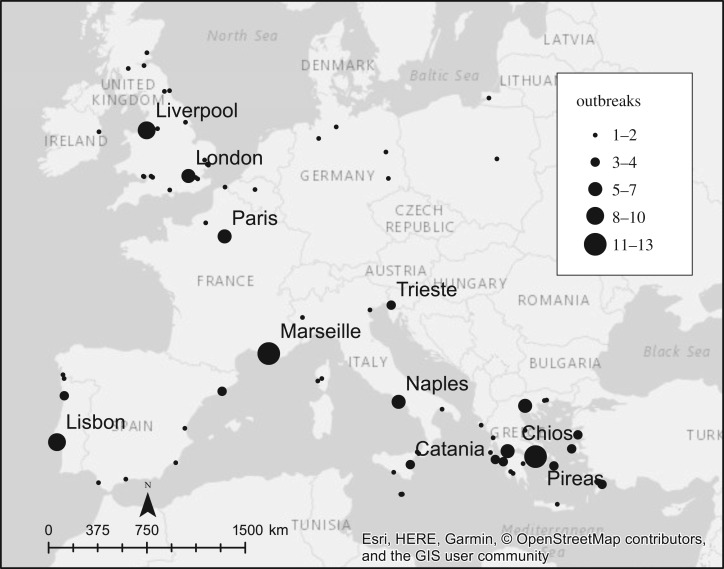
Plague has a long history on the European continent, with evidence of the disease dating back to the Stone Age. Plague epidemics in Europe during the First and Second Pandemics, including the Black Death, are infamous for their widespread mortality and lasting social and economic impact. Yet, Europe still experienced plague outbreaks during the Third Pandemic, which began in China and spread globally at the end of the nineteenth century. The digitization of international records of notifiable diseases, including plague, has enabled us to retrace the introductions of the disease to Europe from the earliest reported cases in 1899, to its disappearance in the 1940s. Using supplemental literature, we summarize the potential sources of plague in Europe and the transmission of the disease, including the role of rats. Finally, we discuss the international efforts aimed at prevention and intervention measures, namely improved hygiene and sanitation, that ultimately led to the disappearance of plague in Europe.
欧洲大陆有着悠久的瘟疫历史,早在石器时代就有这种疾病的证据。第一次和第二次大流行期间,欧洲的鼠疫流行,包括黑死病,因其广泛的死亡率和持久的社会经济影响而臭名昭著。然而,欧洲在第三次大流行期间仍爆发了鼠疫,这次大流行始于中国,并于 19 世纪末在全球范围内蔓延。包括鼠疫在内的国际传染病报告记录的数字化,使我们能够从 1899 年最早报告的病例追溯到该病传入欧洲的情况,直到它在 20 世纪 40 年代消失。利用补充文献,我们总结了欧洲鼠疫的潜在来源和疾病传播途径,包括老鼠的作用。最后,我们讨论了旨在预防和干预措施的国际努力,即改善卫生和环境卫生,这最终导致了欧洲鼠疫的消失。