Bennasar-Figueras Antoni
Microbiologia-Departament de Biologia, Universitat de les Illes Balears (UIB), Campus UIB, Carretera de Valldemossa, Km 7.5, 07122 Palma de Mallorca, Spain.
Facultat de Medicina, Hospital Universitari Son Espases (HUSE), Universitat de les Illes Balears (UIB), Carretera de Valldemossa, 79, 07122 Palma de Mallorca, Spain.
Microorganisms. 2024 Jan 11;12(1):146. doi: 10.3390/microorganisms12010146.
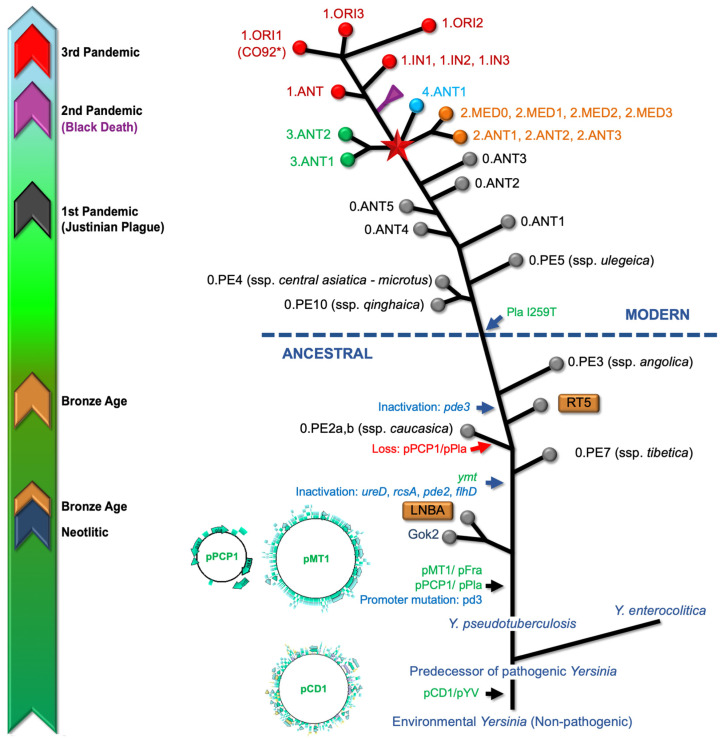
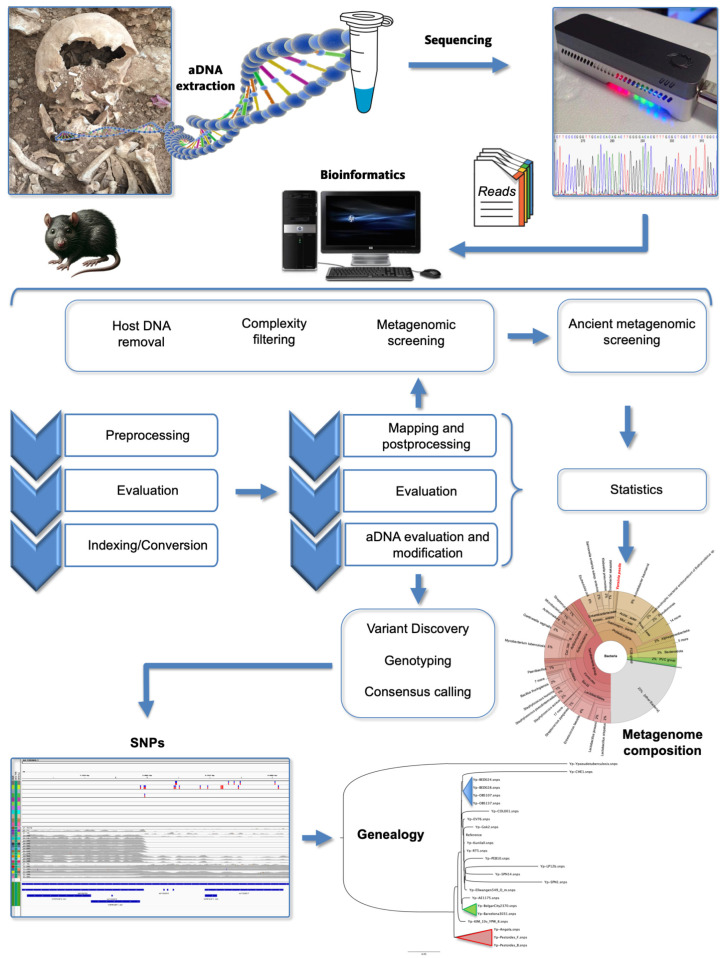
The human pathogen is responsible for bubonic, septicemic, and pneumonic plague. A deeply comprehensive overview of its historical context, bacteriological characteristics, genomic analysis based on ancient DNA (aDNA) and modern strains, and its impact on historical and actual human populations, is explored. The results from multiple studies have been synthesized to investigate the origins of plague, its transmission, and effects on different populations. Additionally, molecular interactions of , from its evolutionary origins to its adaptation to flea-born transmission, and its impact on human and wild populations are considered. The characteristic combinations of aDNA patterns, which plays a decisive role in the reconstruction and analysis of ancient genomes, are reviewed. Bioinformatics is fundamental in identifying specific lineages, and automated pipelines are among the valuable tools in implementing such studies. Plague, which remains among human history's most lethal infectious diseases, but also other zoonotic diseases, requires the continuous investigation of plague topics. This can be achieved by improving molecular and genetic screening of animal populations, identifying ecological and social determinants of outbreaks, increasing interdisciplinary collaborations among scientists and public healthcare providers, and continued research into the characterization, diagnosis, and treatment of these diseases.
这种人类病原体可引发腺鼠疫、败血性鼠疫和肺鼠疫。本文对其历史背景、细菌学特征、基于古代DNA(aDNA)和现代菌株的基因组分析,以及它对历史和现实人类群体的影响进行了深入全面的概述。综合了多项研究的结果,以探究鼠疫的起源、传播及其对不同人群的影响。此外,还考虑了该病原体从进化起源到适应跳蚤传播的分子相互作用,以及它对人类和野生种群的影响。回顾了在古代基因组的重建和分析中起决定性作用的aDNA模式的特征组合。生物信息学对于识别特定的病原体谱系至关重要,自动化流程是开展此类研究的宝贵工具之一。鼠疫仍是人类历史上最致命的传染病之一,其他人畜共患疾病也是如此,因此需要持续对鼠疫相关课题进行研究。这可以通过改进对动物种群的分子和基因筛查、确定疫情爆发的生态和社会决定因素、加强科学家与公共卫生保健提供者之间的跨学科合作,以及继续研究这些疾病的特征、诊断和治疗来实现。