Centre for Ecological and Evolutionary Synthesis (CEES), Department of Biosciences, University of Oslo, N-0316 Oslo, Norway;
Centre for Ecological and Evolutionary Synthesis (CEES), Department of Biosciences, University of Oslo, N-0316 Oslo, Norway.
Proc Natl Acad Sci U S A. 2018 Dec 11;115(50):E11790-E11797. doi: 10.1073/pnas.1812865115. Epub 2018 Nov 26.
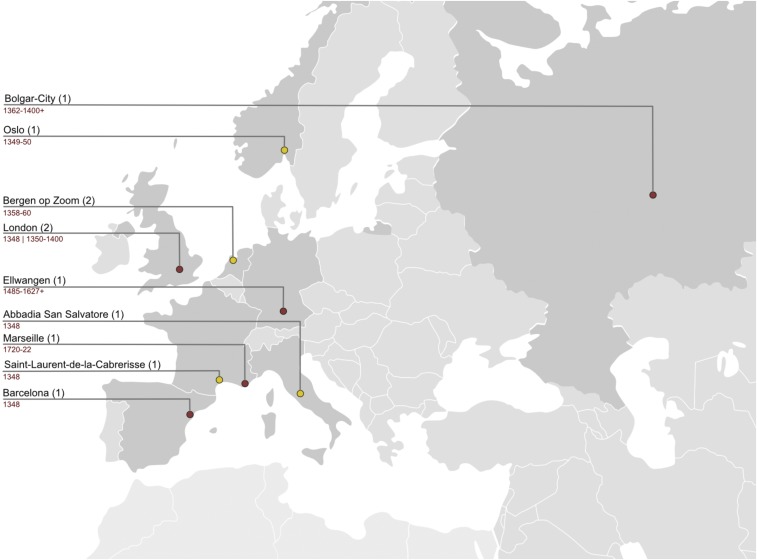
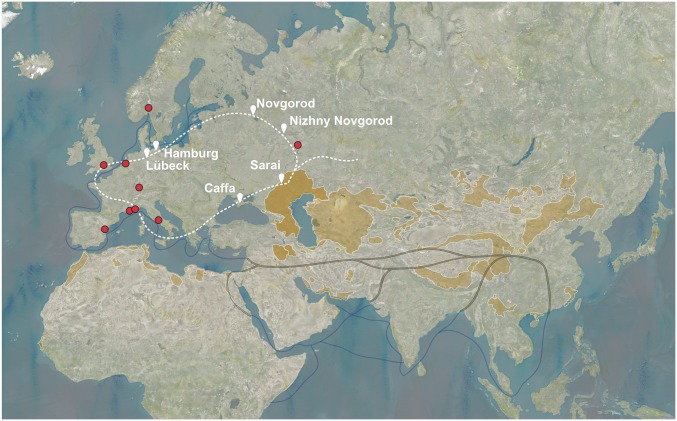
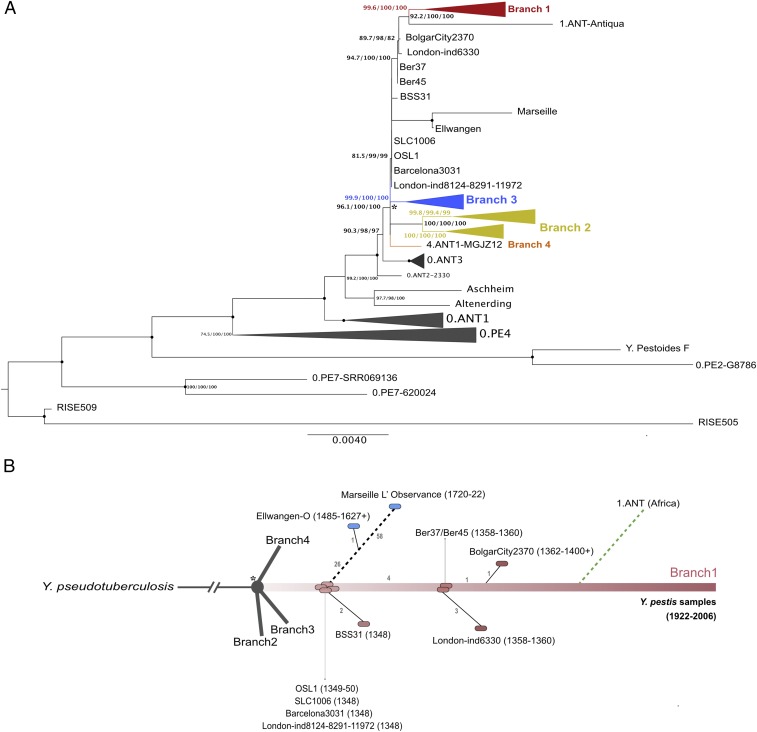
Over the last few years, genomic studies on , the causative agent of all known plague epidemics, have considerably increased in numbers, spanning a period of about 5,000 y. Nonetheless, questions concerning historical reservoirs and routes of transmission remain open. Here, we present and describe five genomes from the second half of the 14th century and reconstruct the evolutionary history of by reanalyzing previously published genomes and by building a comprehensive phylogeny focused on strains attributed to the Second Plague Pandemic (14th to 18th century). Corroborated by historical and ecological evidence, the presented phylogeny, which includes our genomes, could support the hypothesis of an entry of plague into Western European ports through distinct waves of introduction during the Medieval Period, possibly by means of fur trade routes, as well as the recirculation of plague within the human population via trade routes and human movement.
在过去的几年中,针对所有已知鼠疫流行的病原体 开展的基因组研究数量显著增加,跨度约为 5000 年。尽管如此,有关历史宿主和传播途径的问题仍未得到解答。在这里,我们展示并描述了五个来自 14 世纪下半叶的基因组,并通过重新分析先前发表的基因组和构建一个侧重于归因于第二次鼠疫大流行(14 至 18 世纪)的菌株的综合系统发育树,重建了 的进化史。通过历史和生态证据证实,该系统发育树(包括我们的五个基因组)可以支持鼠疫通过中世纪时期的多次传入浪潮进入西欧港口的假说,这可能是通过皮毛贸易路线,以及通过贸易路线和人类活动在人类群体中循环传播鼠疫。