Clinic for Internal Medicine I, Martin-Luther University Halle/Wittenberg, Ernst-Grube-Straße 40, 06120, Halle, Germany.
Department of Gastroenterology and Endocrinology, University Hospital Marburg, Baldinger Strasse, 35043, Marburg, Germany.
BMC Cancer. 2019 Apr 16;19(1):362. doi: 10.1186/s12885-019-5559-7.
Brain metastases (BM) are rarely reported in patients with neuroendocrine carcinoma (NEC) of non-lung origin and neuroendocrine tumors (NET) of the gastroenteropancreatic (GEP) or bronchopulmonary system. However, symptomatic brain metastases are associated with dismal prognosis, so early detection and treatment could be advisable.
We retrospectively analyzed 51 patients with GEP-NEN and bronchopulmonary NEN excluding small cell lung cancer. All patients were treated at the University Hospital Marburg and Halle (Saale) between 2000 and 2017. The median overall survival (mOS) and mOS after diagnosis of brain metastases (BM) were calculated using Kaplan-Meier analysis. Risk factors for poor prognosis were evaluated using univariate and multivariate Cox regression method.
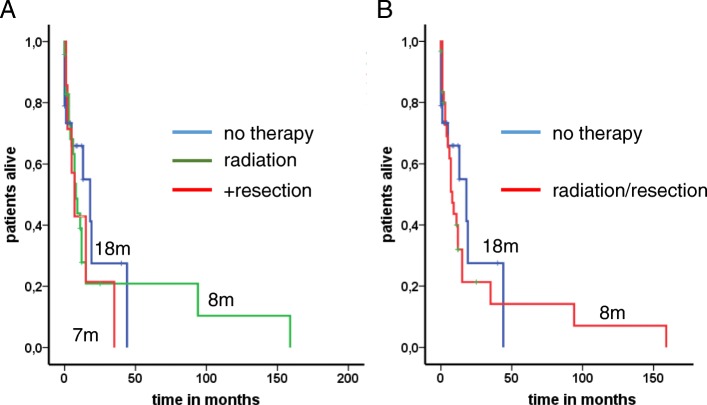
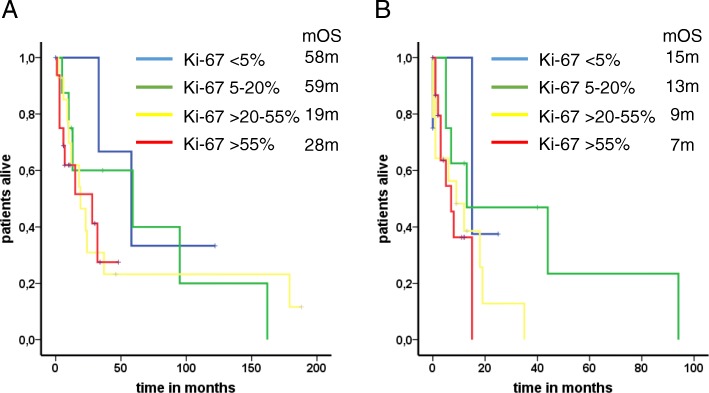
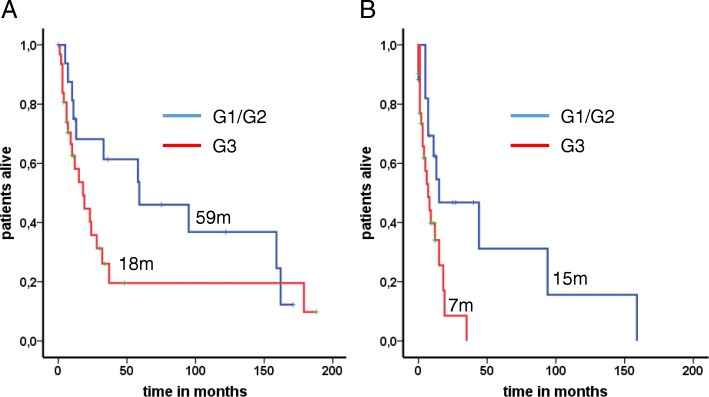
Overall, 51 patients with a median age of 58 years presented BM. Lung (n = 23, 45.1%) was the most frequent primary localization. Most patients had NEC (n = 31, 60.8%), including 26 carcinomas (51%) with Ki-67 indices > 55%. Singular BM were present in 16 patients (31.4%), but 21 patients (41.2%) had multiple lesions. Overall, the median period from first diagnosis of the tumor disease up to diagnosis of brain metastasis was 5.0 months. Palliative radiation was the most common therapy (n = 31, 60.8%). Median OS after initial diagnosis and diagnosis of BM was 23.0 and 11.0 months, respectively. Univariate and multivariate analysis for prognostic indicators depicted differentiation (NEC HR 4.2, 95% CI 1.1-16.1) and age (≥60 HR 3.0, 95% CI 1.2-7.5) as markers for poor outcome.
Overall, the risk for symptomatic brain metastases is low in GEP-NEN and bronchopulmonary NEN patients. Age above 60 and poor tumor differentiation may deteriorate the overall survival. Therefore, screening for brain metastases could be advisable in NEC patients.
脑转移(BM)在非肺部起源的神经内分泌癌(NEC)和胃肠胰(GEP)或支气管肺系统的神经内分泌肿瘤(NET)患者中很少见。然而,有症状的脑转移与预后不良相关,因此早期检测和治疗可能是明智的。
我们回顾性分析了 2000 年至 2017 年间在马尔堡大学医院和哈勒(萨尔)治疗的 51 例 GEP-NEN 和支气管肺 NEN 患者,不包括小细胞肺癌。使用 Kaplan-Meier 分析计算中位总生存期(mOS)和脑转移(BM)诊断后的 mOS。使用单因素和多因素 Cox 回归方法评估预后不良的危险因素。
总体而言,51 例中位年龄为 58 岁的患者出现 BM。肺(n=23,45.1%)是最常见的原发部位。大多数患者为 NEC(n=31,60.8%),包括 26 例 Ki-67 指数>55%的癌(51%)。16 例患者(31.4%)存在单发 BM,但 21 例(41.2%)存在多发病变。总体而言,从肿瘤疾病首次诊断到诊断脑转移的中位时间为 5.0 个月。姑息性放疗是最常见的治疗方法(n=31,60.8%)。初始诊断后和 BM 诊断后的中位 OS 分别为 23.0 和 11.0 个月。单因素和多因素分析显示,分化(NEC HR 4.2,95%CI 1.1-16.1)和年龄(≥60 HR 3.0,95%CI 1.2-7.5)是预后不良的标志。
总体而言,GEP-NEN 和支气管肺 NEN 患者发生有症状脑转移的风险较低。年龄>60 岁和肿瘤分化不良可能会降低总体生存率。因此,在 NEC 患者中筛查脑转移可能是明智的。