Triki Zegni, Bshary Redouan
Institute of Biology, University of Neuchâtel, Neuchâtel, NE, Switzerland.
PeerJ. 2019 Apr 8;7:e6720. doi: 10.7717/peerj.6720. eCollection 2019.
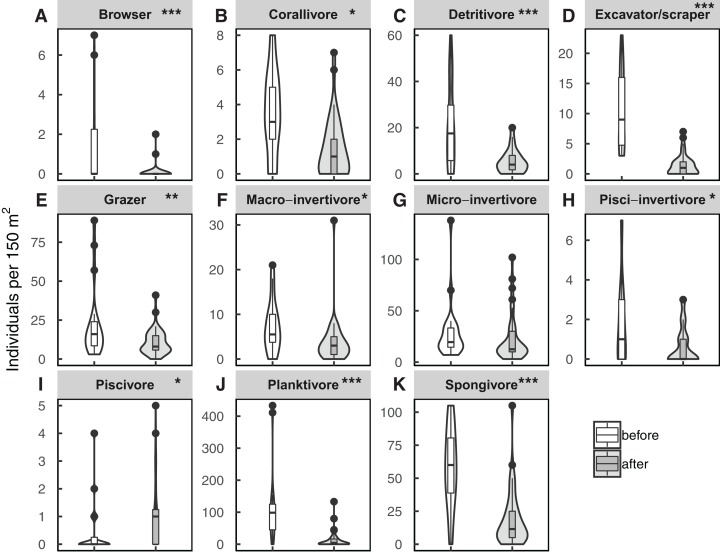
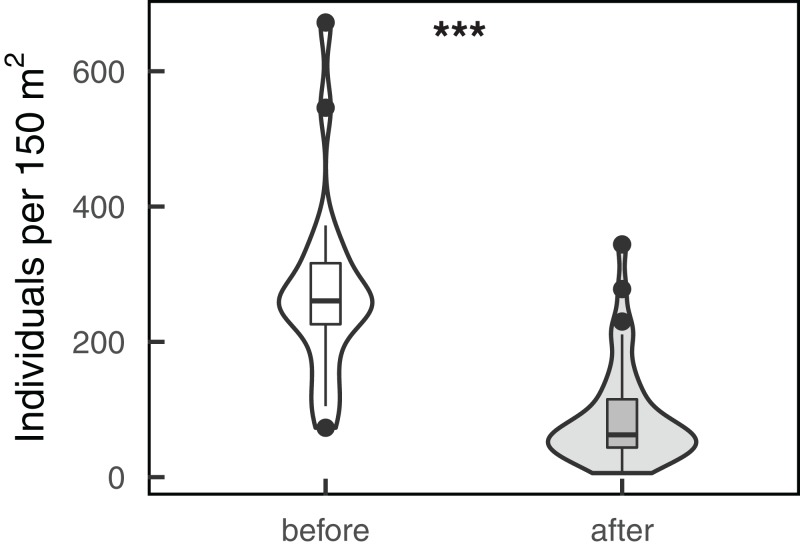
Global warming is predicted to increase the frequency and or severity of many disturbances including cyclones, storms, and prolonged heatwaves. The coral reef at Lizard Island, part of the Great Barrier Reef, has been recently exposed to a sequence of severe tropical cyclones (i.e., Ita in 2014 and Nathan in 2015) and a coral bleaching in the year 2016. Reef fishes are an essential part of the coral reef ecosystem, and their abundance is thus a good marker to estimate the magnitude of such disturbances. Here, we examined whether the recent disturbances at Lizard Island had an impact on the coral reef fish communities. To do this, we examined fish survey data collected before and after the disturbances for potential changes in total fish density post-disturbance. Also, by sorting fish species into 11 functional groups based on their trophic level (i.e., diet), we further explored the density changes within each functional group. Our findings showed an overall decline of 68% in fish density post-disturbance, with a significant density decrease in nine of 11 trophic groups. These nine groups were: browsers, corallivores, detritivores, excavator/scrapers, grazers, macro-invertivores, pisci-invertivores, planktivores, and spongivores. The piscivores, on the other hand, were the only "winners," wherein their density showed an increase post-disturbance. These changes within functional groups might have a further impact on the trophodynamics of the food web. In summary, our findings provide evidence that the fish assemblage on the reefs around Lizard Island was considerably affected by extreme weather events, leading to changes in the functional composition of the reef fish assemblage.
据预测,全球变暖将增加包括气旋、风暴和长期热浪在内的许多干扰的频率和/或强度。蜥蜴岛的珊瑚礁是大堡礁的一部分,最近遭受了一系列严重的热带气旋(即2014年的伊塔气旋和2015年的内森气旋)以及2016年的一次珊瑚白化事件。珊瑚礁鱼类是珊瑚礁生态系统的重要组成部分,因此它们的数量是估计此类干扰程度的良好指标。在此,我们研究了蜥蜴岛最近的干扰是否对珊瑚礁鱼类群落产生了影响。为此,我们检查了干扰前后收集的鱼类调查数据,以了解干扰后鱼类总密度的潜在变化。此外,通过根据鱼类的营养级(即饮食)将其分为11个功能组,我们进一步探索了每个功能组内的密度变化。我们的研究结果表明,干扰后鱼类密度总体下降了68%,11个营养组中有9个组的密度显著下降。这9个组分别是:食草动物、食珊瑚动物、碎屑食性动物、挖掘/刮食动物、食草动物、大型无脊椎动物捕食者、鱼类无脊椎动物捕食者、浮游生物捕食者和食海绵动物。另一方面,食鱼动物是唯一的“赢家”,其密度在干扰后有所增加。功能组内的这些变化可能会对食物网的营养动力学产生进一步影响。总之,我们的研究结果提供了证据,表明蜥蜴岛周围珊瑚礁上的鱼类群落受到极端天气事件的显著影响,导致珊瑚礁鱼类群落的功能组成发生变化。