Savrasova Ekaterina A, Stoynova Nataliya V
Ajinomoto-Genetika Research Institute, Moscow, 117545 Russia.
Heliyon. 2019 Apr 4;5(4):e01406. doi: 10.1016/j.heliyon.2019.e01406. eCollection 2019 Apr.
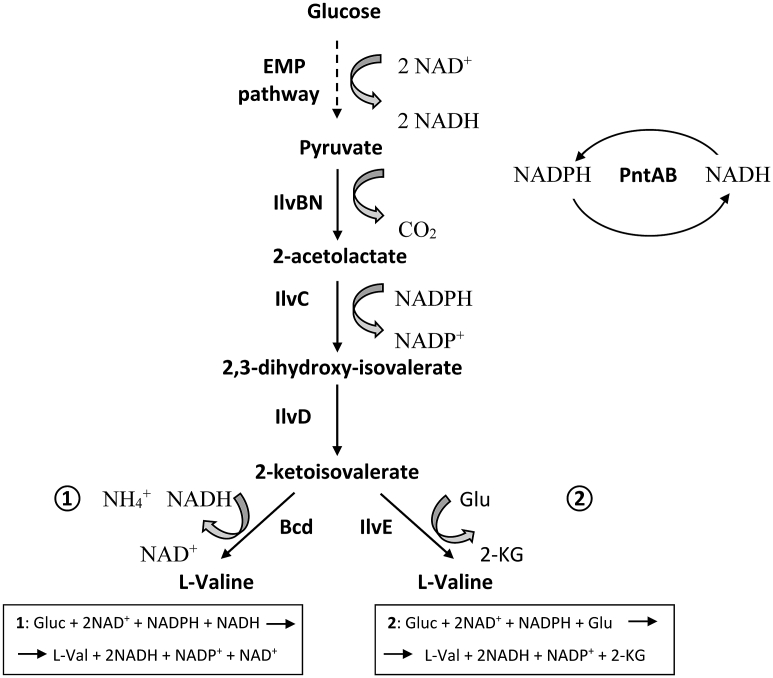
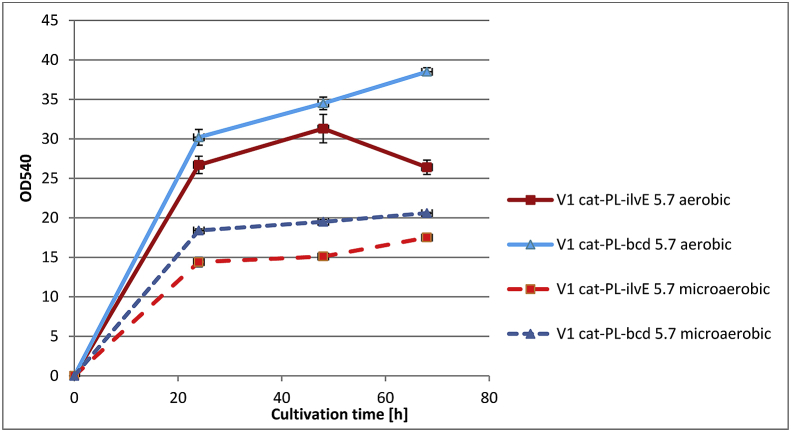
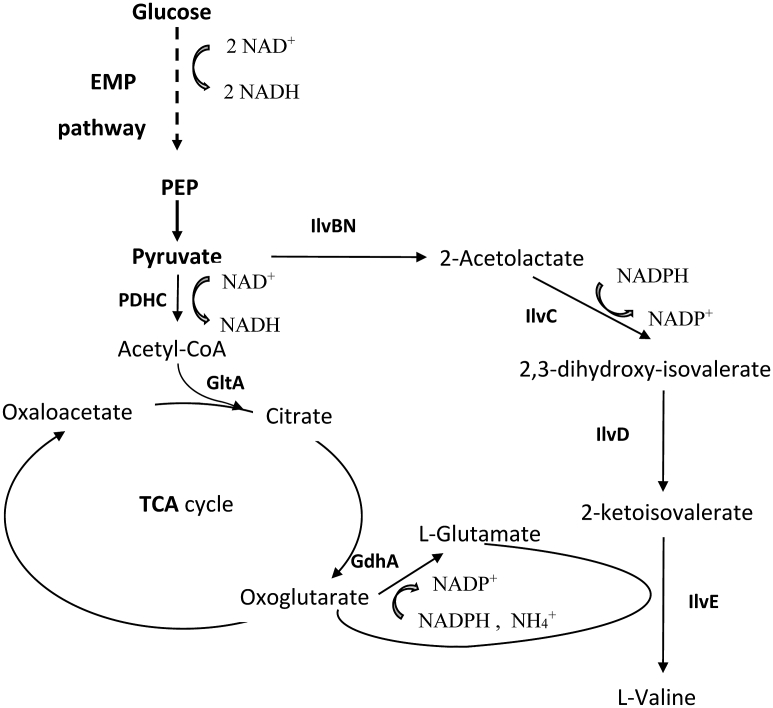
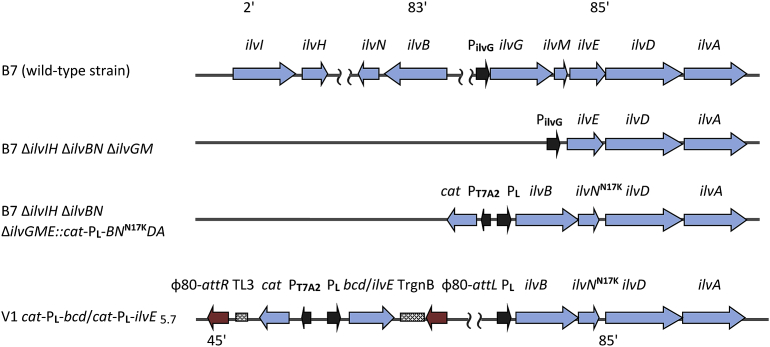
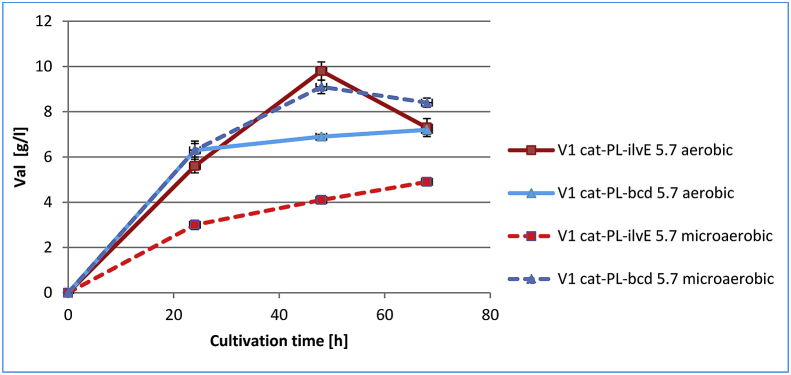
Microaerobic cultivation conditions have been shown experimentally and theoretically to improve the performance of a number of bioproduction systems. However, under these conditions, the production of l-valine by is decreased mainly because of a redox cofactor imbalance and a decreased l-glutamate supply. The synthesis of one mole of l-valine from one mole of glucose generates two moles of NADH via glycolysis but consumes a total of two moles of NADPH, one in the ketol-acid reductoisomerase (KARI) reaction and the other in the regeneration of l-glutamate as an amino group donor for the branched-chain amino acid aminotransferase (BCAT) reaction. The improvement of l-valine synthesis under oxygen deprivation may be due to solving these problems. Increased l-valine synthesis under oxygen deprivation conditions was previously shown in (Hasegawa et al., 2012). In this study, we have proposed the use of NADH-dependent leucine dehydrogenase (LeuDH; EC 1.4.1.9) Bcd from instead of the native NADPH-dependent pathway including aminotransferase encoded by to improve l-valine production in under microaerobic conditions. We have created l-valine-producing strains on the base of the aminotransferase B-deficient strain V1 (B-7 Δ Δ Δ:P ) by introducing one chromosomal copy of the gene or the gene. Evaluation of the l-valine production by the obtained strains under microaerobic and aerobic conditions revealed that leucine dehydrogenase Bcd had a higher potential for l-valine production under microaerobic conditions. The Bcd-possessing strain exhibited 2.2-fold higher l-valine accumulation (up to 9.1 g/L) and 2.0-fold higher yield (up to 35.3%) under microaerobic conditions than the IlvEpossessing strain. The obtained results could be interpreted as follows: an altering of redox cofactor balance in the l-valine biosynthesis pathway increased the production and yield by cells under microaerobic conditions. Thus, the effective synthesis of l-valine by means of "valine fermentation" was shown in . This methodology has the advantages of being an economical and environmentally friendly process.
实验和理论均表明,微需氧培养条件可提高多种生物生产系统的性能。然而,在这些条件下,谷氨酸棒杆菌生产L-缬氨酸的能力下降,主要原因是氧化还原辅因子失衡和L-谷氨酸供应减少。从一摩尔葡萄糖合成一摩尔L-缬氨酸通过糖酵解产生两摩尔NADH,但总共消耗两摩尔NADPH,一摩尔用于酮醇酸还原异构酶(KARI)反应,另一摩尔用于L-谷氨酸再生,作为支链氨基酸转氨酶(BCAT)反应的氨基供体。缺氧条件下L-缬氨酸合成的改善可能是由于解决了这些问题。先前在谷氨酸棒杆菌中已显示缺氧条件下L-缬氨酸合成增加(Hasegawa等人,2012年)。在本研究中,我们提出使用来自嗜热栖热菌的NADH依赖性亮氨酸脱氢酶(LeuDH;EC 1.4.1.9)Bcd,而不是包括由ilvE编码的转氨酶在内的天然NADPH依赖性途径,以改善微需氧条件下谷氨酸棒杆菌中L-缬氨酸的生产。我们通过引入一个染色体拷贝的bcd基因或LeuDH基因,在转氨酶B缺陷菌株V1(B-7ΔΔΔ:P ilvE)的基础上创建了L-缬氨酸生产菌株。对所得菌株在微需氧和好氧条件下L-缬氨酸生产的评估表明,亮氨酸脱氢酶Bcd在微需氧条件下具有更高的L-缬氨酸生产潜力。与含有IlvE的菌株相比,含有Bcd的菌株在微需氧条件下L-缬氨酸积累量高2.2倍(高达9.1 g/L),产量高2.0倍(高达35.3%)。所得结果可以如下解释:L-缬氨酸生物合成途径中氧化还原辅因子平衡的改变增加了微需氧条件下谷氨酸棒杆菌细胞的产量。因此,在谷氨酸棒杆菌中展示了通过“缬氨酸发酵”有效合成L-缬氨酸。该方法具有经济和环境友好的优点。