Kuopio Research Centre of Geriatric Care, University of Eastern Finland, PO Box 1627, 70211, Kuopio, Finland.
School of Pharmacy, University of Eastern Finland, Kuopio, Finland.
Osteoporos Int. 2019 Jul;30(7):1481-1489. doi: 10.1007/s00198-019-04957-0. Epub 2019 Apr 16.
We investigated the association between thiazide use and the risk of low-energy fractures among community dwellers with Alzheimer's disease. Longer use was associated with a decreased risk of low-energy fractures. This study extends the previous knowledge of reduced fracture risk of thiazides to persons with Alzheimer's disease.
To investigate the association between thiazide use and the risk of low-energy fractures (LEF), and hip fracture among community dwellers with Alzheimer's disease (AD). No prior study has evaluated the effect of thiazides on LEF risk of AD patients.
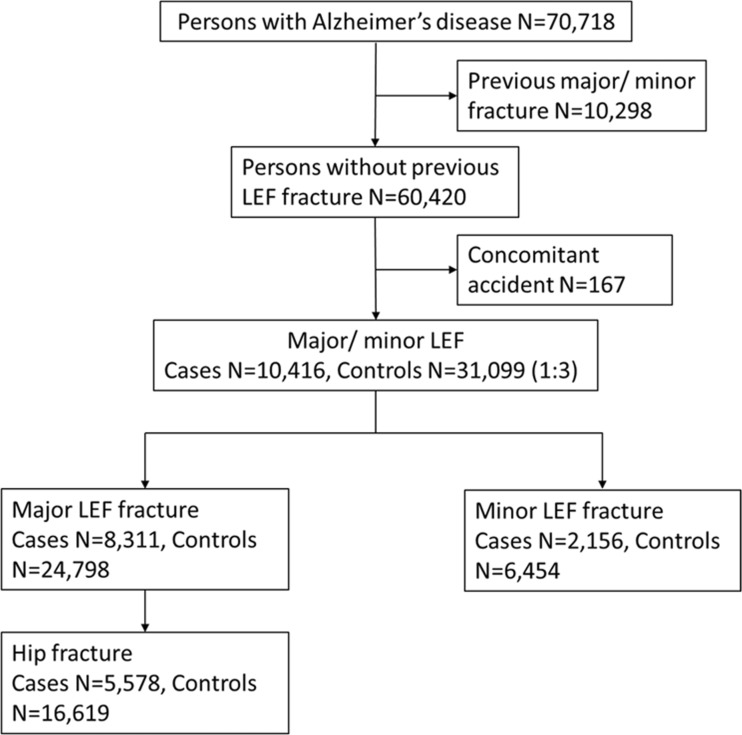
LEF cases were identified from the MEDALZ study, including all community-dwelling persons diagnosed with AD in Finland 2005-2011. During the follow-up from AD diagnoses until the end of 2015, cases with LEF (N = 10,416) and hip fracture (N = 5578) were identified. LEF cases were matched with up to three controls without LEF, according to time since AD diagnosis, age and gender. Thiazide use identified from the Prescription register data was modeled with PRE2DUP method. Current use was defined in 0-30 days' time window before the fracture/matching date, and duration of current use was assessed. The association between thiazide exposure and LEFs was assessed with conditional logistic regression.
Current thiazide use was observed in 10.5% of LEF cases and 12.5% of controls. Current thiazide use was associated with a decreased risk of LEF (adjusted OR [aOR] 0.83, 95% CI 0.77-0.88). In terms of the duration of use, no association was observed with short-term use (< 1 year or 1-3 years), while longer use (> 3 years) was associated with a reduced risk of LEF (aOR 0.77, 95% CI 0.71-0.83) and hip fracture (aOR 0.68, 95% CI 0.60-0.78).
Our study extends the previous knowledge of reduced fracture risk of thiazides to persons with AD, a population with significantly increased background risk of fractures.
我们研究了噻嗪类药物的使用与社区中阿尔茨海默病患者发生低能量骨折(LEF)的风险之间的关系。较长时间的使用与低能量骨折风险降低相关。这项研究将噻嗪类药物降低骨折风险的先前知识扩展到了患有阿尔茨海默病的人群。
为了研究噻嗪类药物的使用与社区中患有阿尔茨海默病(AD)的患者发生低能量骨折(LEF)和髋部骨折的风险之间的关系。之前没有研究评估噻嗪类药物对 AD 患者 LEF 风险的影响。
LEF 病例从 MEDALZ 研究中确定,包括芬兰 2005-2011 年期间所有被诊断为 AD 的社区居住者。在 AD 诊断后的随访期间,即 2015 年底,确定了 LEF(n=10416)和髋部骨折(n=5578)的病例。根据 AD 诊断后的时间、年龄和性别,将 LEF 病例与多达 3 名无 LEF 的对照进行匹配。从处方登记数据中确定噻嗪类药物的使用情况,并采用 PRE2DUP 方法进行建模。目前的使用定义为骨折/匹配日期前 0-30 天的时间窗内,评估当前使用的持续时间。使用条件逻辑回归评估噻嗪类药物暴露与 LEFs 之间的关联。
LEF 病例中有 10.5%和对照组中有 12.5%目前正在使用噻嗪类药物。目前使用噻嗪类药物与 LEF 风险降低相关(调整后的比值比[aOR]0.83,95%CI0.77-0.88)。就使用时间的长短而言,短期使用(<1 年或 1-3 年)与风险无关,而较长时间(>3 年)的使用与 LEF(aOR0.77,95%CI0.71-0.83)和髋部骨折(aOR0.68,95%CI0.60-0.78)风险降低相关。
我们的研究将噻嗪类药物降低骨折风险的先前知识扩展到了 AD 患者,AD 患者的骨折风险显著增加。