Tanskanen Antti, Taipale Heidi, Koponen Marjaana, Tolppanen Anna-Maija, Hartikainen Sirpa, Ahonen Riitta, Tiihonen Jari
Karolinska Institutet, Department of Clinical Neuroscience, Stockholm, Sweden.
National Institute for Health and Welfare, Helsinki, Finland.
PLoS One. 2017 Sep 8;12(9):e0184070. doi: 10.1371/journal.pone.0184070. eCollection 2017.
In register-based pharmacoepidemiological studies, construction of drug exposure periods from drug purchases is a major methodological challenge. Various methods have been applied but their validity is rarely evaluated. Our objective was to conduct an expert-opinion based evaluation of the correctness of drug use periods produced by different methods.
Drug use periods were calculated with three fixed methods: time windows, assumption of one Defined Daily Dose (DDD) per day and one tablet per day, and with PRE2DUP that is based on modelling of individual drug purchasing behavior. Expert-opinion based evaluation was conducted with 200 randomly selected purchase histories of warfarin, bisoprolol, simvastatin, risperidone and mirtazapine in the MEDALZ-2005 cohort (28,093 persons with Alzheimer's disease). Two experts reviewed purchase histories and judged which methods had joined correct purchases and gave correct duration for each of 1000 drug exposure periods.
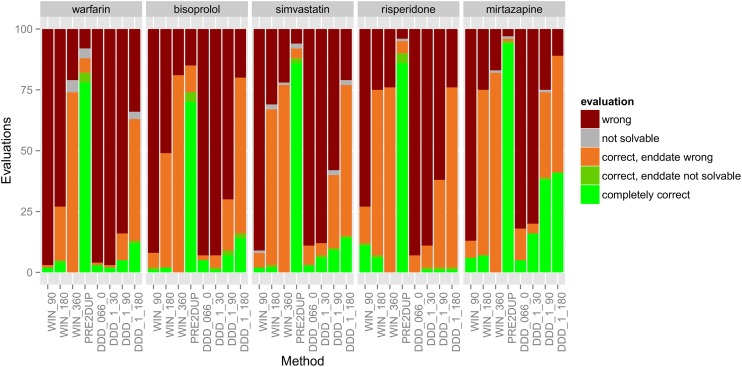
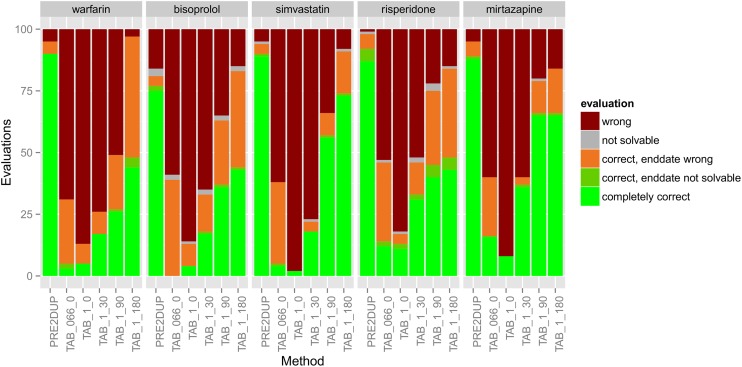
The evaluated correctness of drug use periods was 70-94% for PRE2DUP, and depending on grace periods and time window lengths 0-73% for tablet methods, 0-41% for DDD methods and 0-11% for time window methods. The highest rate of evaluated correct solutions for each method class were observed for 1 tablet per day with 180 days grace period (TAB_1_180, 43-73%), and 1 DDD per day with 180 days grace period (1-41%). Time window methods produced at maximum only 11% correct solutions. The best performing fixed method TAB_1_180 reached highest correctness for simvastatin 73% (95% CI 65-81%) whereas 89% (95% CI 84-94%) of PRE2DUP periods were judged as correct.
This study shows inaccuracy of fixed methods and the urgent need for new data-driven methods. In the expert-opinion based evaluation, the lowest error rates were observed with data-driven method PRE2DUP.
在基于登记处的药物流行病学研究中,根据药品购买记录构建药物暴露期是一个主要的方法学挑战。已经应用了各种方法,但它们的有效性很少得到评估。我们的目标是基于专家意见对不同方法产生的用药期的正确性进行评估。
使用三种固定方法计算用药期:时间窗法、每天假定一个限定日剂量(DDD)和每天一片法,以及基于个体药品购买行为建模的PRE2DUP法。在MEDALZ - 2005队列(28093名阿尔茨海默病患者)中,对随机选择的200份华法林、比索洛尔、辛伐他汀、利培酮和米氮平的购买记录进行了基于专家意见的评估。两名专家审查了购买记录,并判断哪些方法将正确的购买记录合并在一起,并为1000个药物暴露期的每一个给出了正确的持续时间。
PRE2DUP法评估的用药期正确性为70% - 94%,片剂法根据宽限期和时间窗长度为0% - 73%,DDD法为0% - 41%,时间窗法为0% - 11%。对于每种方法类别,观察到的评估正确解决方案的最高比例出现在宽限期为180天的每天一片法(TAB_1_180,43% - 73%)和宽限期为180天的每天一个DDD法(1% - 41%)。时间窗法最多只能产生11%的正确解决方案。表现最佳的固定方法TAB_1_180对辛伐他汀的正确性最高,为73%(95%置信区间65% - 81%),而PRE2DUP期的89%(95%置信区间84% - 94%)被判定为正确。
本研究表明固定方法不准确,迫切需要新的数据驱动方法。在基于专家意见的评估中,数据驱动方法PRE2DUP的错误率最低。