MRC Centre for Neuropsychiatric Genetics and Genomics, Division of Psychological Medicine and Clinical Neurosciences, Cardiff University, Cardiff, Wales, United Kingdom.
Centre for Academic Mental Health, Department of Population Health Sciences, University of Bristol, Bristol, United Kingdom.
JAMA Psychiatry. 2019 Aug 1;76(8):818-825. doi: 10.1001/jamapsychiatry.2019.0566.
The role of large, rare copy number variants (CNVs) in neuropsychiatric disorders is well established, but their association with common psychiatric disorders, such as depression, remains unclear.
To examine the association of a group of 53 CNVs associated with neurodevelopmental disorders and burden of rare CNVs with risk of depression.
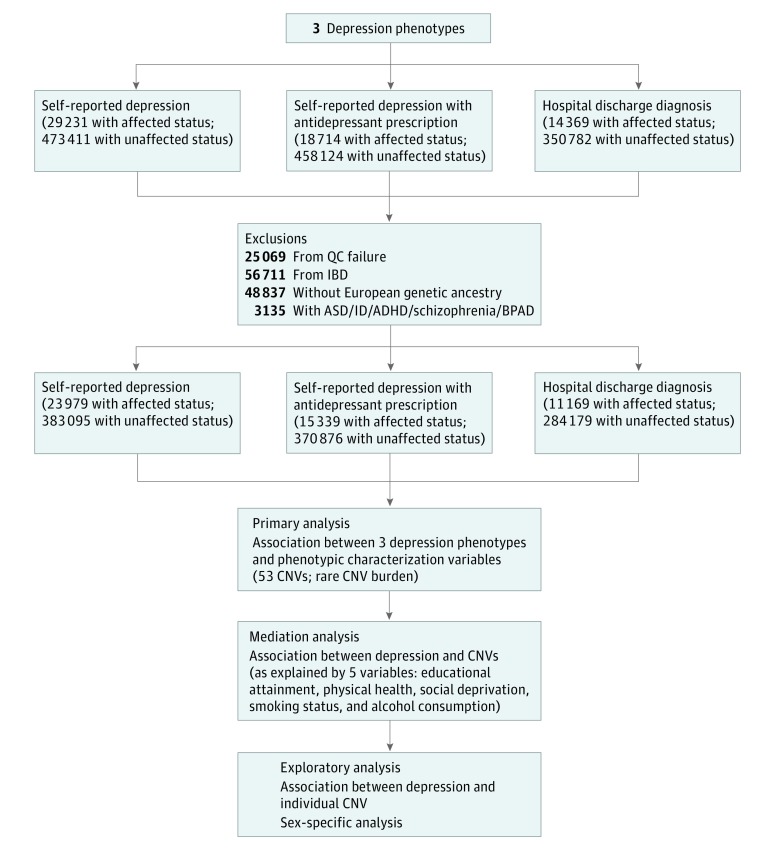
DESIGN, SETTING, AND PARTICIPANTS: This case-control study used data from the UK Biobank study sample, which comprised 502 534 individuals living in the United Kingdom. Individuals with autism spectrum disorder, intellectual disability, attention-deficit/hyperactivity disorder, schizophrenia, or bipolar affective disorder diagnoses were excluded. Analyses were further restricted to individuals of European genetic ancestry (n = 407 074). The study was conducted from January 2017 to September 2018.
CNV carrier status.
For the primary outcome, individuals who reported that a physician had told them they had a depression diagnosis were defined as cases. Analyses were repeated using 2 alternative depression definitions: self-reported lifetime depression with current antidepressant prescription at the time of visit 1, and hospital discharge diagnosis of depression.
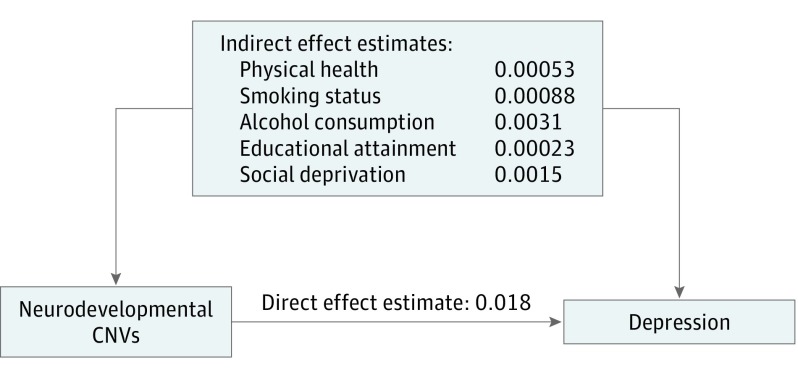
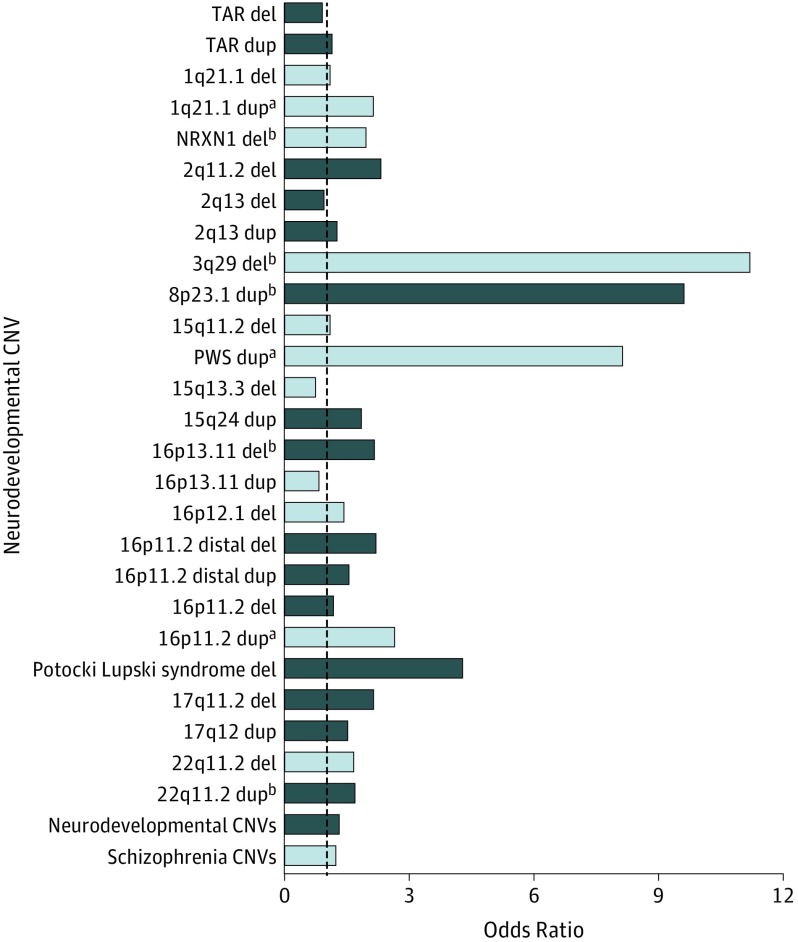
Copy number variants were identified in 488 366 individuals aged 37 to 73 years. In total, 407 074 individuals with European genetic ancestry (220 201 female [54.1%]; mean [SD] age of 56.9 [8.0] years) were included in the study. Of these individuals, 23 979 (5.9%) had self-reported lifetime depression and 383 095 (94.1%) reported no lifetime depression. The group of 53 neurodevelopmental CNVs was associated with self-reported depression (odds ratio [OR], 1.34; 95% CI, 1.19-1.49, uncorrected P = 1.38 × 10⁻⁷), and these results were consistent when using 2 alternative definitions of depression. This association was partially explained by physical health, educational attainment, social deprivation, smoking status, and alcohol consumption. A strong independent association remained between the neurodevelopmental CNVs and depression in analyses that incorporated these other measures (OR, 1.26; 95% CI, 1.11-1.43; P = 2.87 × 10⁻⁴). Eight individual CNVs were nominally associated with risk of depression, and 3 of these 8 CNVs (1q21.1 duplication, Prader-Willi syndrome duplication, and 16p11.2 duplication) survived Bonferroni correction for the 53 CNVs tested. After the exclusion of carriers of neurodevelopmental CNVs, no association was found between measures of CNV burden and depression.
Neurodevelopmental CNVs appear to be associated with depression, extending the spectrum of clinical phenotypes that are associated with CNV carrier status.
大量罕见拷贝数变异(CNVs)在神经精神疾病中的作用已得到充分证实,但它们与常见精神疾病(如抑郁症)的关联仍不清楚。
研究与神经发育障碍相关的一组 53 个 CNVs 以及罕见 CNV 负担与抑郁症风险之间的关联。
设计、地点和参与者: 这项病例对照研究使用了来自英国生物银行研究样本的数据,该样本包括居住在英国的 502534 人。排除了自闭症谱系障碍、智力障碍、注意力缺陷/多动障碍、精神分裂症或双相情感障碍诊断的个体。分析进一步限制在具有欧洲遗传血统的个体(n=407074)中。研究于 2017 年 1 月至 2018 年 9 月进行。
CNV 携带者状态。
对于主要结局,报告医生告知他们患有抑郁症的个体被定义为病例。使用两种替代抑郁症定义重复分析:在第 1 次就诊时报告的终身抑郁症且当前正在服用抗抑郁药,以及因抑郁症而住院的诊断。
在 37 至 73 岁的 488366 人中发现了拷贝数变异。共有 407074 名具有欧洲遗传血统的个体(220201 名女性[54.1%];平均[SD]年龄 56.9[8.0]岁)纳入研究。其中,23979 人(5.9%)有报告称曾患有终身抑郁症,383095 人(94.1%)报告没有终身抑郁症。这组 53 个神经发育 CNVs 与自我报告的抑郁症相关(比值比[OR],1.34;95%CI,1.19-1.49,未校正 P=1.38×10⁻⁷),当使用两种替代抑郁症定义时,这些结果是一致的。在纳入这些其他措施的分析中,这种关联部分由身体健康、教育程度、社会贫困、吸烟状况和饮酒情况解释。在纳入这些其他措施的分析中,神经发育 CNVs 与抑郁症之间仍存在强烈的独立关联(OR,1.26;95%CI,1.11-1.43;P=2.87×10⁻⁴)。8 个个体 CNVs 与抑郁症风险呈名义相关,其中 3 个 CNVs(1q21.1 重复、普氏综合征重复和 16p11.2 重复)在对 53 个测试的 CNVs 进行的 Bonferroni 校正后仍然存在。在排除携带神经发育 CNVs 的个体后,CNV 负担与抑郁症之间没有关联。
神经发育 CNVs 似乎与抑郁症有关,这扩展了与 CNV 携带者状态相关的临床表型谱。