Fluharty Meg, Taylor Amy E, Grabski Meryem, Munafò Marcus R
MRC Integrative Epidemiology Unit (IEU), University of Bristol, Bristol, United Kingdom;
UK Centre for Tobacco and Alcohol Studies, School of Experimental Psychology, University of Bristol, Bristol, United Kingdom.
Nicotine Tob Res. 2017 Jan;19(1):3-13. doi: 10.1093/ntr/ntw140. Epub 2016 May 19.
Many studies report a positive association between smoking and mental illness. However, the literature remains mixed regarding the direction of this association. We therefore conducted a systematic review evaluating the association of smoking and depression and/or anxiety in longitudinal studies.
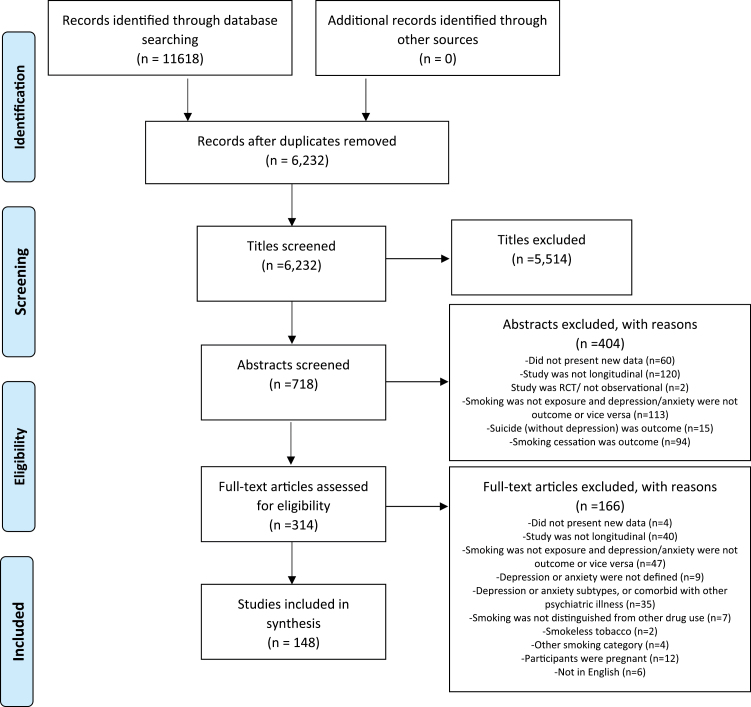
Studies were identified by searching PubMed, Scopus, and Web of Science and were included if they: (1) used human participants, (2) were longitudinal, (3) reported primary data, (4) had smoking as an exposure and depression and/or anxiety as an outcome, or (5) had depression and/or anxiety as the exposure and smoking as an outcome.
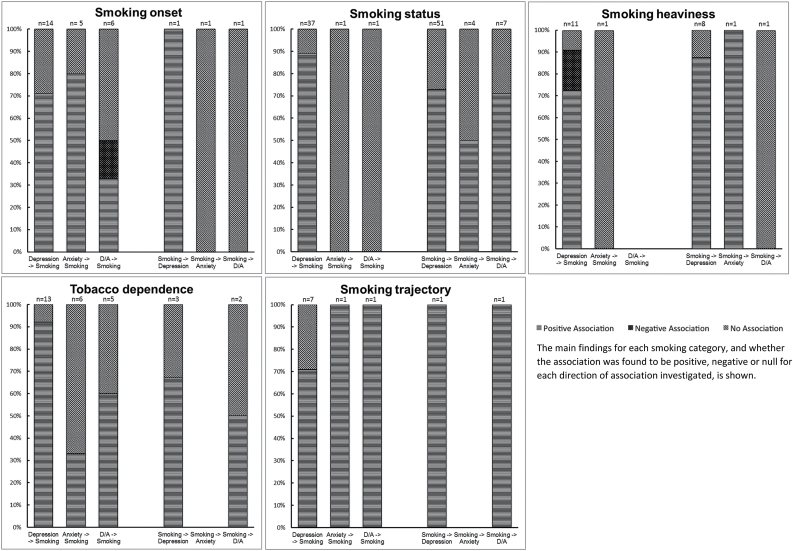
Outcomes from 148 studies were categorized into: smoking onset, smoking status, smoking heaviness, tobacco dependence, and smoking trajectory. The results for each category varied substantially, with evidence for positive associations in both directions (smoking to later mental health and mental health to later smoking) as well as null findings. Overall, nearly half the studies reported that baseline depression/anxiety was associated with some type of later smoking behavior, while over a third found evidence that a smoking exposure was associated with later depression/anxiety. However, there were few studies directly supporting a bidirectional model of smoking and anxiety, and very few studies reporting null results.
The literature on the prospective association between smoking and depression and anxiety is inconsistent in terms of the direction of association most strongly supported. This suggests the need for future studies that employ different methodologies, such as Mendelian randomization (MR), which will allow us to draw stronger causal inferences.
We systematically reviewed longitudinal studies on the association of different aspects of smoking behavior with depression and anxiety. The results varied considerably, with evidence for smoking both associated with subsequent depression and anxiety, and vice versa. Few studies supported a bidirectional relationship, or reported null results, and no clear patterns by gender, ethnicity, clinical status, length to follow-up, or diagnostic test. Suggesting that despite advantages of longitudinal studies, they cannot alone provide strong evidence of causality. Therefore, future studies investigating this association should employ different methods allowing for stronger causal inferences to be made, such as MR.
许多研究报告了吸烟与精神疾病之间存在正相关。然而,关于这种关联的方向,文献报道仍不一致。因此,我们进行了一项系统综述,以评估纵向研究中吸烟与抑郁和/或焦虑之间的关联。
通过检索PubMed、Scopus和Web of Science来确定研究,如果这些研究:(1)使用人类参与者,(2)为纵向研究,(3)报告了原始数据,(4)将吸烟作为暴露因素,抑郁和/或焦虑作为结果,或者(5)将抑郁和/或焦虑作为暴露因素,吸烟作为结果,则纳入研究。
148项研究的结果分为:吸烟开始、吸烟状态、吸烟量、烟草依赖和吸烟轨迹。每个类别的结果差异很大,既有双向正相关的证据(吸烟导致后期心理健康问题,心理健康问题导致后期吸烟),也有无效结果。总体而言,近一半的研究报告称基线抑郁/焦虑与某种类型的后期吸烟行为有关,而超过三分之一的研究发现有证据表明吸烟暴露与后期抑郁/焦虑有关。然而,很少有研究直接支持吸烟与焦虑的双向模型,而且报告无效结果的研究非常少。
关于吸烟与抑郁和焦虑之间前瞻性关联的文献,在最有力支持的关联方向上并不一致。这表明未来需要采用不同方法的研究,如孟德尔随机化(MR),这将使我们能够得出更强有力的因果推断。
我们系统综述了关于吸烟行为不同方面与抑郁和焦虑之间关联的纵向研究。结果差异很大,有证据表明吸烟既与随后的抑郁和焦虑有关,反之亦然。很少有研究支持双向关系,或报告无效结果,且未发现按性别、种族、临床状态、随访时长或诊断测试的明确模式。这表明尽管纵向研究有其优势,但仅凭它们无法提供有力的因果证据。因此,未来调查这种关联的研究应采用不同方法,以便能够做出更强有力的因果推断,如MR。