EA 7426 « Pathophysiology of injury-induced immunosuppression (PI3) » Lyon 1 University / Hospices Civils de Lyon / bioMérieux, Hôpital Edouard Herriot 5 place d'Arsonval, 69003, Lyon, France.
Joint Research Unit HCL-bioMérieux-Université Lyon 1, Hôpital Edouard Herriot, 5 place d'Arsonval, 69003, Lyon, France.
Crit Care. 2019 Apr 17;23(1):131. doi: 10.1186/s13054-018-2305-5.
Sepsis is the leading cause of mortality for critically ill patients worldwide. Patients develop T lymphocyte dysfunctions leading to T-cell exhaustion associated with increased risk of death. As interleukin-7 (IL-7) is currently tested in clinical trials to reverse these dysfunctions, it is important to evaluate the expression of its specific CD127 receptor on the T-cell surface of patients with septic shock. Moreover, the CD127PD-1 phenotype has been proposed as a T-cell exhaustion marker in chronic viral infections but has never been evaluated in sepsis. The objective of this study was first to evaluate CD127 and CD127PD-1 phenotype in septic shock in parallel with functional T-cell alterations. Second, we aimed to reproduce septic shock-induced T-cell alterations in an ex vivo model.
CD127 expression was followed at the protein and mRNA levels in patients with septic shock and healthy volunteers. CD127PD-1 phenotype was also evaluated in parallel with T-cell functional alterations after ex vivo activation. To reproduce T-cell alterations observed in patients, purified T cells from healthy volunteers were activated ex vivo and their phenotype and function were evaluated.
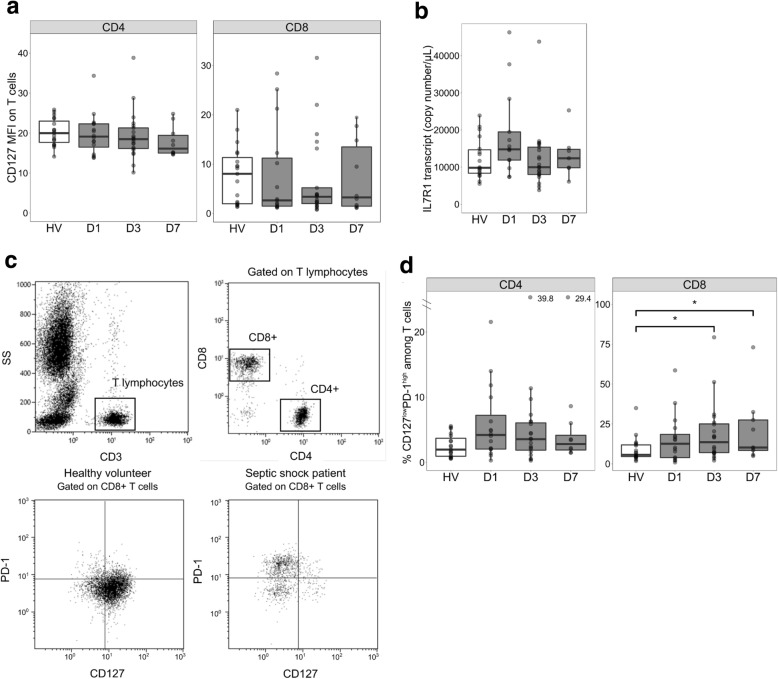
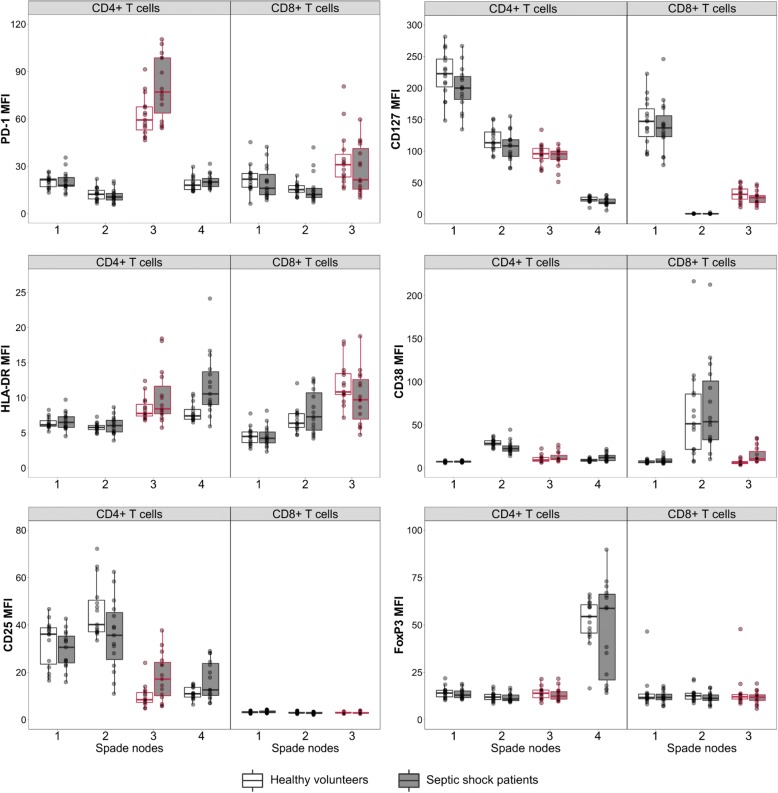
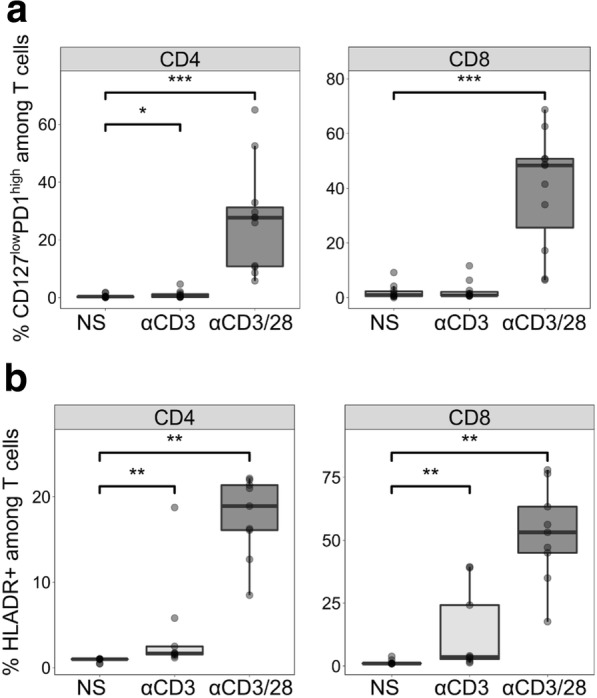
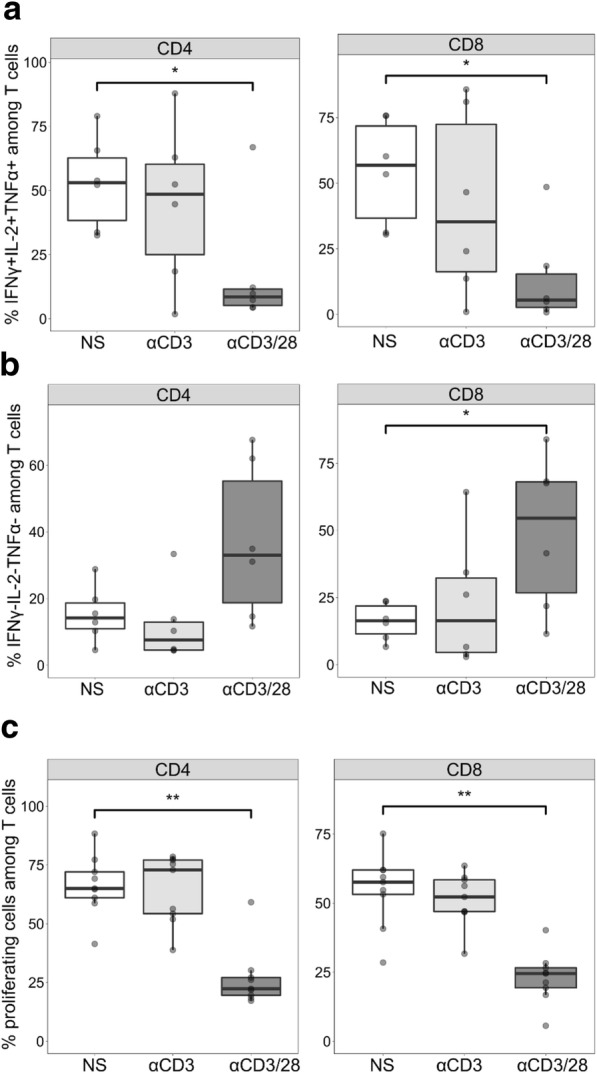
In patients, neither CD127 expression nor its corresponding mRNA transcript level was modified compared with normal values. However, the percentage of CD127PD-1 T cells was increased while T cells also presented functional alterations. CD127PD-1 T cells co-expressed HLA-DR, an activation marker, suggesting a role for T-cell activation in the development of this phenotype. Indeed, T-cell receptor (TCR) activation of normal T lymphocytes ex vivo reproduced the increase of CD127PD-1 T cells and functional alterations following a second stimulation, as observed in patients. Finally, in this model, as observed in patients, IL-7 could improve T-cell proliferation.
The proportion of CD127PD-1 T cells in patients was increased compared with healthy volunteers, although no global CD127 regulation was observed. Our results suggest that TCR activation participates in the occurrence of this T-cell population and in the development of T-cell alterations in septic shock. Furthermore, we provide an ex vivo model for the investigation of the pathophysiology of sepsis-induced T-cell immunosuppression and the testing of innovative immunostimulant treatments.
脓毒症是全球危重病患者死亡的主要原因。患者会出现 T 淋巴细胞功能障碍,导致 T 细胞耗竭,从而增加死亡风险。由于白细胞介素-7(IL-7)目前正在临床试验中用于逆转这些功能障碍,因此评估其在感染性休克患者 T 细胞表面的特异性 CD127 受体的表达非常重要。此外,CD127PD-1 表型已被提出作为慢性病毒感染中 T 细胞耗竭的标志物,但从未在脓毒症中进行过评估。本研究的目的首先是平行评估感染性休克中 CD127 和 CD127PD-1 表型与 T 细胞功能改变的关系。其次,我们旨在在体外模型中重现感染性休克诱导的 T 细胞改变。
在感染性休克患者和健康志愿者中,我们分别在蛋白和 mRNA 水平上检测 CD127 的表达。同时,我们还平行评估了 CD127PD-1 表型与体外激活后 T 细胞功能改变的关系。为了重现患者中观察到的 T 细胞改变,我们从健康志愿者中纯化 T 细胞进行体外激活,并评估其表型和功能。
与正常值相比,患者的 CD127 表达或其相应的 mRNA 转录水平均未改变。然而,CD127PD-1 T 细胞的百分比增加,同时 T 细胞也表现出功能改变。CD127PD-1 T 细胞共表达 HLA-DR,这是一种激活标志物,提示 T 细胞激活在该表型的发展中起作用。事实上,体外正常 T 淋巴细胞的 T 细胞受体(TCR)激活可重现第二次刺激后 CD127PD-1 T 细胞的增加和功能改变,正如患者中观察到的那样。最后,在该模型中,与患者一样,白细胞介素-7 可改善 T 细胞增殖。
与健康志愿者相比,患者的 CD127PD-1 T 细胞比例增加,尽管未观察到整体 CD127 调节。我们的结果表明,TCR 激活参与了这种 T 细胞群的发生以及感染性休克中 T 细胞改变的发生。此外,我们提供了一种体外模型,用于研究脓毒症诱导的 T 细胞免疫抑制的病理生理学,并测试创新的免疫刺激治疗方法。