EA7426 "Pathophysiology of injury-induced immunosuppression (PI3)," Université Claude Bernard Lyon 1 - Hospices Civils de Lyon - bioMérieux, Lyon, France.
Hospices Civils de Lyon - bioMérieux - Université Claude Bernard Lyon 1 Joint Research Unit, Hôpital Edouard Herriot, Lyon, France.
Crit Care Med. 2018 Nov;46(11):1739-1746. doi: 10.1097/CCM.0000000000003281.
Septic shock is the primary cause of death in ICUs. A better comprehension of its pathophysiology, in particular, the immune alteration mechanisms, opened new therapeutic perspectives such as the recombinant interleukin-7. The use of biomarkers could improve the identification of eligible patients for this therapy. The soluble form of the interleukin-7 appears as a promising candidate in this regard since an association between its high plasmatic level and mortality in critically ill patients has been demonstrated. Because there are no data available on the transcriptional regulation of the interleukin-7 receptor in such patients, this study aimed to explore the expression level of different interleukin-7 receptor transcripts after septic shock and evaluate their association with mortality.
Retrospective discovery cohort (30 patients) and validation cohort (177 patients).
Two French ICUs (discovery study) and six French ICUs (validation study).
Adult septic shock patients.
None.
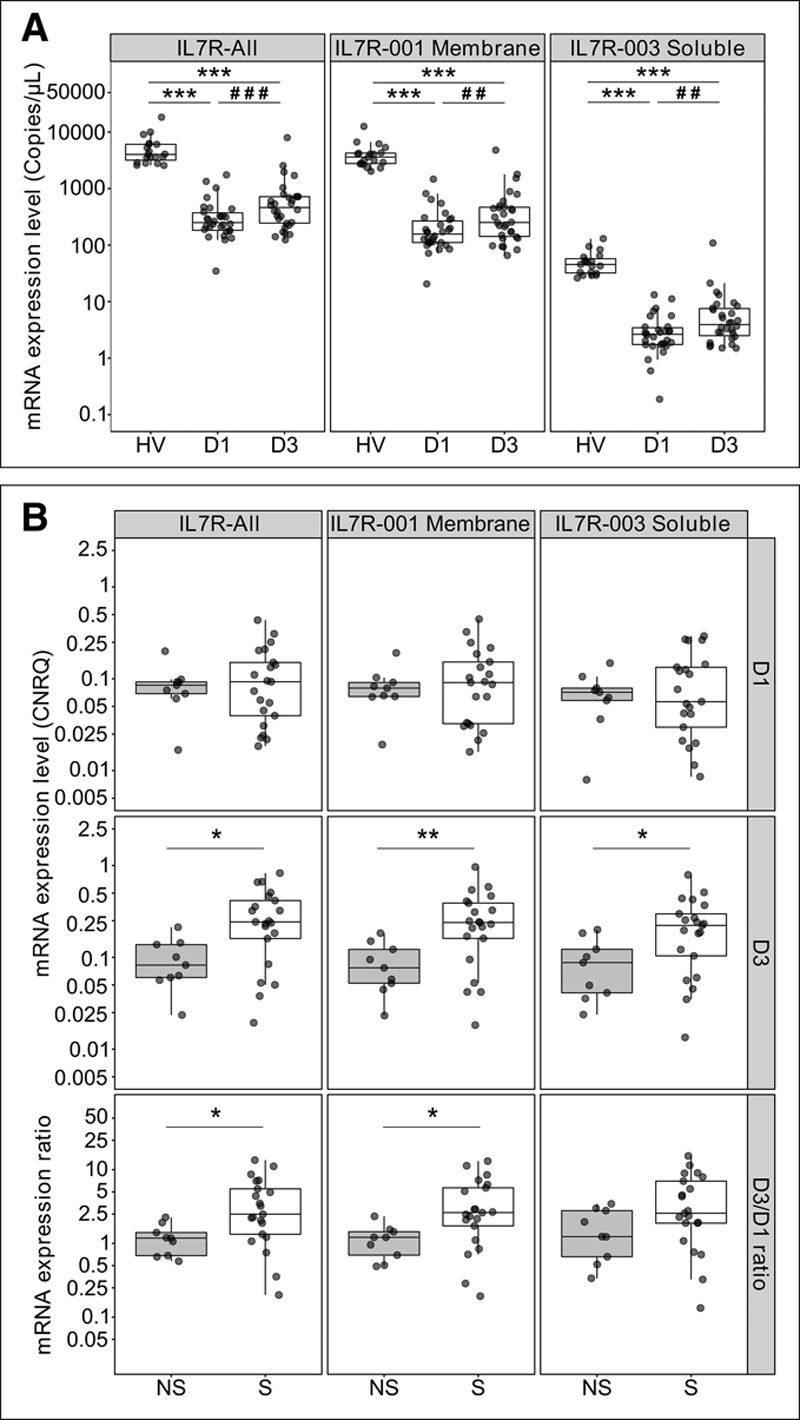
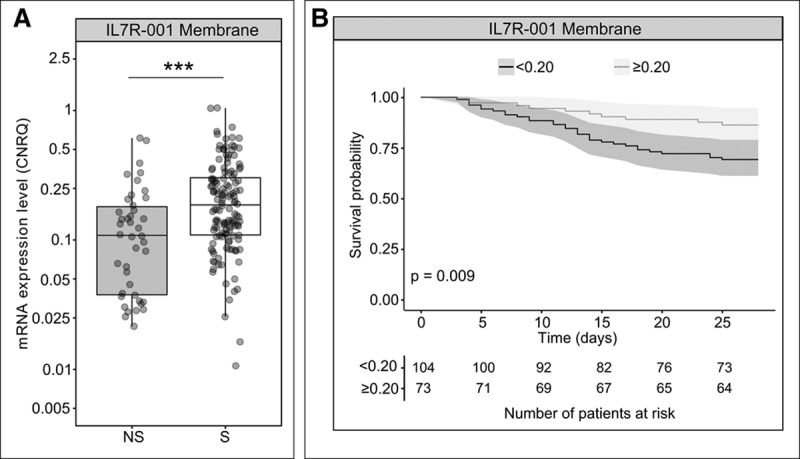
The quantification of several interleukin-7 receptor transcripts using specific reverse transcription quantitative polymerase chain reaction designs allowed for global evaluation of interleukin-7 receptor gene expression in whole blood. In the discovery cohort, all interleukin-7 receptor transcripts studied were expressed at lower levels in septic shock patients than in healthy volunteers. Interleukin-7 receptor gene expression at day 3 after septic shock diagnosis was associated with day 28 mortality. Patients at a lower risk of death showed higher expression levels. These results were confirmed in the independent validation cohort. Interestingly, using a threshold obtained on the discovery cohort, we observed in the validation cohort a high negative predictive value for day 28 mortality for the transcript encoding the membrane form of interleukin-7 receptor (0.86; 95% CI, 0.79-0.93).
Interleukin-7 receptor transcripts appear as biomarkers of impaired adaptive immune response in septic shock patients and as a promising tool for patient stratification in clinical trials evaluating immunoadjuvant therapies.
脓毒症休克是 ICU 患者死亡的主要原因。对其病理生理学,特别是免疫改变机制的更好理解,为新的治疗方法提供了新的视角,例如重组白细胞介素-7。生物标志物的使用可以提高对适合这种治疗的患者的识别能力。白细胞介素-7 的可溶性形式似乎是一个很有前途的候选者,因为已经证明其在危重病患者中的高血浆水平与死亡率之间存在关联。由于在这些患者中没有关于白细胞介素-7 受体转录的调节的数据,因此本研究旨在探索脓毒症休克后不同白细胞介素-7 受体转录本的表达水平,并评估其与死亡率的关系。
回顾性发现队列(30 例)和验证队列(177 例)。
法国的两个 ICU(发现研究)和六个法国的 ICU(验证研究)。
成年脓毒症休克患者。
无。
使用特定的逆转录定量聚合酶链反应设计对几种白细胞介素-7 受体转录本进行定量,可对全血中白细胞介素-7 受体基因表达进行全面评估。在发现队列中,与健康志愿者相比,所有研究的白细胞介素-7 受体转录本在脓毒症休克患者中的表达水平均较低。脓毒症休克诊断后第 3 天白细胞介素-7 受体基因表达与第 28 天死亡率相关。死亡风险较低的患者表达水平较高。这些结果在独立的验证队列中得到了证实。有趣的是,使用在发现队列中获得的阈值,我们在验证队列中观察到,编码白细胞介素-7 受体膜形式的转录本对第 28 天死亡率具有很高的阴性预测值(0.86;95%CI,0.79-0.93)。
白细胞介素-7 受体转录本似乎是脓毒症休克患者适应性免疫反应受损的生物标志物,并且是评估免疫佐剂治疗临床试验中患者分层的有前途的工具。