Dept of Pulmonary diseases, University of Groningen, University Medical Centre Groningen, Groningen, The Netherlands
Groningen Research Institute for Asthma and COPD, University of Groningen, University Medical Centre Groningen, Groningen, The Netherlands.
Eur Respir Rev. 2019 Apr 17;28(152). doi: 10.1183/16000617.0121-2018. Print 2019 Jun 30.
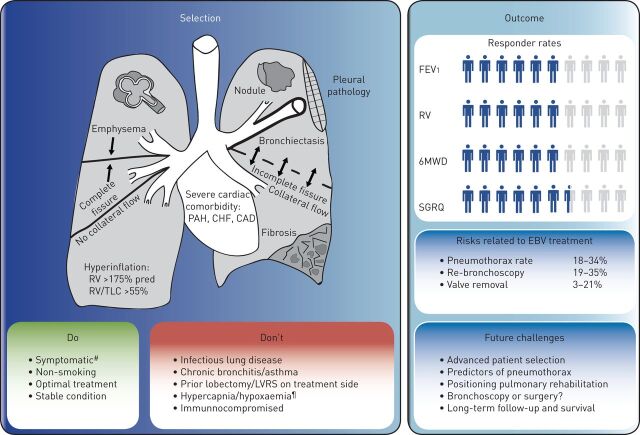
The results of the randomised controlled trials investigating the bronchoscopic lung volume reduction treatment using endobronchial valves (EBV) are promising, and have led to their inclusion in treatment guidelines, US Food and Drug Administration approval and inclusion in routine care in an increasing number of countries. The one-way valve treatment has advanced and is now a regular treatment option. However, this new phase will lead to new challenges in terms of implementation. We believe that key issues in future research concern advanced patient selection, improved methods for target lobe selection, increased knowledge on the predictive risk of a pneumothorax, positioning of pulmonary rehabilitation in conjunction with the EBV treatment, the positioning of lung volume reduction surgery EBV treatment, and the long-term efficacy, adverse events, impact on exacerbations and hospitalisations, costs and survival. Hopefully, the increasing number of patients treated, the setup of (inter)national registries and future research efforts will further optimise all aspects of this treatment.
采用支气管镜肺减容术(endobronchial valves, EBV)的随机对照试验结果令人鼓舞,并已将其纳入治疗指南、美国食品和药物管理局(food and Drug Administration, FDA)批准,并在越来越多的国家纳入常规治疗。单向阀治疗已得到发展,现已成为常规治疗选择。然而,这一新阶段将在实施方面带来新的挑战。我们认为,未来研究的关键问题涉及先进的患者选择、目标肺叶选择方法的改进、气胸预测风险的增加、肺康复与 EBV 治疗的结合、肺减容术与 EBV 治疗的结合、长期疗效、不良事件、对加重和住院的影响、成本和生存。希望随着接受治疗的患者数量的增加、(国际)注册中心的建立以及未来的研究工作,将进一步优化这一治疗的各个方面。