Du Jingzhen, King David M, Chatelain Lucile, Lu Erli, Tuna Floriana, McInnes Eric J L, Wooles Ashley J, Maron Laurent, Liddle Stephen T
School of Chemistry , The University of Manchester , Oxford Road , Manchester , M13 9PL , UK . Email:
School of Chemistry , The University of Nottingham , University Park , Nottingham , NG7 2RD , UK.
Chem Sci. 2019 Feb 23;10(13):3738-3745. doi: 10.1039/c8sc05473h. eCollection 2019 Apr 7.
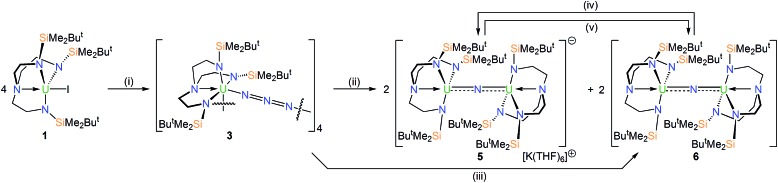
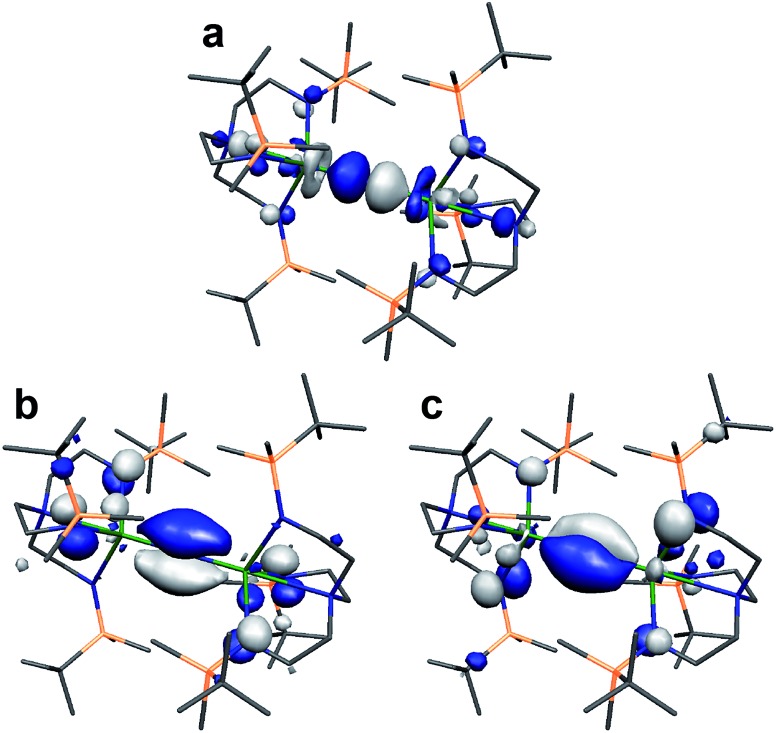
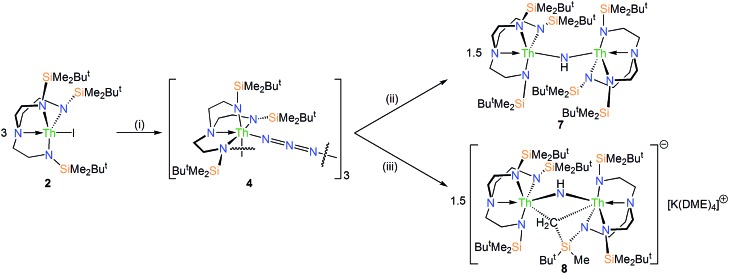
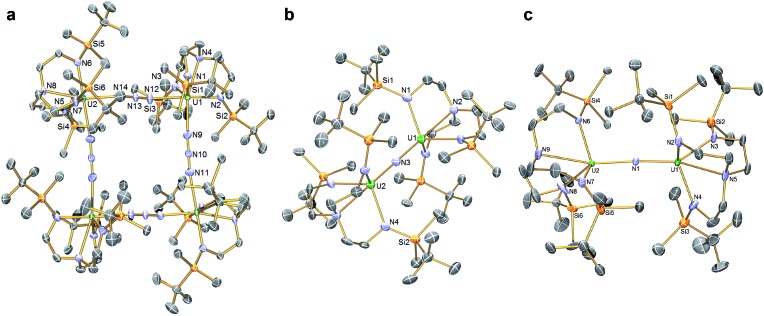
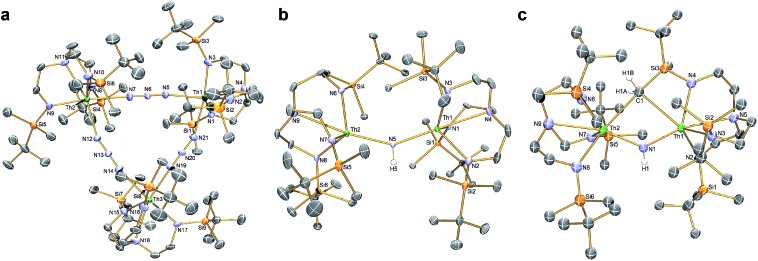
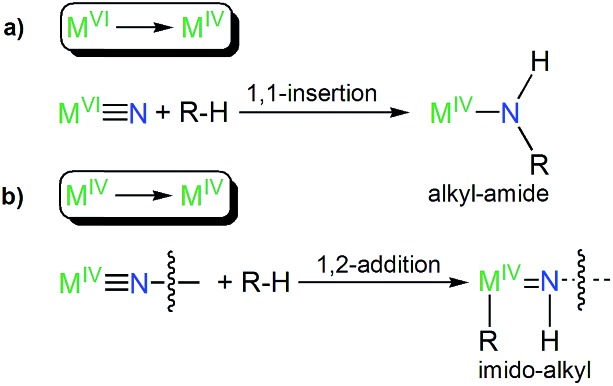
Molecular uranium-nitrides are now well known, but there are no isolable molecular thorium-nitrides outside of cryogenic matrix isolation experiments. We report that treatment of [M(Tren)(I)] (M = U, ; Th, ; Tren = {N(CHCHNSiMeBu )}) with NaN or KN, respectively, affords very rare examples of actinide molecular square and triangle complexes [{M(Tren)(μ-N)} ] (M = U, = 4, ; Th, = 3, ). Chemical reduction of produces [{U(Tren)}(μ-N)][K(THF)] () and [{U(Tren)}(μ-N)] (), whereas photolysis produces exclusively . Complexes and can be reversibly inter-converted by oxidation and reduction, respectively, showing that these UNU cores are robust with no evidence for any C-H bond activations being observed. In contrast, reductions of in arene or ethereal solvents gives [{Th(Tren)}(μ-NH)] () or [{Th(Tren)}{Th(N[CHCHNSiMeBu ]CHCHNSi[μ-CH]MeBu )}(μ-NH)][K(DME)] (), respectively, providing evidence unprecedented outside of matrix isolation for a transient dithorium-nitride. This suggests that thorium-nitrides are intrinsically much more reactive than uranium-nitrides, since they consistently activate C-H bonds to form rare examples of Th-N(H)-Th linkages with alkyl by-products. The conversion here of a bridging thorium(iv)-nitride to imido-alkyl combination by 1,2-addition parallels the reactivity of transient terminal uranium(iv)-nitrides, but contrasts to terminal uranium(vi)-nitrides that produce alkyl-amides by 1,1-insertion, suggesting a systematic general pattern of C-H activation chemistry for metal(iv)- metal(vi)-nitrides. Surprisingly, computational studies reveal a σ > π energy ordering for all these bridging nitride bonds, a phenomenon for actinides only observed before in terminal uranium nitrides and uranyl with very short U-N or U-O distances.
分子型铀氮化物如今已广为人知,但除了低温基质隔离实验外,尚无可分离的分子型钍氮化物。我们报告称,分别用NaN或KN处理[M(Tren)(I)](M = U、Th;Tren = {N(CH₂CH₂NSiMe₂Bu³)₂}),可得到非常罕见的锕系分子方形和三角形配合物[{M(Tren)(μ-N)}ₙ](M = U,n = 4;Th,n = 3)。对[U(Tren)(μ-N)₄]进行化学还原可生成[{U(Tren)}(μ-N)][K(THF)]([U(Tren)(μ-N)₃K(THF)])和[{U(Tren)}(μ-N)₃]([U(Tren)(μ-N)₃]),而光解则仅产生[U(Tren)(μ-N)₄]。配合物[U(Tren)(μ-N)₃K(THF)]和[U(Tren)(μ-N)₃]可分别通过氧化和还原进行可逆的相互转化,这表明这些UNU核很稳定,未观察到任何C-H键活化现象。相比之下,在芳烃或醚类溶剂中对[Th(Tren)(μ-N)₃]进行还原,分别得到[{Th(Tren)}(μ-NH)]([Th(Tren)(μ-NH)])或[{Th(Tren)}{Th(N[CH₂CH₂NSiMe₂Bu³]CH₂CH₂NSi[μ-CH₂]Me₂Bu³)}(μ-NH)][K(DME)]([{Th(Tren)}{Th(N[CH₂CH₂NSiMe₂Bu³]CH₂CH₂NSi[μ-CH₂]Me₂Bu³)}(μ-NH)][K(DME)]),这为基质隔离之外的瞬态二钍氮化物提供了前所未有的证据。这表明钍氮化物本质上比铀氮化物更具反应性,因为它们始终会活化C-H键,形成带有烷基副产物的罕见Th-N(H)-Th键实例。此处通过1,2-加成将桥连钍(IV)氮化物转化为亚氨基-烷基组合,这与瞬态末端铀(IV)氮化物的反应性相似,但与通过1,1-插入生成烷基酰胺的末端铀(VI)氮化物形成对比,这表明金属(IV)-金属(VI)氮化物的C-H活化化学存在系统的一般模式。令人惊讶的是,计算研究揭示了所有这些桥连氮化物键的σ > π能量顺序,这种现象此前仅在末端铀氮化物和铀酰中观察到,其U-N或U-O距离非常短。