Zeng Nan, Johnson Susan L, Boles Richard E, Bellows Laura L
Department of Food Science and Human Nutrition, Colorado State University, Fort Collins, CO 80523, USA.
Department of Pediatrics, University of Colorado Anschutz Medical Campus, Aurora, CO 80045, USA.
J Sport Health Sci. 2019 Mar;8(2):122-129. doi: 10.1016/j.jshs.2019.01.001. Epub 2019 Jan 11.
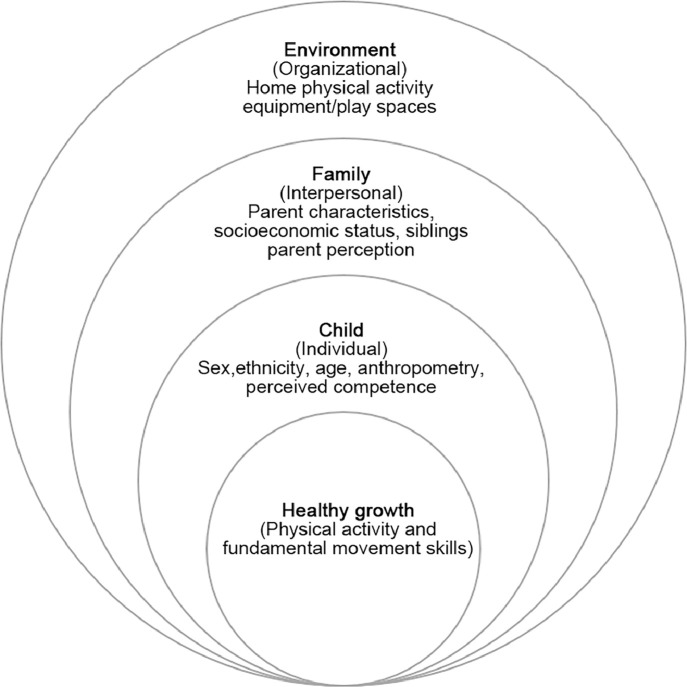
To identify the social-ecological correlates associated with fundamental movement skills at the child, family, and environment levels in young children.
Preschool children from 4 Colorado Head Start/preschool centers were recruited from 2010 to 2012. Two hundred twenty-eight children (128 girls; age = 56.08 ± 4.09 months; body mass index (BMI) z-score = 0.53 ± 1.12 (mean ± SD); 42.1% Hispanic/Latino) and 159 families were included in the final analysis. Children's perceived competence and fundamental movement skills were assessed via the Pictorial Scale of Perceived Competence and Social Acceptance and the Bruininks-Oseretsky Test of Motor Proficiency, 2nd edition. Data on the number of children in the family, parent age, BMI, education, employment status, family income, perception of child coordination, and home physical activity environment were collected via a questionnaire. Linear regressions adjusted for child BMI, age, sex, and school site were performed at each level.
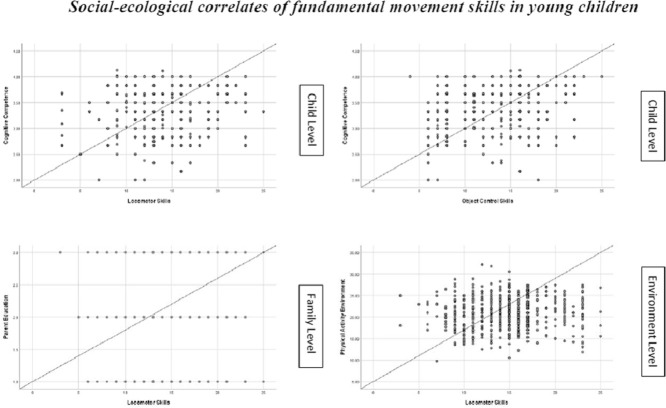
Child perceived cognitive competence was positively associated with locomotor skills ( = 0.04; adjusted = 0.035) and object-control skills ( = 0.003; adjusted = 0.083) at the child level. Parent education, BMI, and perception of child coordination were positively associated with locomotor skills and explained 8.8% of variance, but only parent education was significant ( = 0.04) at the family level. In addition, physical environment was positively associated with locomotor skills ( = 0.02) and explained 5.5% of variance at the environment level.
Social-ecological correlates associated with young children's fundamental movement skills are multidimensional and differ according to skill category at the child, family, and environment levels.
确定与幼儿在儿童、家庭和环境层面的基本运动技能相关的社会生态关联因素。
2010年至2012年从科罗拉多州的4个启蒙计划/学前教育中心招募学龄前儿童。最终分析纳入了228名儿童(128名女孩;年龄 = 56.08 ± 4.09个月;体重指数(BMI)z评分 = 0.53 ± 1.12(均值 ± 标准差);42.1%为西班牙裔/拉丁裔)和159个家庭。通过《感知能力与社会接纳图片量表》和《布鲁因inks - 奥塞列茨基运动熟练度测试》第2版评估儿童的感知能力和基本运动技能。通过问卷收集家庭中孩子数量、父母年龄、BMI、教育程度、就业状况、家庭收入、对孩子协调性的感知以及家庭体育活动环境等数据。在每个层面进行了针对儿童BMI、年龄、性别和学校地点进行调整的线性回归分析。
在儿童层面,儿童感知到的认知能力与运动技能(β = 0.04;调整后β = 0.035)和物体控制技能(β = 0.003;调整后β = 0.083)呈正相关。父母教育程度、BMI和对孩子协调性的感知与运动技能呈正相关,解释了8.8%的方差,但在家庭层面只有父母教育程度具有显著性(β = 0.04)。此外,物理环境与运动技能呈正相关(β = 0.02),在环境层面解释了5.5%的方差。
与幼儿基本运动技能相关的社会生态关联因素是多维度的,并且在儿童、家庭和环境层面因技能类别而异。