Goodale Brianna Mae, Shilaih Mohaned, Falco Lisa, Dammeier Franziska, Hamvas Györgyi, Leeners Brigitte
Ava AG, Zurich, Switzerland.
Department of Reproductive Endocrinology, University Hospital, Zurich, Switzerland.
J Med Internet Res. 2019 Apr 18;21(4):e13404. doi: 10.2196/13404.
Previous research examining physiological changes across the menstrual cycle has considered biological responses to shifting hormones in isolation. Clinical studies, for example, have shown that women's nightly basal body temperature increases from 0.28 to 0.56 ˚C following postovulation progesterone production. Women's resting pulse rate, respiratory rate, and heart rate variability (HRV) are similarly elevated in the luteal phase, whereas skin perfusion decreases significantly following the fertile window's closing. Past research probed only 1 or 2 of these physiological features in a given study, requiring participants to come to a laboratory or hospital clinic multiple times throughout their cycle. Although initially designed for recreational purposes, wearable technology could enable more ambulatory studies of physiological changes across the menstrual cycle. Early research suggests that wearables can detect phase-based shifts in pulse rate and wrist skin temperature (WST). To date, previous work has studied these features separately, with the ability of wearables to accurately pinpoint the fertile window using multiple physiological parameters simultaneously yet unknown.
In this study, we probed what phase-based differences a wearable bracelet could detect in users' WST, heart rate, HRV, respiratory rate, and skin perfusion. Drawing on insight from artificial intelligence and machine learning, we then sought to develop an algorithm that could identify the fertile window in real time.
We conducted a prospective longitudinal study, recruiting 237 conception-seeking Swiss women. Participants wore the Ava bracelet (Ava AG) nightly while sleeping for up to a year or until they became pregnant. In addition to syncing the device to the corresponding smartphone app daily, women also completed an electronic diary about their activities in the past 24 hours. Finally, women took a urinary luteinizing hormone test at several points in a given cycle to determine the close of the fertile window. We assessed phase-based changes in physiological parameters using cross-classified mixed-effects models with random intercepts and random slopes. We then trained a machine learning algorithm to recognize the fertile window.
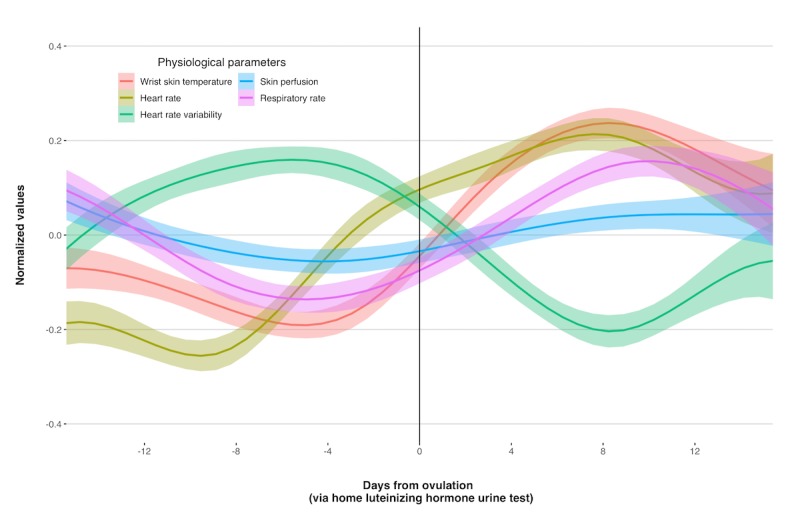
We have demonstrated that wearable technology can detect significant, concurrent phase-based shifts in WST, heart rate, and respiratory rate (all P<.001). HRV and skin perfusion similarly varied across the menstrual cycle (all P<.05), although these effects only trended toward significance following a Bonferroni correction to maintain a family-wise alpha level. Our findings were robust to daily, individual, and cycle-level covariates. Furthermore, we developed a machine learning algorithm that can detect the fertile window with 90% accuracy (95% CI 0.89 to 0.92).
Our contributions highlight the impact of artificial intelligence and machine learning's integration into health care. By monitoring numerous physiological parameters simultaneously, wearable technology uniquely improves upon retrospective methods for fertility awareness and enables the first real-time predictive model of ovulation.
以往研究月经周期生理变化时,多孤立地考量生物对激素变化的反应。例如,临床研究表明,排卵后孕酮分泌增加,女性夜间基础体温会从0.28℃升至0.56℃。黄体期女性静息脉搏率、呼吸频率和心率变异性(HRV)同样升高,而排卵期结束后皮肤灌注显著下降。以往研究在特定研究中仅探究了这些生理特征中的1种或2种,要求参与者在整个月经周期内多次前往实验室或医院诊所。可穿戴技术虽最初是为娱乐目的设计,但能使对月经周期生理变化的研究更具动态性。早期研究表明,可穿戴设备能检测脉搏率和手腕皮肤温度(WST)的阶段性变化。迄今为止,此前的研究都是分别研究这些特征,可穿戴设备能否同时利用多个生理参数准确确定排卵期尚不清楚。
在本研究中,我们探究了可穿戴手环能检测出用户WST、心率、HRV、呼吸频率和皮肤灌注的哪些阶段性差异。基于人工智能和机器学习的见解,我们随后试图开发一种能实时识别排卵期的算法。
我们进行了一项前瞻性纵向研究,招募了237名寻求受孕的瑞士女性。参与者每晚睡觉时佩戴Ava手环(Ava AG),为期长达一年或直至怀孕。除了每天将设备与相应的智能手机应用程序同步外,女性还完成了一份关于过去24小时活动的电子日记。最后,女性在给定周期的几个时间点进行尿促黄体生成素检测,以确定排卵期结束。我们使用具有随机截距和随机斜率的交叉分类混合效应模型评估生理参数的阶段性变化。然后,我们训练了一种机器学习算法来识别排卵期。
我们已证明,可穿戴技术能检测出WST、心率和呼吸频率在不同阶段的显著同步变化(均P<0.001)。HRV和皮肤灌注在月经周期中也有类似变化(均P<0.05),不过在进行Bonferroni校正以维持家族性α水平后,这些影响仅趋于显著。我们的研究结果对每日、个体和周期水平的协变量具有稳健性。此外,我们开发了一种机器学习算法,其检测排卵期的准确率可达90%(95%CI 0.89至0.92)。
我们的研究成果凸显了人工智能和机器学习融入医疗保健的影响。通过同时监测多个生理参数,可穿戴技术独特地改进了生育意识的回顾性方法,并实现了首个排卵实时预测模型。
