Department of Orthopaedic Surgery, Vanderbilt University Medical Center, Nashville, Tennessee.
Department of Physical Therapy, The University of Texas Medical Branch, Galveston.
J Geriatr Phys Ther. 2020 Jul/Sep;43(3):159-169. doi: 10.1519/JPT.0000000000000235.
Pain is common among older adults with dementia. There are nonpharmacological options for managing pain in this population. However, the effects of physical therapist-delivered interventions have not been summarized. The purpose of this systematic review was to summarize the literature on physical therapist-delivered interventions in randomized trials for reducing pain among older adults with dementia.
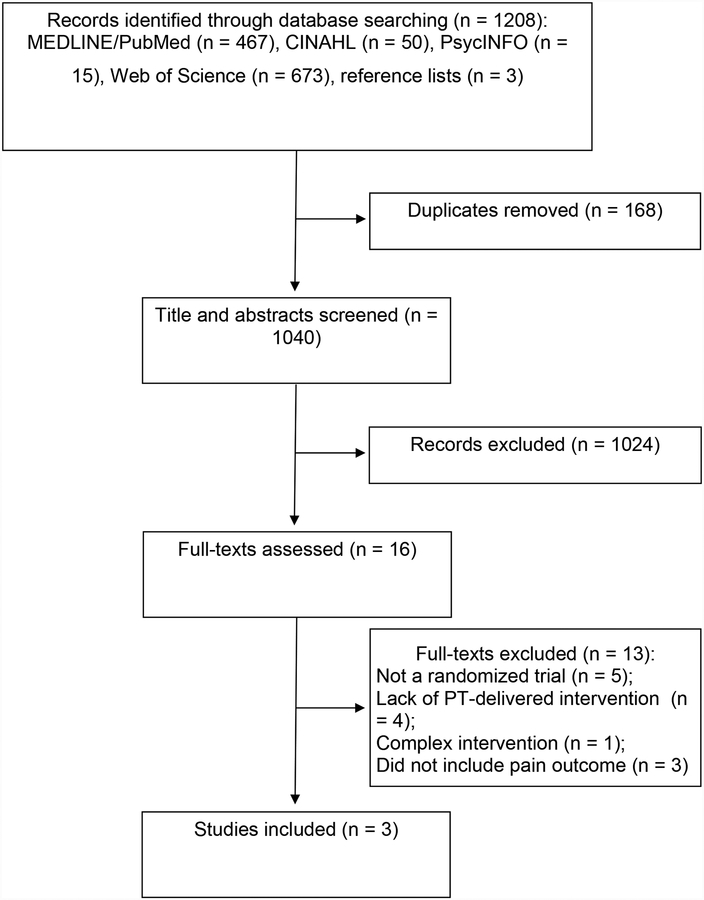
A systematic search of MEDLINE/PubMed, CINAHL, PsycINFO, and Web of Science was conducted for randomized trials of pain management in individuals 60 years or older with medically diagnosed dementia of any severity. Included studies addressed the effects of nonpharmacological physical therapist-delivered interventions on pain outcomes. Pain outcomes included patient or caregiver self-report, observational or interactive measures. Independent reviewers extracted relevant data and assessed methodological quality using the PEDro scale.
Three studies (total = 222 participants; mean age range = 82.2-84.0 years; 178 [80.2%] females) met inclusion criteria. PEDro scores ranged from 4 to 8/10. Interventions included passive movement and massage. Pain outcomes included the observational measures Pain Assessment Checklist for Seniors with Limited Ability to Communicate (PACSLAC), Pain in Advanced Dementia (PAINAD), and Doloplus-2 Scale. Passive movement did not show better results when compared with no treatment, while massage showed pain-reducing effects in 1 study compared with no treatment.
The evidence supporting pain-reducing physical therapy interventions for patients with dementia is limited. There is a clear gap in knowledge related to evidence-based physical therapy for managing pain in this population. Future studies should examine active physical therapist-delivered interventions and utilize interactive pain measures.
痴呆症老年患者常伴有疼痛。针对该人群,存在非药物治疗选择来缓解疼痛。然而,尚未对物理治疗师实施的干预措施的效果进行总结。本系统评价的目的是总结关于物理治疗师实施的随机试验中干预措施,以减轻老年痴呆症患者疼痛的文献。
对 MEDLINE/PubMed、CINAHL、PsycINFO 和 Web of Science 进行了系统检索,以查找针对任何严重程度的有医学诊断的痴呆症、年龄在 60 岁及以上的个体的疼痛管理的随机试验。纳入的研究探讨了非药物性物理治疗师实施的干预措施对疼痛结果的影响。疼痛结果包括患者或护理人员的自我报告、观察或互动测量。独立评审员提取相关数据,并使用 PEDro 量表评估方法学质量。
有 3 项研究(共 222 名参与者;平均年龄范围为 82.2-84.0 岁;178 [80.2%] 名女性)符合纳入标准。PEDro 评分为 4-8/10。干预措施包括被动运动和按摩。疼痛结果包括观察性测量工具《老年人有限沟通能力疼痛评估清单》(PACSLAC)、《晚期痴呆症疼痛》(PAINAD)和 Doloplus-2 量表。与无治疗相比,被动运动并未显示出更好的结果,而按摩在 1 项研究中与无治疗相比显示出了减轻疼痛的效果。
支持针对痴呆症患者的减轻疼痛的物理治疗干预措施的证据有限。在为该人群管理疼痛的基于证据的物理治疗方面,知识存在明显差距。未来的研究应检查物理治疗师实施的主动干预措施,并使用互动性疼痛测量工具。