Department of Neurosurgery, University Hospital Knappschaftskrankenhaus Bochum, Ruhr-University Bochum, Bochum, Germany.
Department of Mechanical Engineering, University of Siegen, Siegen, Germany.
PLoS One. 2019 Apr 18;14(4):e0215171. doi: 10.1371/journal.pone.0215171. eCollection 2019.
Manual skull drilling is an old but in modern neurosurgery still established procedure which can be applied quickly and universally in emergency situations. Electrical drilling requires more complex equipment and is usually reserved to the Operating Room (OR). It also seems desirable to apply an electrical drill for bedside usage but a suitable product does not exist so far.
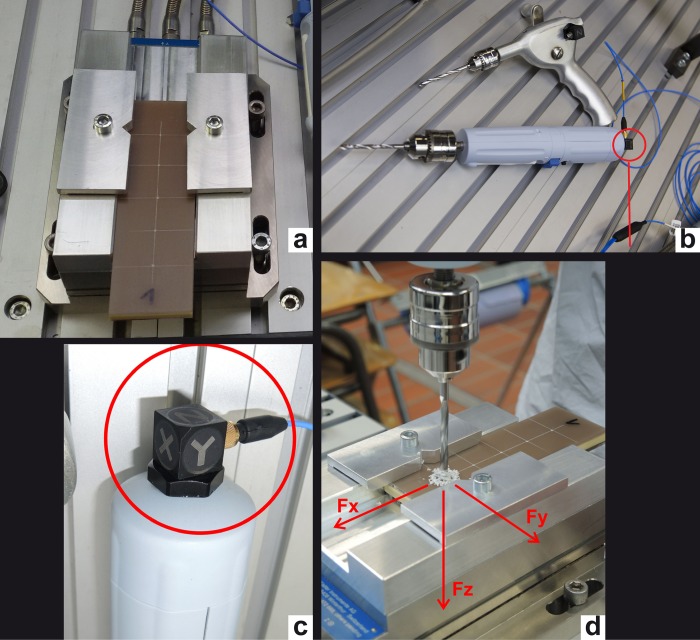
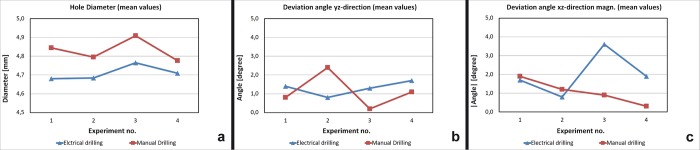
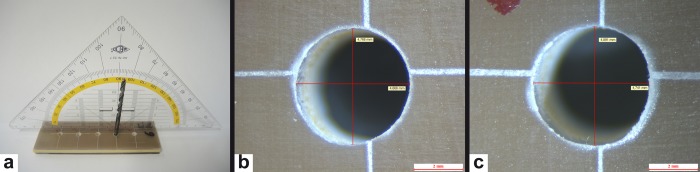
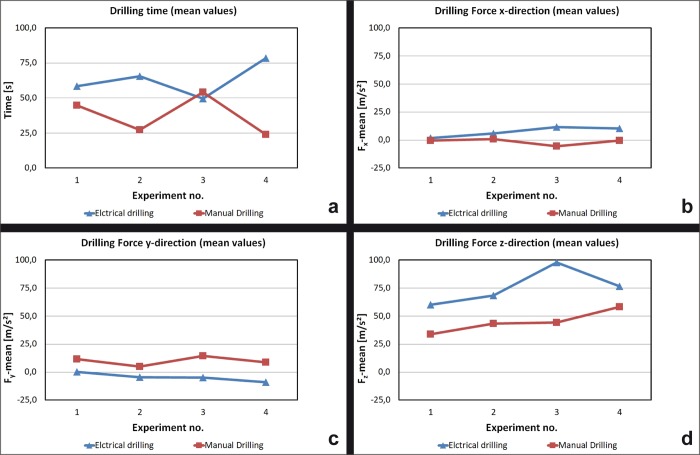
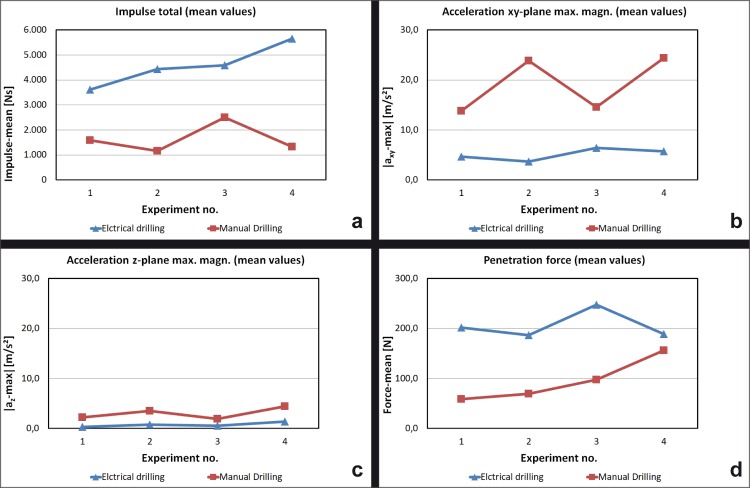
Our experimental study using a manually and an electrically driven skull drill included a total of 40 holes drilled into synthetic biomechanical sheets. Half of the holes were produced with a prototype electrical drilling machine of the company Kaiser Technology and half of them with a traditional manual drill. Different drilling parameters such as the geometry of the borehole, the drilling forces and the drilling vibrations were captured during all experiments.
The electrical drilling needed higher vertical force by the operators and a longer time to penetrate the sheet. A reason was the relatively lower rotational speed provided by this particular drill. When drilling electrically the vibrations were substantially less which in turn led to a more precise shape of the holes (revealed by observation via a microscope).
The electrification of bedside drilling can in principle enable emergency craniostomies to be performed with greater ease and accuracy. The power of the electric drive, however, must be at least equivalent to the power of the traditional manual drill. Otherwise, the vertical forces exerted on the scull by the operator become inhibitive. The challenge is to combine cost-efficiency and re-sterilizability of an electrically driven drilling machine which at the same time is small and simple enough to qualify for emergency applications.
手动颅骨钻孔是一种古老但在现代神经外科中仍然确立的程序,它可以在紧急情况下迅速而普遍地应用。电钻需要更复杂的设备,通常保留在手术室(OR)使用。在床边使用电钻似乎也是可取的,但到目前为止还没有合适的产品。
我们的实验研究使用手动和电动颅骨钻总共在合成生物力学板上钻了 40 个孔。其中一半孔由 Kaiser Technology 公司的原型电钻钻孔,另一半孔由传统的手动钻钻孔。在所有实验中,都捕获了不同的钻孔参数,如孔的几何形状、钻孔力和钻孔振动。
电动钻孔需要操作人员施加更高的垂直力,并需要更长的时间才能穿透板材。原因是这种特殊钻头提供的相对较低的转速。当电动钻孔时,振动明显减少,从而导致孔的形状更精确(通过显微镜观察发现)。
原则上,床边钻孔的电气化可以使紧急颅骨切开术更容易、更精确地进行。然而,电动驱动的功率必须至少与传统手动钻相当。否则,操作人员对颅骨施加的垂直力就会受到抑制。挑战在于结合电动钻孔机的成本效益和可重新消毒性,同时使机器足够小而简单,以满足紧急应用的要求。