Department of Physiology and Toxicology, Institute of Experimental Biology, Faculty of Natural Sciences, Kazimierz Wielki University, Chodkiewicza 30, 85-064 Bydgoszcz, Poland.
Department of Agrotechnology, Faculty of Agriculture and Biotechnology, UTP University of Science and Technology, Kaliskiego 7, 85-796 Bydgoszcz, Poland.
Toxins (Basel). 2019 Apr 17;11(4):228. doi: 10.3390/toxins11040228.
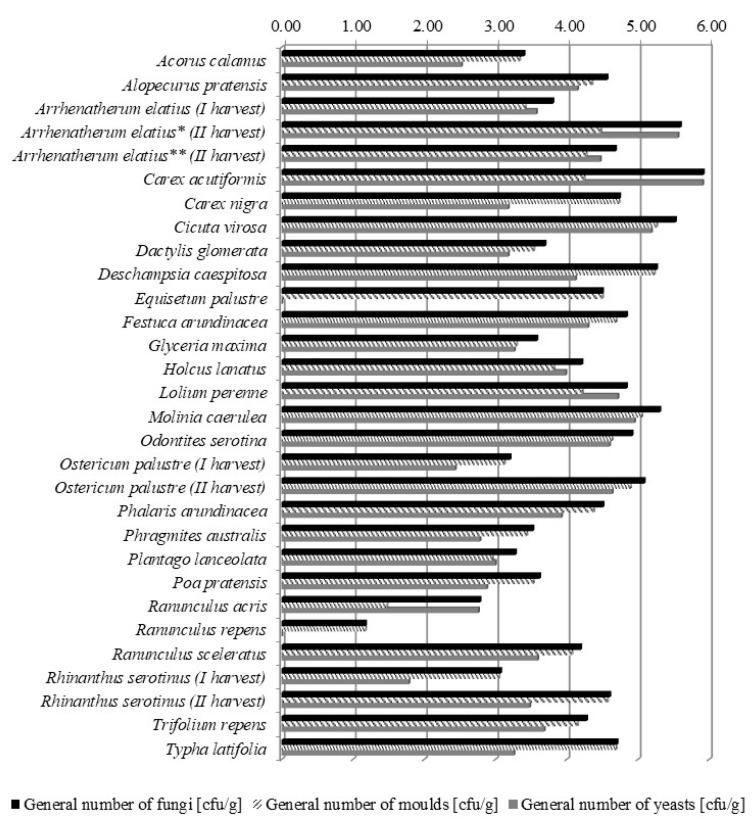
The aim of the study was the evaluation of selected species of meadow plants obtained from the first cut from the area covered by the agri-environmental program 'Natura 2000' in terms of the presence of cytotoxic compounds detected by the MTT test and the level of fungal contamination. The research was carried out on plant species that were evaluated differently in previously used methods for quality assessment of pasture feeds according to Klapp and Filipek. Twenty-six plant species were harvested in 2014 from meadows located in the valley of the Bydgoszcz Canal. Mycological examination of meadow plant samples was carried out according to PN-ISO 7954:1999. Cytotoxicity evaluation was performed using the MTT [3-(4,5-Dimethylthiazol-2-yl)-2,5-diphenyltetrazolium bromide] test. Selected samples were also subjected to evaluation of the endophytes occurrence in grasses using PCR. Natural meadow positions included in the study were dominated by moulds belonging to spp., spp., spp., spp., spp. and spp. The highest level of fungal contamination was observed for Ehrh. The most infested grasses were (L.) P.Beauv., Schreb. and L. The MTT test showed that the most cytotoxic species were (L.) P.Beauv. (IC 1.563 mg/mL) and L. (IC 3.125 mg/mL). Epichloë endophytes were detected in one of 13 examined grass samples. Our own research suggests that previously used feed quality assessments should be verified by introducing modern methods of molecular biology and instrumental analysis. Results of this study may broaden the knowledge of the causes of problems resulting from feeding of roughage, mainly from natural meadows, and help in creating new rankings of the feed value of meadow sward components.
本研究的目的是评估在农业环境计划“Natura 2000”覆盖区域内首次刈割的草地植物中是否存在通过 MTT 试验检测到的细胞毒性化合物和真菌污染水平。该研究基于 Klapp 和 Filipek 之前用于评估牧场饲料质量的不同方法对植物物种进行评估。2014 年,从位于比得哥什运河山谷的草地中收获了 26 种植物。根据 PN-ISO 7954:1999 对草地植物样本进行了真菌学检查。使用 MTT [3-(4,5-二甲基噻唑-2-基)-2,5-二苯基四唑溴盐]试验进行细胞毒性评估。还对选定的样本进行了使用 PCR 评估内生菌在草中的存在情况。包括在研究中的天然草地位置主要由属于 spp.、 spp.、 spp.、 spp.、 spp.和 spp.的霉菌组成。真菌污染程度最高的是 Ehrh. 受感染最严重的草是 (L.) P.Beauv.、 Schreb. 和 L. MTT 试验表明,最具细胞毒性的物种是 (L.) P.Beauv. (IC 1.563 mg/mL)和 L. (IC 3.125 mg/mL)。在 13 个检查的草样本中检测到了一种 Epichloë 内生菌。我们自己的研究表明,应通过引入现代分子生物学和仪器分析方法来验证之前使用的饲料质量评估。本研究的结果可以拓宽对由于粗饲料喂养引起的问题的原因的认识,主要是从天然草地,有助于创建新的草地草丛成分饲料价值排名。