Department of Cancer Control and Population Health, National Cancer Center Graduate School of Cancer Science and Policy, Goyang, Korea.
Center for Breast Cancer, Research Institute and Hospital, National Cancer Center, Goyang, Korea.
Cancer Res Treat. 2019 Oct;51(4):1600-1611. doi: 10.4143/crt.2018.426. Epub 2019 Apr 12.
We aimed to evaluate health-related quality of life (HRQOL) at 1-year post-diagnosis in breast cancer (BC) patients and its association with overall survival using data from the National Cancer Center Hospital.
Data of a BC cohort were first obtained between 2004 and 2006 and followed up. HRQOL was assessed using EORTC QLQ-C30 and BC specific module QLQ-BR23 few days after diagnosis and 1 year after that. We examined and compared the difference in the two HRQOL scores measured for each patient by the patient's current survival status. The Cox proportional hazards model was fitted to evaluate the impact of HRQOL on survival, with adjustment for baseline HRQOL and other factors.
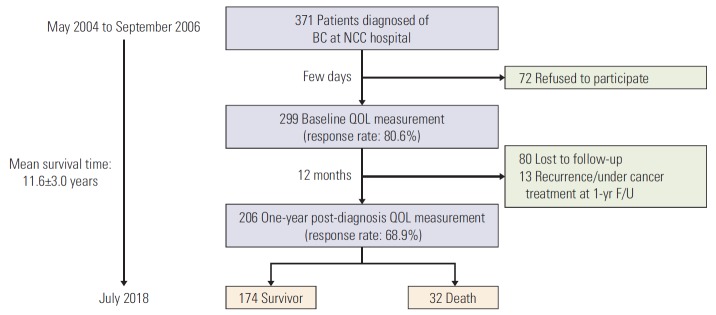
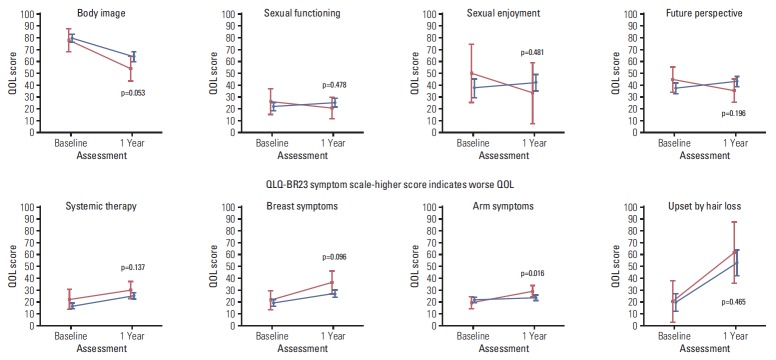
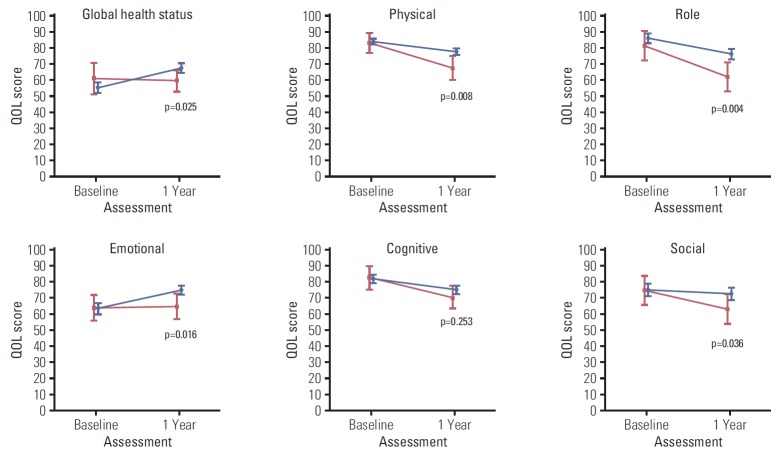
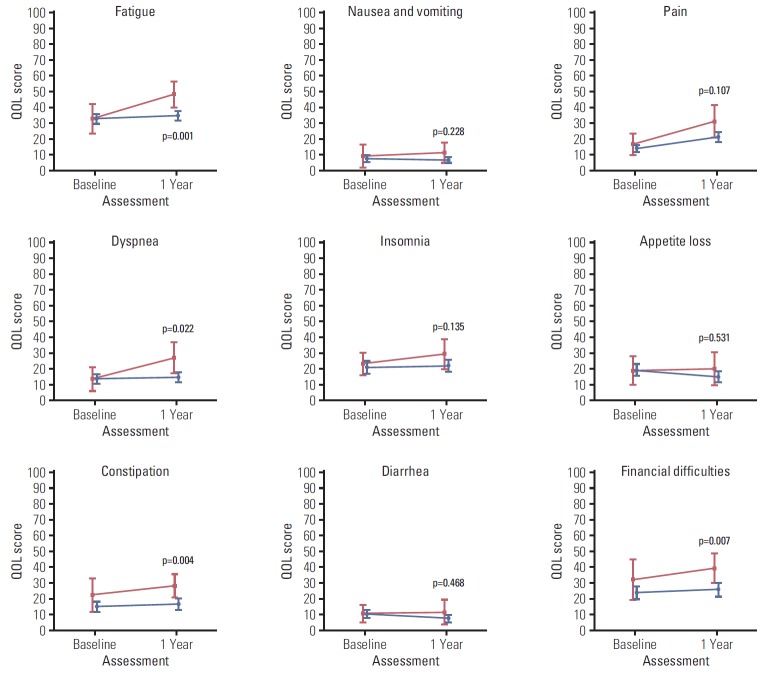
Of 299 enrolled patients, 206 responded at 1-year post-diagnosis (80.6%) and were followed up for 11.6 years on average. At 1-year post-diagnosis, survivors had better HRQOL scores than those who died, although their health status was similar at baseline. Survivors reported significant increase 1 year after diagnosis in global health status and emotional scales. Between the groups, functional scales such as physical, role, and emotional were significantly different. Functional scales, including physical (adjusted hazard ratio [aHR], 0.70), role (aHR, 0.68), emotional (aHR, 0.72), and symptom scales, including fatigue (aHR, 1.34), dyspnea (aHR, 1.29), appetite loss (aHR, 1.24) were significantly associated with overall survival. Patients who were less worried about future health had favorable survival (aHR, 0.83).
Besides treatment-related symptoms, non-medical aspects at 1-year post-diagnosis, including functional well-being and future perspective, are predictive of long-term survival. Intervention to enhance physical, role, and emotional support for women soon after their BC diagnosis might help to improve disease survival outcomes afterwards.
我们旨在使用国家癌症中心医院的数据评估乳腺癌(BC)患者诊断后 1 年的健康相关生活质量(HRQOL)及其与总生存的关系。
首先在 2004 年至 2006 年间获得 BC 队列的数据,并进行随访。在诊断后几天和 1 年后使用 EORTC QLQ-C30 和 BC 特定模块 QLQ-BR23 评估 HRQOL。我们检查并比较了根据患者当前生存状况测量的每位患者的两个 HRQOL 评分之间的差异。使用 Cox 比例风险模型评估 HRQOL 对生存的影响,同时调整基线 HRQOL 和其他因素。
在 299 名入组患者中,206 名在诊断后 1 年时应答(80.6%),平均随访 11.6 年。在诊断后 1 年时,幸存者的 HRQOL 评分优于死亡者,尽管他们的健康状况在基线时相似。幸存者在诊断后 1 年报告了全球健康状况和情绪量表的显著改善。在两组之间,功能量表(如身体、角色和情感)存在显著差异。功能量表,包括身体(调整后的危险比[aHR],0.70)、角色(aHR,0.68)、情感(aHR,0.72),以及症状量表,包括疲劳(aHR,1.34)、呼吸困难(aHR,1.29)、食欲减退(aHR,1.24)与总生存显著相关。对未来健康担忧较少的患者具有较好的生存(aHR,0.83)。
除了与治疗相关的症状外,诊断后 1 年的非医学方面,包括功能健康和未来展望,是长期生存的预测因素。在 BC 诊断后不久对女性进行身体、角色和情感支持的干预可能有助于改善疾病的生存结果。