Department of Biomedical Engineering, Johns Hopkins University School of Medicine, 720 Rutland Ave, Suite 726 Ross Building, Baltimore, MD, 21205, USA.
J Cardiovasc Magn Reson. 2019 Apr 18;21(1):23. doi: 10.1186/s12968-019-0533-8.
Numerous self-gated cardiac imaging techniques have been reported in the literature. Most can track either cardiac or respiratory motion, and many incur some overhead to imaging data acquisition. We previously described a Cartesian cine imaging technique, pseudo-projection motion tracking with golden-step phase encoding, capable of tracking both cardiac and respiratory motion at no cost to imaging data acquisition. In this work, we describe improvements to the technique by dramatically reducing its vulnerability to eddy current and flow artifacts and demonstrating its effectiveness in expanded cardiovascular applications.
As with our previous golden-step technique, the Cartesian phase encodes over time were arranged based on the integer golden step, and readouts near k = 0 (pseudo-projections) were used to derive motion. In this work, however, the readouts were divided into equal and consecutive temporal segments, within which the readouts were sorted according to k. The sorting reduces the phase encode jump between consecutive readouts while maintaining the pseudo-randomness of k to sample both cardiac and respiratory motion without comprising the ability to retrospectively set the temporal resolution of the original technique. On human volunteers, free-breathing, electrocardiographic (ECG)-free cine scans were acquired for all slices of the short axis stack and the 4-chamber view of the long axis. Retrospectively, cardiac motion and respiratory motion were automatically extracted from the pseudo-projections to guide cine reconstruction. The resultant image quality in terms of sharpness and cardiac functional metrics was compared against breath-hold ECG-gated reference cines.
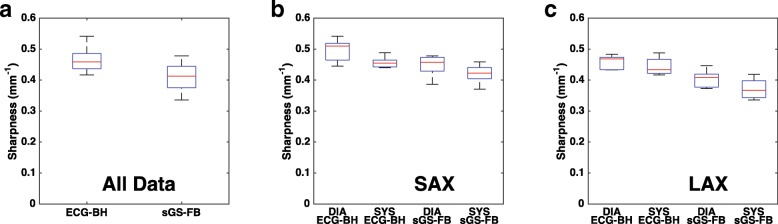
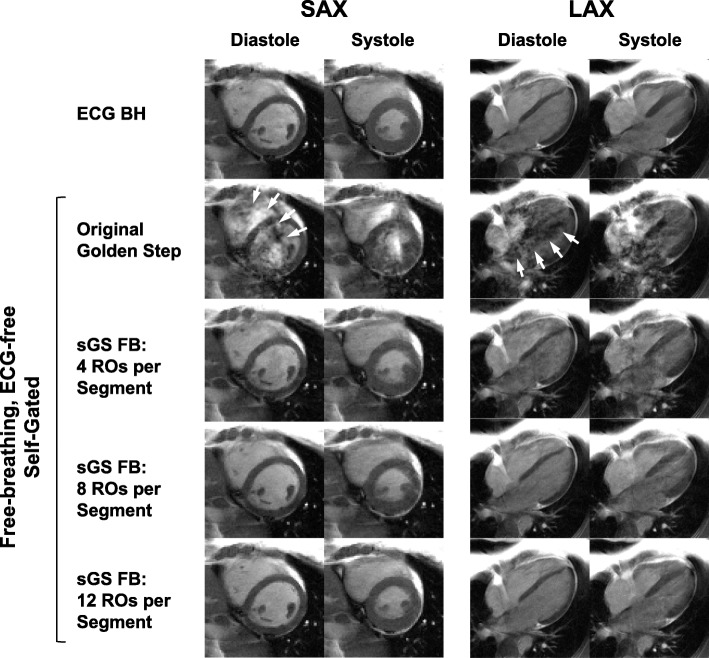
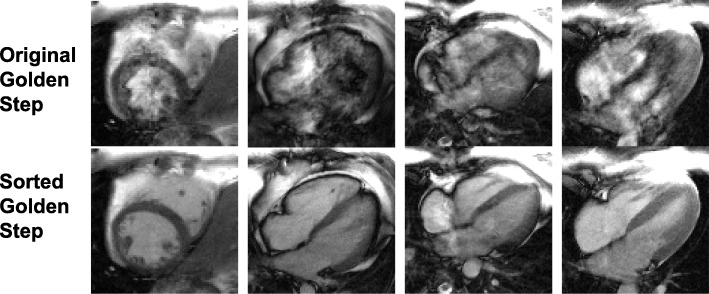
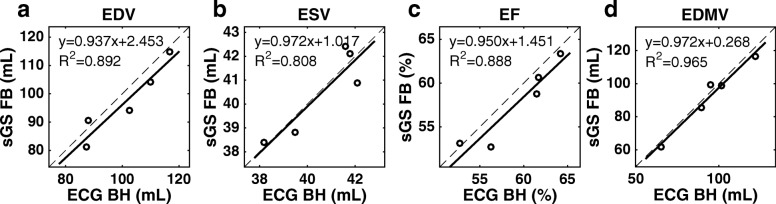
With sorting, motion tracking of both cardiac and respiratory motion was effective for all slices orientations imaged, and artifact occurrence due to eddy current and flow was efficiently eliminated. The image sharpness derived from the self-gated cines was found to be comparable to the reference cines (mean difference less than 0.05 mm for short-axis images and 0.075 mm for long-axis images), and the functional metrics (mean difference < 4 ml) were found not to be statistically different from those from the reference.
This technique dramatically reduced the eddy current and flow artifacts while preserving the ability of cost-free motion tracking and the flexibility of choosing arbitrary navigator zone width, number of cardiac phases, and duration of scanning. With the restriction of the artifacts removed, the Cartesian golden-step cine imaging can now be applied to cardiac imaging slices of more diverse orientation and anatomy at greater reliability.
文献中报道了许多心脏成像的自门控技术。大多数技术可以跟踪心脏或呼吸运动,其中许多技术会增加成像数据采集的开销。我们之前描述了一种笛卡尔电影成像技术,即具有黄金阶相位编码的伪投影运动跟踪技术,该技术可以在不增加成像数据采集开销的情况下跟踪心脏和呼吸运动。在这项工作中,我们通过极大地降低其对涡流和流动伪影的敏感性,并展示其在扩展心血管应用中的有效性,对该技术进行了改进。
与我们之前的黄金阶技术一样,随时间变化的笛卡尔相位编码基于整数黄金阶排列,并且使用接近 k = 0 的读出(伪投影)来推导运动。然而,在这项工作中,读出被分成相等且连续的时间段,在这些时间段内,根据 k 对读出进行排序。排序减小了连续读出之间的相位编码跳跃,同时保持了 k 的伪随机性,从而无需牺牲原始技术的时间分辨率来同时采样心脏和呼吸运动,而无需牺牲原始技术的时间分辨率。在健康志愿者中,使用无心电图(ECG)的自由呼吸电影扫描获取短轴堆栈的所有切片和长轴的 4 腔视图。回顾性地,从伪投影中自动提取心脏运动和呼吸运动以指导电影重建。根据清晰度和心脏功能指标来比较来自自门控电影的图像质量。
使用排序后,对所有成像切片的心脏和呼吸运动的运动跟踪都是有效的,并且有效地消除了由于涡流和流动引起的伪影。发现源自自门控电影的图像清晰度可与参考电影相媲美(短轴图像的平均差异小于 0.05 毫米,长轴图像的平均差异小于 0.075 毫米),并且功能指标(平均差异小于 4 毫升)在统计学上与参考值没有差异。
该技术极大地降低了涡流和流动伪影的影响,同时保留了免费运动跟踪的能力以及选择任意导航区宽度、心脏相位数量和扫描持续时间的灵活性。随着限制伪影的消除,笛卡尔黄金阶电影成像现在可以更可靠地应用于更广泛方向和解剖结构的心脏成像切片。