Department of Electrical Engineering and Information Technology, Otto-von-Guericke University, Magdeburg, Germany.
J Cardiovasc Magn Reson. 2013 Nov 19;15(1):104. doi: 10.1186/1532-429X-15-104.
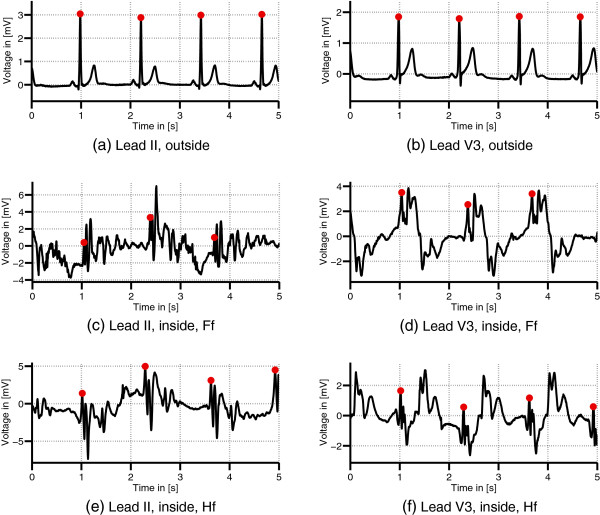
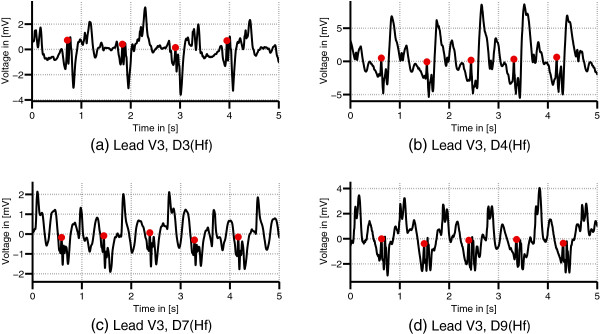
In Cardiovascular Magnetic Resonance (CMR), the synchronization of image acquisition with heart motion is performed in clinical practice by processing the electrocardiogram (ECG). The ECG-based synchronization is well established for MR scanners with magnetic fields up to 3 T. However, this technique is prone to errors in ultra high field environments, e.g. in 7 T MR scanners as used in research applications. The high magnetic fields cause severe magnetohydrodynamic (MHD) effects which disturb the ECG signal. Image synchronization is thus less reliable and yields artefacts in CMR images.
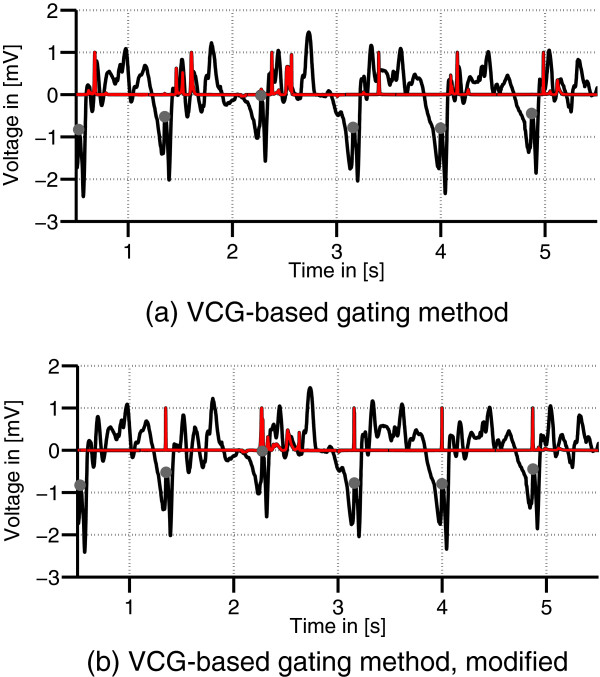
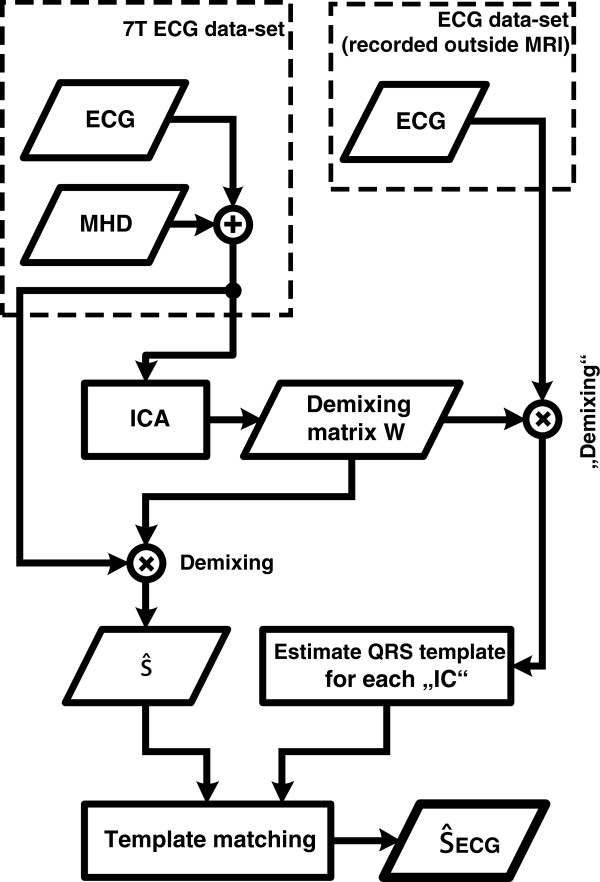
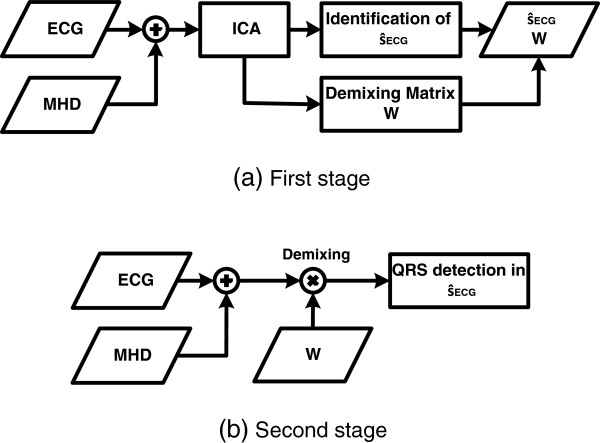
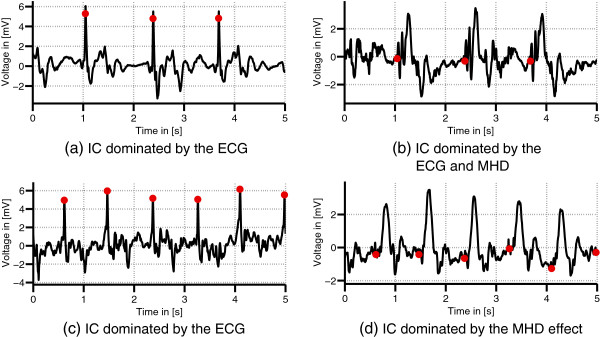
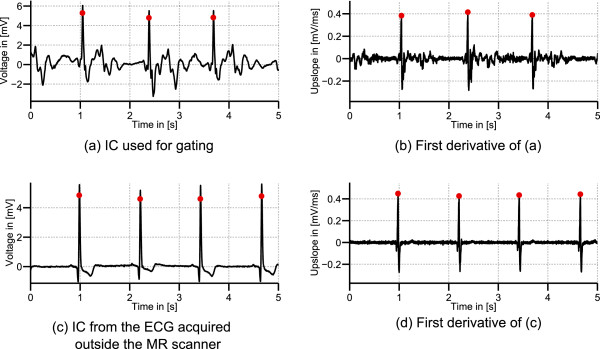
A strategy based on Independent Component Analysis (ICA) was pursued in this work to enhance the ECG contribution and attenuate the MHD effect. ICA was applied to 12-lead ECG signals recorded inside a 7 T MR scanner. An automatic source identification procedure was proposed to identify an independent component (IC) dominated by the ECG signal. The identified IC was then used for detecting the R-peaks. The presented ICA-based method was compared to other R-peak detection methods using 1) the raw ECG signal, 2) the raw vectorcardiogram (VCG), 3) the state-of-the-art gating technique based on the VCG, 4) an updated version of the VCG-based approach and 5) the ICA of the VCG.
ECG signals from eight volunteers were recorded inside the MR scanner. Recordings with an overall length of 87 min accounting for 5457 QRS complexes were available for the analysis. The records were divided into a training and a test dataset. In terms of R-peak detection within the test dataset, the proposed ICA-based algorithm achieved a detection performance with an average sensitivity (Se) of 99.2%, a positive predictive value (+P) of 99.1%, with an average trigger delay and jitter of 5.8 ms and 5.0 ms, respectively. Long term stability of the demixing matrix was shown based on two measurements of the same subject, each being separated by one year, whereas an averaged detection performance of Se = 99.4% and +P = 99.7% was achieved.Compared to the state-of-the-art VCG-based gating technique at 7 T, the proposed method increased the sensitivity and positive predictive value within the test dataset by 27.1% and 42.7%, respectively.
The presented ICA-based method allows the estimation and identification of an IC dominated by the ECG signal. R-peak detection based on this IC outperforms the state-of-the-art VCG-based technique in a 7 T MR scanner environment.
在心血管磁共振(CMR)中,通过处理心电图(ECG)来实现图像采集与心脏运动的同步。基于 ECG 的同步在磁场高达 3T 的磁共振扫描仪中得到了很好的应用。然而,这种技术在超高磁场环境中容易出现错误,例如在研究应用中使用的 7T 磁共振扫描仪中。高磁场会引起严重的磁流体动力学(MHD)效应,从而干扰 ECG 信号。因此,图像同步的可靠性降低,并在 CMR 图像中产生伪影。
本工作采用基于独立分量分析(ICA)的策略来增强 ECG 贡献并衰减 MHD 效应。ICA 应用于在 7T 磁共振扫描仪内记录的 12 导联 ECG 信号。提出了一种自动源识别程序,用于识别由 ECG 信号主导的独立分量(IC)。然后,使用识别出的 IC 来检测 R 波峰。将基于 ICA 的方法与其他 R 波峰检测方法进行了比较,这些方法包括 1)原始 ECG 信号,2)原始向量心电图(VCG),3)基于 VCG 的最新门控技术,4)基于 VCG 的方法的更新版本和 5)VCG 的 ICA。
从八名志愿者体内在磁共振扫描仪内记录了 ECG 信号。可用于分析的记录总长度为 87 分钟,包含 5457 个 QRS 波群。记录被分为训练数据集和测试数据集。在测试数据集内的 R 波峰检测方面,所提出的基于 ICA 的算法实现了平均灵敏度(Se)为 99.2%、阳性预测值(+P)为 99.1%的检测性能,平均触发延迟和抖动分别为 5.8ms 和 5.0ms。基于同一受试者的两次测量(每次测量相隔一年)显示了去混合矩阵的长期稳定性,而平均检测性能为 Se=99.4%和+P=99.7%。与 7T 时的最新 VCG 门控技术相比,所提出的方法将测试数据集内的灵敏度和阳性预测值分别提高了 27.1%和 42.7%。
所提出的基于 ICA 的方法允许对由 ECG 信号主导的 IC 进行估计和识别。基于此 IC 的 R 波峰检测在 7T 磁共振扫描仪环境中的性能优于最新的 VCG 技术。