School of Public Health, Hawassa University, Hawassa, Ethiopia.
Department of Preventive Medicine, School of Public Health, Addis Ababa University, Addis Ababa, Ethiopia.
Malar J. 2019 Apr 18;18(1):141. doi: 10.1186/s12936-019-2775-1.
Conflicting results exist on the added benefit of combining long-lasting insecticidal nets (LLINs) with indoor residual spraying (IRS) to control malaria infection. The main study objective was to evaluate whether the combined use of LLINs and IRS with propoxur provides additional protection against Plasmodium falciparum and/or Plasmodium vivax among all age groups compared to LLINs or IRS alone.
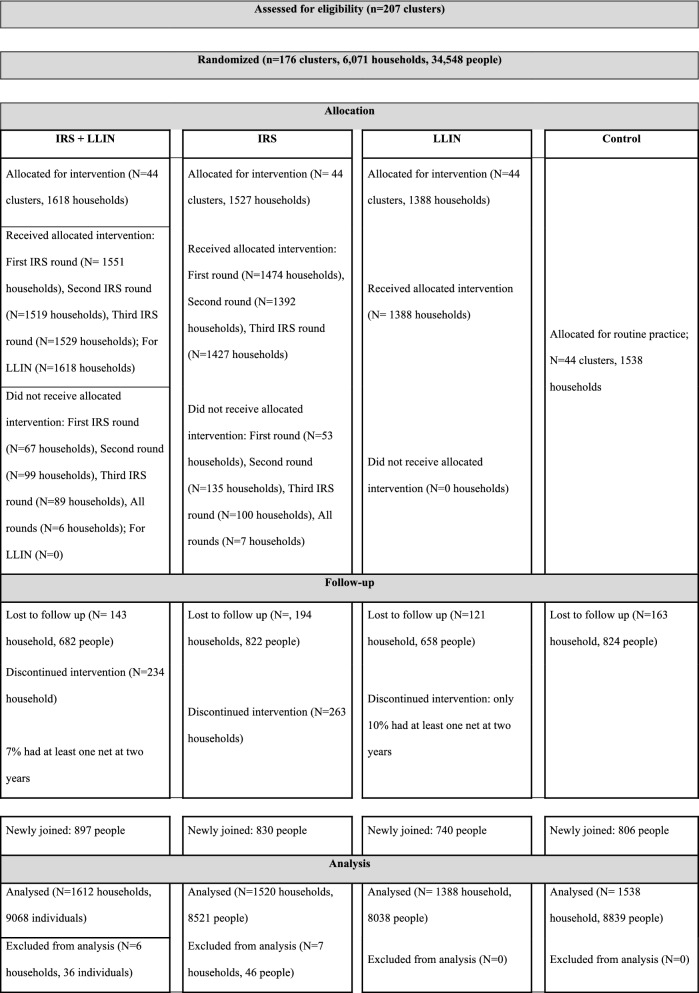
This cluster-randomized, controlled trial was conducted in the Rift Valley area of Ethiopia from September 2014 to January 2017 (121 weeks); 44 villages were allocated to each of four study arms: LLIN + IRS, IRS, LLIN, and control. Each week, 6071 households with 34,548 persons were surveyed by active and passive case detection for clinical malaria. Primary endpoints were the incidence of clinical malaria and anaemia prevalence.
During the study, 1183 malaria episodes were identified, of which 55.1% were P. falciparum and 25.3% were P. vivax, and 19.6% were mixed infections of P. falciparum and P. vivax. The overall malaria incidence was 16.5 per 1000 person-years of observation time (PYO), and similar in the four arms with 17.2 per 1000 PYO in the LLIN + IRS arm, 16.1 in LLIN, 17.0 in IRS, and 15.6 in the control arm. There was no significant difference in risk of anaemia among the trial arms.
The clinical malaria incidence and anaemia prevalence were similar in the four study groups. In areas with low malaria incidence, using LLINs and IRS in combination or alone may not eliminate malaria. Complementary interventions that reduce residual malaria transmission should be explored in addition to LLINs and IRS to further reduce malaria transmission in such settings. Trial registration PACTR201411000882128 (08 September 2014).
关于长效杀虫蚊帐(LLINs)与室内滞留喷洒(IRS)联合使用控制疟疾感染的额外益处,目前结果相互矛盾。主要研究目的是评估与单独使用 LLINs 或 IRS 相比,在所有年龄段人群中,使用丙体六六六处理的 LLINs 和 IRS 联合使用是否能提供针对恶性疟原虫和/或间日疟原虫的额外保护。
本项在 2014 年 9 月至 2017 年 1 月(121 周)期间于埃塞俄比亚裂谷地区进行的一项群组随机对照试验,将 44 个村庄分配到四个研究臂中:LLIN+IRS、IRS、LLIN 和对照组。每周通过主动和被动病例检测对 6071 户家庭中的 34548 人进行临床疟疾调查。主要终点是临床疟疾的发病率和贫血患病率。
研究期间共发现 1183 例疟疾病例,其中 55.1%为恶性疟原虫,25.3%为间日疟原虫,19.6%为恶性疟原虫和间日疟原虫混合感染。总的疟疾发病率为每 1000 人观察年 16.5 例(1000 PYO),四个臂之间相似,LLIN+IRS 臂为每 1000 PYO 17.2 例,LLIN 为 16.1 例,IRS 为 17.0 例,对照组为 15.6 例。试验组之间的贫血风险无显著差异。
四个研究组的临床疟疾发病率和贫血患病率相似。在疟疾发病率较低的地区,单独或联合使用 LLINs 和 IRS 可能无法消除疟疾。应探索除 LLINs 和 IRS 之外的减少残留疟疾传播的补充干预措施,以进一步降低此类地区的疟疾传播。试验注册 PACTR201411000882128(2014 年 8 月 8 日)。