Laboratory Phy-Os, Inserm UMR1238, University of Nantes, Nantes, France.
Harvard School of Engineering and Applied Sciences, Harvard University, Cambridge, MA, United States.
Front Immunol. 2019 Apr 2;10:663. doi: 10.3389/fimmu.2019.00663. eCollection 2019.
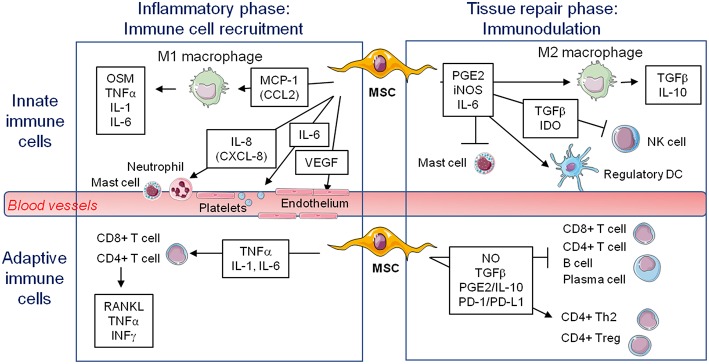
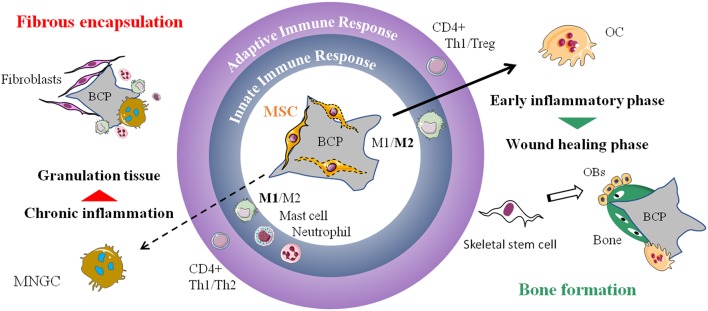
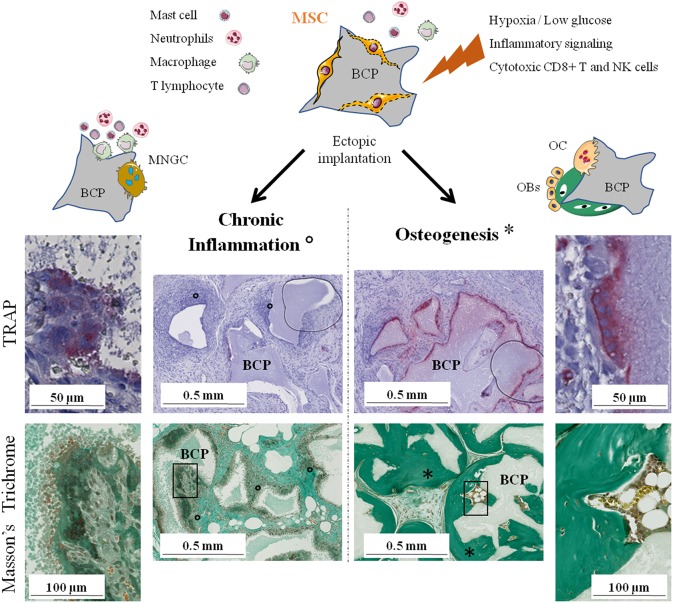
A wide variety of biomaterials have been developed as both stabilizing structures for the injured bone and inducers of bone neoformation. They differ in chemical composition, shape, porosity, and mechanical properties. The most extensively employed and studied subset of bioceramics are calcium phosphate materials (CaPs). These materials, when transplanted alongside mesenchymal stem cells (MSCs), lead to ectopic (intramuscular and subcutaneous) and orthotopic bone formation in preclinical studies, and effective fracture healing in clinical trials. Human MSC transplantation in pre-clinical and clinical trials reveals very low engraftment in spite of successful clinical outcomes and their therapeutic actions are thought to be primarily through paracrine mechanisms. The beneficial role of transplanted MSC could rely on their strong immunomodulatory effect since, even without long-term engraftment, they have the ability to alter both the innate and adaptive immune response which is critical to facilitate new bone formation. This study presents the current knowledge of the immune response to the implantation of CaP biomaterials alone or in combination with MSC. In particular the central role of monocyte-derived cells, both macrophages and osteoclasts, in MSC-CaP mediated bone formation is emphasized. Biomaterial properties, such as macroporosity and surface microstructure, dictate the host response, and the ultimate bone healing cascade. Understanding intercellular communications throughout the inflammation, its resolution and the bone regeneration phase, is crucial to improve the current therapeutic strategies or develop new approaches.
已经开发出了各种各样的生物材料,它们既可以作为受伤骨骼的稳定结构,也可以作为诱导新骨形成的材料。它们在化学成分、形状、孔隙率和机械性能方面存在差异。生物陶瓷中应用最广泛和研究最多的子集是磷酸钙材料(CaPs)。在临床前研究中,这些材料与间充质干细胞(MSCs)一起移植,可导致异位(肌肉内和皮下)和原位骨形成,在临床试验中可有效促进骨折愈合。尽管临床效果良好,但人类 MSC 移植在临床前和临床试验中的植入率非常低,其治疗作用被认为主要通过旁分泌机制发挥。移植 MSC 的有益作用可能依赖于其强大的免疫调节作用,因为即使没有长期植入,它们也有能力改变固有免疫和适应性免疫反应,这对于促进新骨形成至关重要。本研究介绍了单独植入 CaP 生物材料或与 MSC 联合植入时对免疫反应的现有认识。特别是强调了单核细胞衍生细胞(巨噬细胞和破骨细胞)在 MSC-CaP 介导的骨形成中的核心作用。生物材料特性,如大孔率和表面微观结构,决定了宿主反应和最终的骨愈合级联。了解炎症、炎症消退和骨再生阶段的细胞间通讯对于改进现有的治疗策略或开发新方法至关重要。