Lim Hyun, Heo Moon Young, Kim Hyun Pyo
College of Pharmacy, Kangwon National University, Chuncheon 24341, Republic of Korea.
Biomol Ther (Seoul). 2019 May 1;27(3):241-253. doi: 10.4062/biomolther.2019.034.
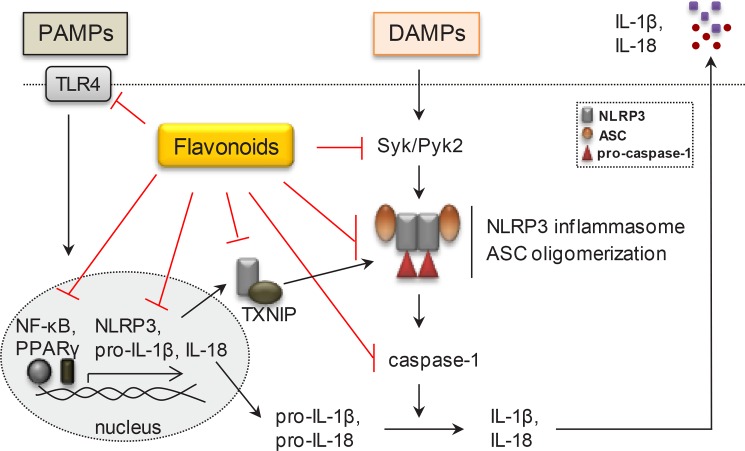
Flavonoids are major plant constituents with numerous biological/pharmacological actions both and . Of these actions, their anti-inflammatory action is prominent. They can regulate transcription of many proinflammatory genes such as cyclooxygenase- 2/inducible nitric oxide synthase and many cytokines/chemokines. Recent studies have demonstrated that certain flavonoid derivatives can affect pathways of inflammasome activation and autophagy. Certain flavonoids can also accelerate the resolution phase of inflammation, leading to avoiding chronic inflammatory stimuli. All these pharmacological actions with newly emerging activities render flavonoids to be potential therapeutics for chronic inflammatory disorders including arthritic inflammation, meta-inflammation, and inflammaging. Recent findings of flavonoids are summarized and future perspectives are presented in this review.
黄酮类化合物是主要的植物成分,具有多种生物学/药理学作用。在这些作用中,它们的抗炎作用尤为突出。它们可以调节许多促炎基因的转录,如环氧化酶-2/诱导型一氧化氮合酶以及许多细胞因子/趋化因子。最近的研究表明,某些黄酮类衍生物可以影响炎性小体激活和自噬的途径。某些黄酮类化合物还可以加速炎症的消退阶段,从而避免慢性炎症刺激。所有这些具有新出现活性的药理学作用使黄酮类化合物成为治疗包括关节炎炎症、代谢性炎症和炎症衰老在内的慢性炎症性疾病的潜在药物。本文综述了黄酮类化合物的最新研究成果并展望了未来前景。