Mozgunov Pavel, Jaki Thomas
Lancaster University UK.
J R Stat Soc Ser C Appl Stat. 2019 Feb;68(2):347-367. doi: 10.1111/rssc.12293. Epub 2018 Jun 15.
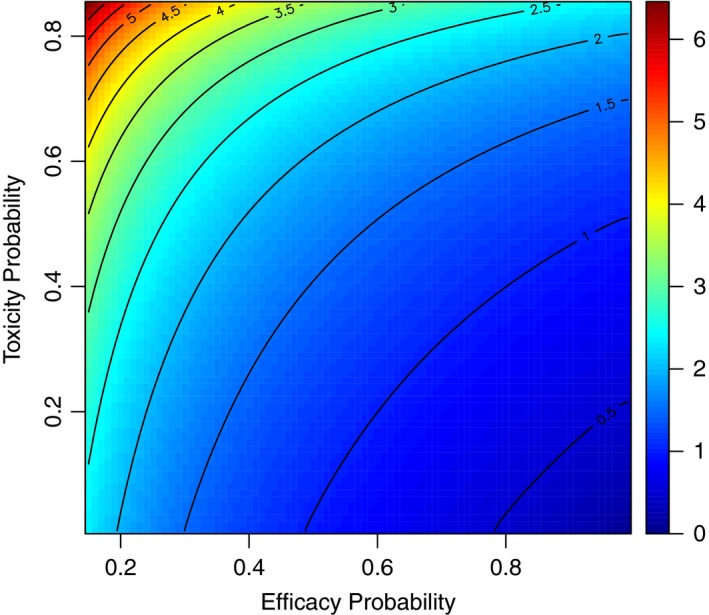
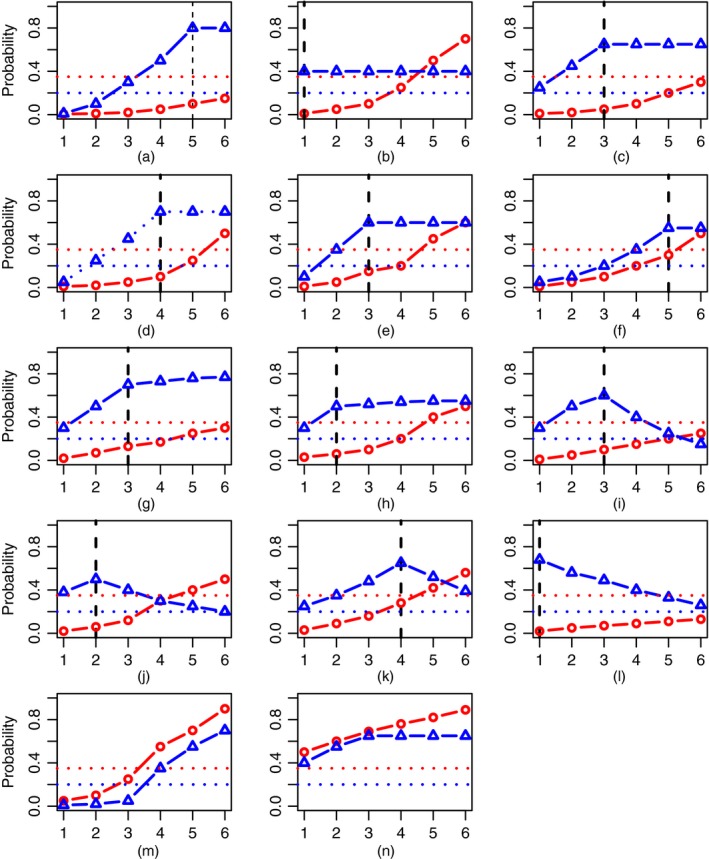
For many years phase I and phase II clinical trials have been conducted separately, but there has been a recent shift to combine these phases. Although a variety of phase I-II model-based designs for cytotoxic agents have been proposed in the literature, methods for molecularly targeted agents (TAs) are just starting to develop. The main challenge of the TA setting is the unknown dose-efficacy relationship that can have either an increasing, plateau or umbrella shape. To capture these, approaches with more parameters are needed or, alternatively, more orderings are required to account for the uncertainty in the dose-efficacy relationship. As a result, designs for more complex clinical trials, e.g. trials looking at schedules of a combination treatment involving TAs, have not been extensively studied yet. We propose a novel regimen finding design which is based on a derived efficacy-toxicity trade-off function. Because of its special properties, an accurate regimen selection can be achieved without any parametric or monotonicity assumptions. We illustrate how this design can be applied in the context of a complex combination-schedule clinical trial. We discuss practical and ethical issues such as coherence, delayed and missing efficacy responses, safety and futility constraints.
多年来,I期和II期临床试验都是分开进行的,但最近出现了将这两个阶段合并的趋势。尽管文献中已经提出了多种基于模型的细胞毒性药物I-II期设计方法,但分子靶向药物(TAs)的方法才刚刚开始发展。TA环境的主要挑战是未知的剂量-疗效关系,这种关系可能呈上升、平台或伞形。为了捕捉这些关系,需要更多参数的方法,或者需要更多的排序来考虑剂量-疗效关系的不确定性。因此,针对更复杂临床试验的设计,例如研究涉及TA的联合治疗方案的试验,尚未得到广泛研究。我们提出了一种基于导出的疗效-毒性权衡函数的新型方案寻找设计。由于其特殊性质,无需任何参数或单调性假设就能实现准确的方案选择。我们说明了这种设计如何应用于复杂的联合方案临床试验。我们讨论了一致性、延迟和缺失疗效反应、安全性和无效性限制等实际和伦理问题。