Buser Thomas, Gerhards Leonie, van der Weele Joël
1Tinbergen Institute, University of Amsterdam, Amsterdam, Netherlands.
2University of Hamburg, Hamburg, Germany.
J Risk Uncertain. 2018;56(2):165-192. doi: 10.1007/s11166-018-9277-3. Epub 2018 May 10.
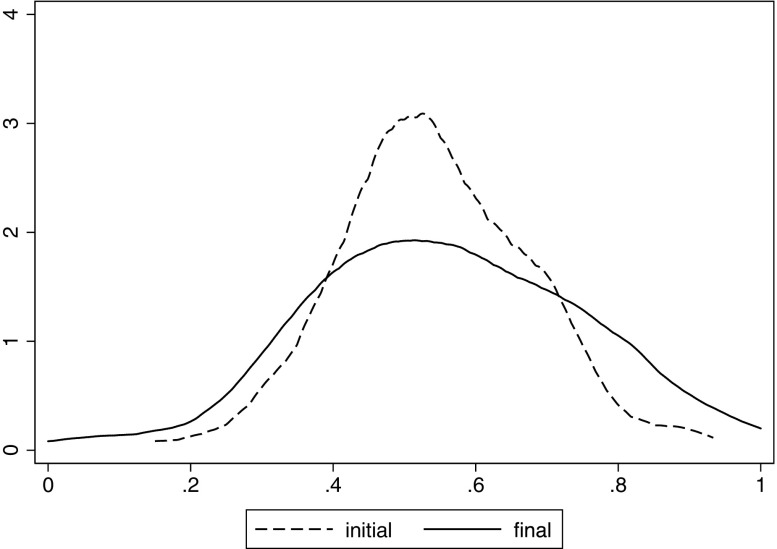
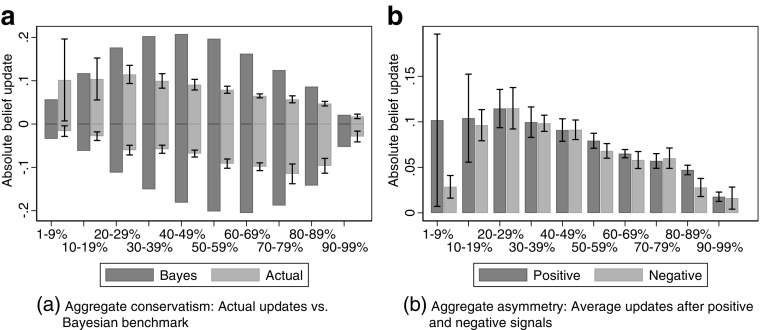
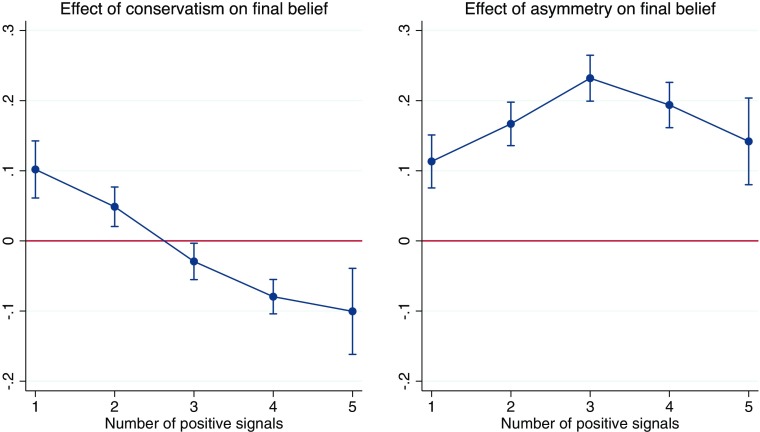
We investigate individual heterogeneity in the tendency to under-respond to feedback ("conservatism") and to respond more strongly to positive compared to negative feedback ("asymmetry"). We elicit beliefs about relative performance after repeated rounds of feedback across a series of cognitive tests. Relative to a Bayesian benchmark, we find that subjects update on average conservatively but not asymmetrically. We define individual measures of conservatism and asymmetry relative to the average subject, and show that these measures explain an important part of the variation in beliefs and competition entry decisions. Relative conservatism is correlated across tasks and predicts competition entry both independently of beliefs and by influencing beliefs, suggesting it can be considered a personal trait. Relative asymmetry is less stable across tasks, but predicts competition entry by increasing self-confidence. Ego-relevance of the task correlates with relative conservatism but not relative asymmetry.
我们研究了个体在对反馈反应不足(“保守主义”)以及对积极反馈比对消极反馈反应更强烈(“不对称性”)倾向方面的异质性。我们通过一系列认知测试中的多轮反馈来引出关于相对表现的信念。相对于贝叶斯基准,我们发现受试者平均更新较为保守,但并非不对称。我们相对于平均受试者定义了保守主义和不对称性的个体度量,并表明这些度量解释了信念和竞争进入决策变化的重要部分。相对保守主义在不同任务之间具有相关性,并且独立于信念并通过影响信念来预测竞争进入,这表明它可被视为一种个人特质。相对不对称性在不同任务之间不太稳定,但通过增强自信心来预测竞争进入。任务的自我相关性与相对保守主义相关,但与相对不对称性无关。