Patel Samir, Arya Vandana, Saraf Amrita, Bhargava Manorama, Agrawal C S
Department of Neurology, Sir Ganga Ram Hospital, New Delhi, India.
Department of Hematology, Sir Ganga Ram Hospital, New Delhi, India.
Ann Indian Acad Neurol. 2019 Apr-Jun;22(2):147-152. doi: 10.4103/aian.AIAN_4_18.
Antiplatelet resistance is one of the urgent issues in current stroke care. One-third to one-half of the patients who experience a recurrent stroke is already on antiplatelet medications. We studied resistance to aspirin and clopidogrel in Indian stroke patients and its association with gene polymorphisms.
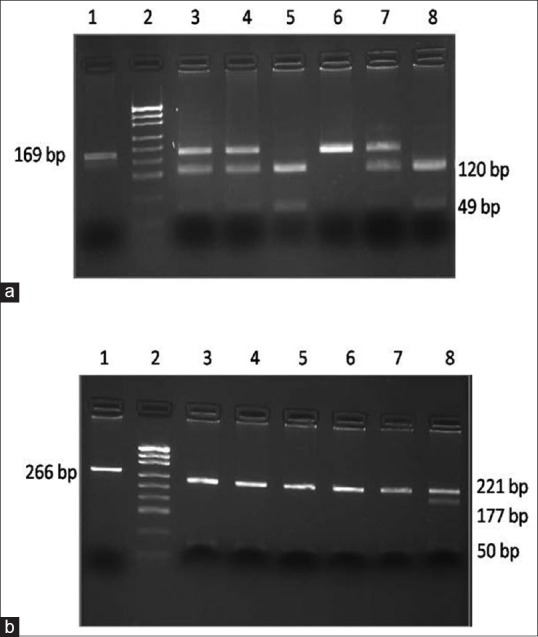
Platelet function testing by light transmission aggregometry was performed on 65 patients with ischemic stroke who were stable on dual antiplatelet therapy (clopidogrel 75 mg OD and aspirin 75 mg OD) along with 65 age-matched controls. Aspirin resistance was considered as mean platelet aggregation ≥70% with 10 μM adenosine diphosphate (ADP) and ≥20% with 0.75 mM arachidonic acid. Clopidogrel resistance was defined as <10% decrease from the baseline in platelet aggregation in response to ADP 10 μM and semi-response as <30% decrease from the baseline. Polymorphisms CYP2C19 * 2 and GPIIb/IIIa (PLA1/A2) were genotyped by polymerase chain reaction-restriction fragment length polymorphism.
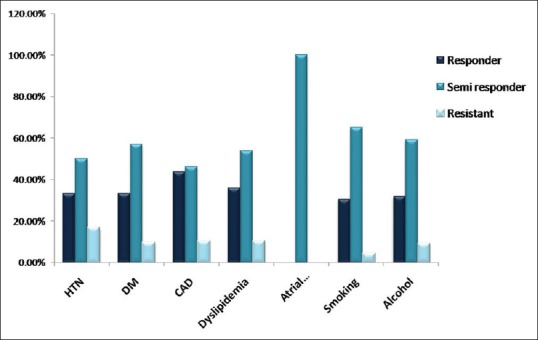
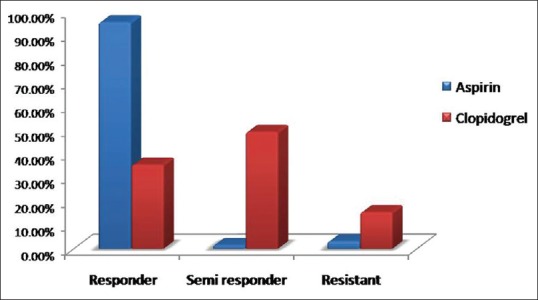
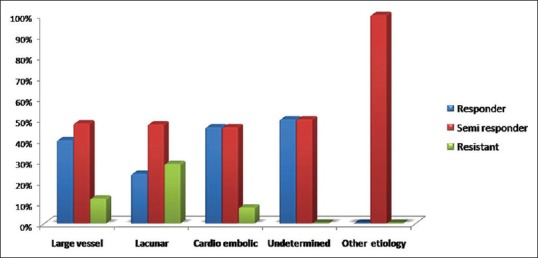
We found 64.6% (42/65) patients with inadequate response to clopidogrel (15.4% [10/65] resistant and 49.2% [32/65] semi-responders) and 4.6% (3/65) patients with inadequate response to aspirin (3.1% [2/65] resistant and 1.5% [1/65] semi-responder). The frequency of CYP2C19*2 mutant genotype was significantly higher in clopidogrel nonresponders compared to responders ( = 0.014). Clopidogrel nonresponsiveness was much higher in small vessel stroke.
Unlike aspirin, a high proportion of nonresponders to clopidogrel was identified. In an interim analysis on 65 Indian patients, a significant association was found between CYP2C19*2 and clopidogrel nonresponsiveness.
抗血小板药物抵抗是当前卒中治疗中的紧迫问题之一。三分之一至二分之一经历复发性卒中的患者已经在服用抗血小板药物。我们研究了印度卒中患者对阿司匹林和氯吡格雷的抵抗情况及其与基因多态性的关联。
对65例接受双重抗血小板治疗(氯吡格雷75mg每日一次和阿司匹林75mg每日一次)且病情稳定的缺血性卒中患者以及65例年龄匹配的对照者进行光透射聚集法血小板功能检测。阿司匹林抵抗定义为用10μM二磷酸腺苷(ADP)时平均血小板聚集率≥70%,用0.75mM花生四烯酸时≥20%。氯吡格雷抵抗定义为对10μM ADP反应时血小板聚集率较基线下降<10%,半反应为较基线下降<30%。通过聚合酶链反应-限制性片段长度多态性对CYP2C19*2和糖蛋白IIb/IIIa(PLA1/A2)基因多态性进行基因分型。
我们发现64.6%(42/65)的患者对氯吡格雷反应不足(15.4%[10/65]为抵抗,49.2%[32/65]为半反应者),4.6%(3/65)的患者对阿司匹林反应不足(3.1%[2/65]为抵抗,1.5%[1/65]为半反应者)。与反应者相比,氯吡格雷无反应者中CYP2C19*2突变基因型的频率显著更高(P = 0.014)。小血管卒中患者中氯吡格雷无反应性更高。
与阿司匹林不同,我们发现有很大比例的患者对氯吡格雷无反应。在对65例印度患者的中期分析中,发现CYP2C19*2与氯吡格雷无反应性之间存在显著关联。