Holder Amanda J, McCalmont Jon P, Rowe Rebecca, McNamara Niall P, Elias Dafydd, Donnison Iain S
Institute of Biological, Environmental and Rural Sciences (IBERS) Aberystwyth University Aberystwyth, Wales UK.
College of Life and Environmental Sciences University of Exeter Exeter UK.
Glob Change Biol Bioenergy. 2019 Mar;11(3):539-549. doi: 10.1111/gcbb.12570. Epub 2018 Oct 24.
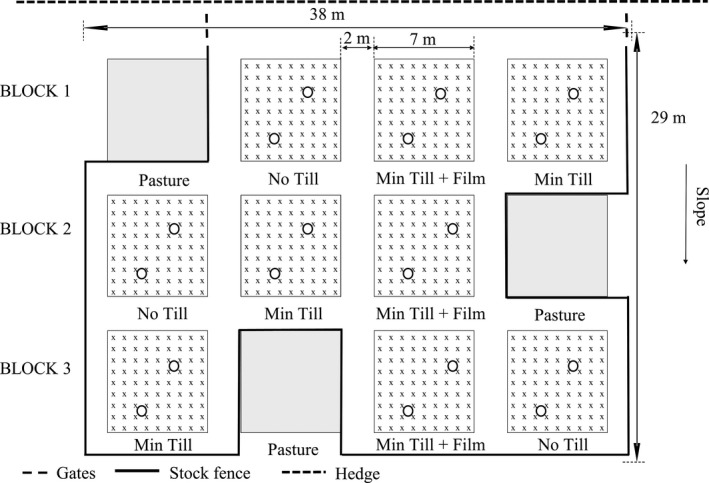
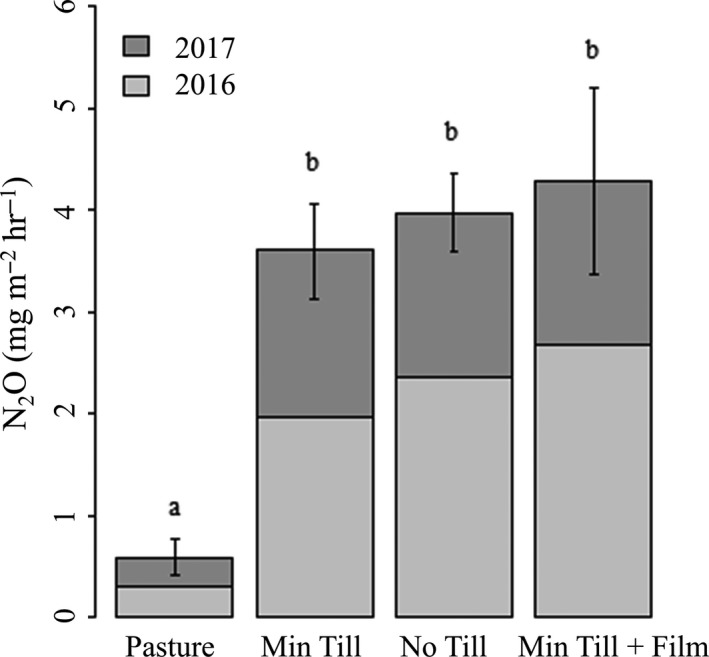
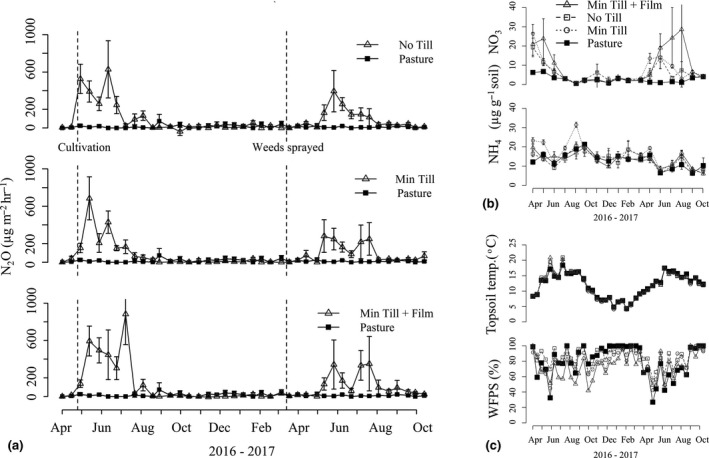
An increase in renewable energy and the planting of perennial bioenergy crops is expected in order to meet global greenhouse gas (GHG) targets. Nitrous oxide (NO) is a potent greenhouse gas, and this paper addresses a knowledge gap concerning soil NO emissions over the possible "hot spot" of land use conversion from established pasture to the biofuel crop . The work aims to quantify the impacts of this land use change on NO fluxes using three different cultivation methods. Three replicates of four treatments were established: (Mxg) planted without tillage; Mxg planted with light tillage; a novel seed-based hybrid planted with light tillage under bio-degradable mulch film; and a control of uncultivated established grass pasture with sheep grazing. Soil NO fluxes were recorded every 2 weeks using static chambers starting from preconversion in April 2016 and continuing until the end of October 2017. Monthly soil samples were also taken and analysed for nitrate and ammonium. There was no significant difference in NO emissions between the different cultivation methods. However, in comparison with the uncultivated pasture, NO emissions from the cultivated plots were 550%-819% higher in the first year (April to December 2016) and 469%-485% higher in the second year (January to October 2017). When added to an estimated carbon cost for production over a 10 year crop lifetime (including crop management, harvest, and transportation), the measured NO conversion cost of 4.13 Mg CO-eq./ha represents a 44% increase in emission compared to the base case. This paper clearly shows the need to incorporate NO fluxes during establishment into assessments of GHG balances and life cycle analysis and provides vital knowledge needed for this process. This work therefore also helps to support policy decisions regarding the costs and benefits of land use change to .
为了实现全球温室气体(GHG)减排目标,预计可再生能源的使用量将增加,多年生生物能源作物的种植面积也将扩大。一氧化二氮(N₂O)是一种强效温室气体,本文旨在填补一个知识空白,即研究从已有的牧场转变为生物燃料作物种植地这一可能的土地利用转换“热点”地区的土壤N₂O排放情况。这项研究旨在通过三种不同的种植方法来量化这种土地利用变化对N₂O通量的影响。实验设置了四个处理组,每个处理组有三个重复:(Mxg)免耕种植;Mxg浅耕种植;一种新型种子杂交品种在可生物降解地膜覆盖下浅耕种植;以及一个未开垦的有绵羊放牧的已建草地作为对照。从2016年4月转换前开始,每隔两周使用静态箱记录土壤N₂O通量,一直持续到2017年10月底。每月还采集土壤样本并分析硝酸盐和铵含量。不同种植方法之间的N₂O排放没有显著差异。然而,与未开垦的牧场相比,开垦地块在第一年(2016年4月至12月)的N₂O排放量高出550%-819%,在第二年(2017年1月至10月)高出469%-485%。当将其添加到作物10年生命周期内估计的生产碳成本(包括作物管理、收获和运输)中时,测得的N₂O转换成本为4.13 Mg CO₂-eq./ha,与基准情况相比,排放量增加了44%。本文清楚地表明,在评估温室气体平衡和生命周期分析时需要纳入建立阶段的N₂O通量,并提供了这一过程所需的重要知识。因此,这项工作也有助于支持有关土地利用变化成本和收益的政策决策。