Center for Esophageal Diseases and Swallowing, and Center for Gastrointestinal Biology and Disease, Division of Gastroenterology and Hepatology, University of North Carolina School of Medicine, Chapel Hill, NC.
Ann Allergy Asthma Immunol. 2019 Aug;123(2):166-172. doi: 10.1016/j.anai.2019.04.010. Epub 2019 Apr 19.
To examine costs related to eosinophilic esophagitis (EoE), understand the source of these costs, discuss a possible approach for cost-effective care in EoE, and identify areas for future research in this topic.
DATA SOURCES/STUDY SELECTIONS: Narrative review of the literature from 1977 (first description of EoE) to March 2019, focusing on costs and cost-effectiveness analyses in EoE.
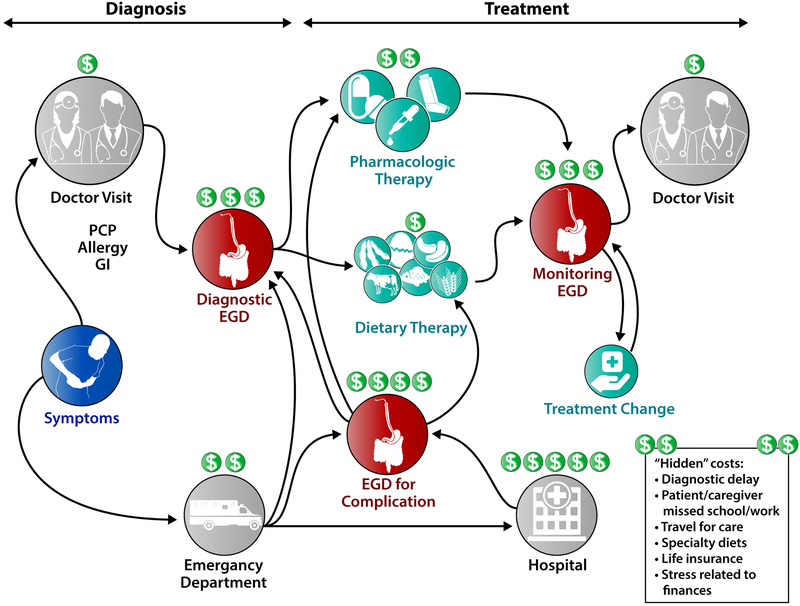
High costs in EoE can be related to diagnostic delays, requirement for upper endoscopy with biopsy for diagnosis and monitoring of disease activity, expensive medications currently used off-label, increased food costs related to dietary elimination treatment, frequent doctor visits with subspecialists, and complications or disease exacerbations. Provision of cost-effective care in EoE is an understudied area, and a patient-centric approach is key. There are multiple areas in which future research can make an impact. These include determining predictors of treatment response, minimally or noninvasive methods to monitor disease activity, and validation of the use of multidisciplinary care.
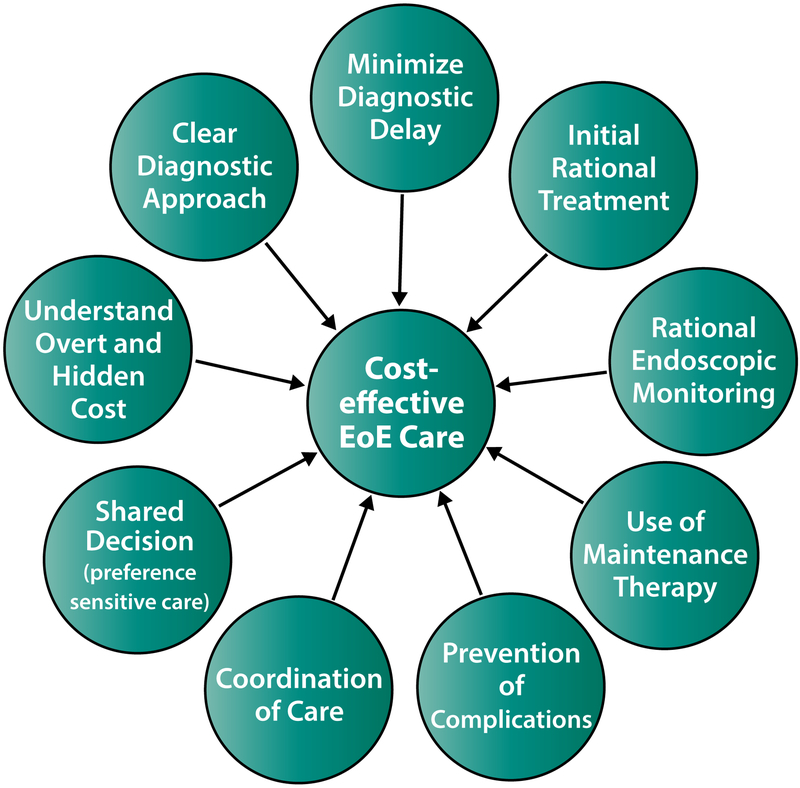
Eosinophilic esophagitis (EoE) is considered to be a rare disease, but the costs of care and burden of disease attributed to EoE are substantial. However, few studies examine either the costs related to EoE or the approach to cost-effective care for the EoE patient. To provide cost-effective care, a patient-centric approach and shared decision-making model are optimal. In addition, a rational strategy for EoE diagnosis and initial treatment, effective maintenance therapy for disease control and ideally to prevent complications, and appropriate long-term monitoring are all required.
探讨嗜酸性粒细胞性食管炎(EoE)相关的成本,了解这些成本的来源,讨论 EoE 成本效益护理的可能方法,并确定该主题未来研究的方向。
资料来源/研究选择:对 1977 年(首次描述 EoE)至 2019 年 3 月的文献进行叙述性综述,重点关注 EoE 的成本和成本效益分析。
EoE 中的高成本可能与诊断延误、诊断和监测疾病活动需要进行上消化道内镜检查和活检、目前标签外使用的昂贵药物、与饮食消除治疗相关的增加的食物成本、经常就诊于专科医生以及并发症或疾病恶化有关。EoE 中提供成本效益护理是一个研究不足的领域,以患者为中心的方法是关键。未来的研究可以在多个领域产生影响。这些包括确定治疗反应的预测因素、监测疾病活动的最小侵入性或非侵入性方法以及验证多学科护理的使用。
嗜酸性粒细胞性食管炎(EoE)被认为是一种罕见疾病,但与 EoE 相关的护理成本和疾病负担是相当大的。然而,很少有研究探讨 EoE 的相关成本或 EoE 患者的成本效益护理方法。为了提供成本效益护理,以患者为中心的方法和共同决策模型是最佳选择。此外,还需要制定合理的 EoE 诊断和初始治疗策略、有效控制疾病的维持治疗,理想情况下可预防并发症,并进行适当的长期监测。