Arab-Zozani Morteza, Pezeshki Mohammad Zakaria, Khodayari-Zarnaq Rahim, Janati Ali
Iranian Center of Excellence in Health Management, Department of Health Services Management, School of Management and Medical Informatics, Tabriz University of Medical Sciences, Tabriz, Iran.
Student Research Committee, Tabriz University of Medical Sciences, Tabriz, Iran.
Ethiop J Health Sci. 2019 Mar;29(2):231-238. doi: 10.4314/ejhs.v29i2.10.
Overuse and underuse of healthcare services occure within population, organizations and even patients around the world. Producing a balance between these two can increase efficiency, service quality and patient satisfaction. It also decrease extra costs. The aim of this study was to identify forces for change and forces against change for generating balance between overuse and underuse to achieve right care.
This study was conducted in five steps: 1) describe our plan or proposal for change; 2) identify forces for change; 3) identify forces against change; 4) assign forces; and 5) analyze and apply. We used purposive sampling strategy. The number of participants in the expert panel were eight. Each participant signed informed consent form before starting the study (Ethical code: IR.TBZMED.REC.1396.908).
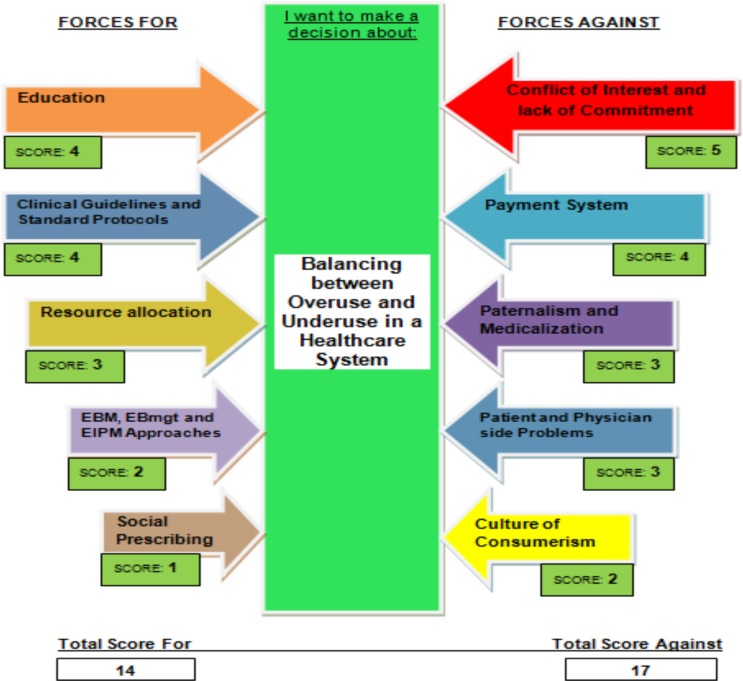
The driving factors for balancing overuse and underuse were education, preparing clinical guideline and standard protocols, resource allocation, using evidence-based medicine, evidence-based management and evidence-informed policy making approaches and social prescribing. The restraining factors for balancing overuse and underuse were conflict of interest issues, payment systems, paternalism and medicalization, patients and physicians' side problems and culture of consumerism in the community. The total scores for and against change were 14 and 17, respectively.
It seems that the emphasis on education and training in this field is essential for physicians, patients and all people in the community. Also, making reforms in payment systems and changing the rules and regulations in this area could be major drivers.
医疗服务的过度使用和使用不足在全球范围内的人群、组织甚至患者中都存在。在这两者之间实现平衡可以提高效率、服务质量和患者满意度,还能降低额外成本。本研究的目的是确定促进变革和阻碍变革的因素,以在过度使用和使用不足之间实现平衡,从而提供恰当的医疗服务。
本研究分五步进行:1)描述我们的变革计划或提议;2)确定促进变革的因素;3)确定阻碍变革的因素;4)分配因素;5)分析并应用。我们采用了目的抽样策略。专家小组的参与者有八名。每位参与者在研究开始前签署了知情同意书(伦理代码:IR.TBZMED.REC.1396.908)。
平衡过度使用和使用不足的驱动因素包括教育、制定临床指南和标准方案、资源分配、采用循证医学、循证管理和循证政策制定方法以及社会处方。平衡过度使用和使用不足的限制因素包括利益冲突问题、支付系统、家长作风和医学化、患者和医生方面的问题以及社区中的消费主义文化。促进变革和阻碍变革的总分分别为14分和17分。
看来在这一领域强调对医生、患者和社区所有人员的教育和培训至关重要。此外,改革支付系统并改变该领域的规章制度可能是主要驱动力。