Mbuthia Oliver Waithaka, Mathenge Scholastica Gatwiri, Oyaro Micah Ongeri, Ng'ayo Musa Otieno
Medical Laboratory Science Department, Kenyatta University, Nairobi, Kenya.
Human Pathology Department, Immunology Unit, University of Nairobi, Nairobi Kenya.
Pan Afr Med J. 2018 Oct 4;31:88. doi: 10.11604/pamj.2018.31.88.15644. eCollection 2018.
Bacterial agents are among pathogens implicated to cause diarrhea in children resulting to huge mortality and morbidities. Bacterial etiologies causing diarrhea in children below five years are rarely investigated in Central Kenya, which would otherwise guide prescription and target health education.
A cross-sectional study approach was applied on 163 randomly selected stool samples from children below five years who presented with diarrhea in Muranga and Muriranjas hospitals. The objective was to determine the bacterial agents of diarrhea. Enteric bacterial pathogens were cultured using appropriate media and identified. Statistical analyses were performed using STATA v.13. Chi-square or Fisher exact-test were used to check for evidence of relationship whenever applicable.
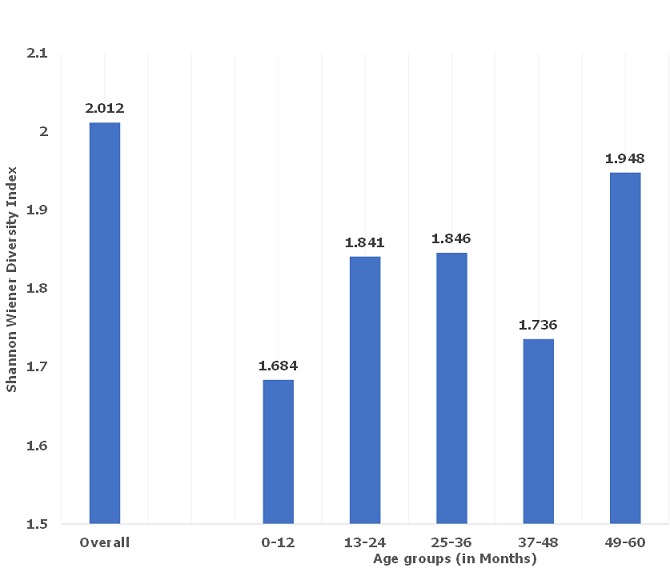
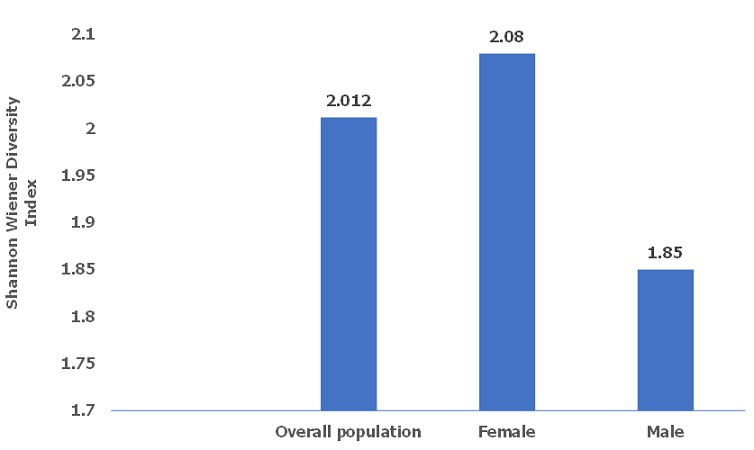
There were nearly equal distributions in gender 86 (52.8%) female vs. 77 (47.2%) male, majority (35.6%) aged between 0-12 months. Bacterial isolates were highly diverse in female than the male, children aged 49-60 months and least among those aged 0-12 months. A total of 188 bacterial isolates belonging to 11 genera were recovered. The predominant bacteria was nonpathogenic Escherichia coli 85 (45.2%), while 13 (6.9%) Escherichia coli were positive for virulence genes, including 8 (4.3%) positive for LT and STp Shiga-like or Enterotoxigenic Escherichia coli, 3 (1.6%) positive for eae and bfpA Enteropathogenic Escherichia coli and 2 (1.1%) positive for Enteroaggregative Escherichia coli gene. Others included: Salmonella 21 (11.2%), Pseudomonas 14 (7.4%), Shigella 14 (7.4%), Klebsiella 12 (6.4%), Aeromonas 8 (4.3%), Enterobacter 7 (3.7%), Proteus 8 (4.3%), Citrobactor 3 (1.6%), Yersinia 2 (1.1%) and Vibrio 1 (0.5%).
was the major bacterial isolate and majority of the bacteria were statistically significant cause of diarrhea (p=0.001).
细菌病原体是导致儿童腹泻的病原体之一,可造成巨大的死亡率和发病率。肯尼亚中部地区很少对五岁以下儿童腹泻的细菌病因进行调查,而这有助于指导用药和开展针对性的健康教育。
采用横断面研究方法,从穆朗加和穆里兰贾医院随机选取163例五岁以下腹泻儿童的粪便样本。目的是确定腹泻的细菌病原体。使用合适的培养基培养并鉴定肠道细菌病原体。使用STATA v.13进行统计分析。在适用时,使用卡方检验或费舍尔精确检验来检查是否存在关联证据。
性别分布几乎相等,女性86例(52.8%),男性77例(47.2%),大多数(35.6%)年龄在0至12个月之间。女性的细菌分离株比男性更为多样,49至60个月大的儿童中细菌分离株最多,0至12个月大的儿童中最少。共分离出188株属于11个属的细菌。主要细菌是非致病性大肠杆菌85株(45.2%),而13株(6.9%)大肠杆菌的毒力基因呈阳性,其中8株(4.3%)LT和STp志贺样或产肠毒素大肠杆菌呈阳性,3株(1.6%)eae和bfpA肠致病性大肠杆菌呈阳性,2株(1.1%)聚集性大肠杆菌基因呈阳性。其他包括:沙门氏菌21株(11.2%)、假单胞菌14株(7.4%)、志贺氏菌14株(7.4%)、克雷伯氏菌12株(6.4%)、气单胞菌8株(4. < 3%)、肠杆菌7株(3.7%)、变形杆菌8株(4.3%)、柠檬酸杆菌3株(1.6%)、耶尔森氏菌2株(1.1%)和弧菌1株(0.5%)。
是主要的细菌分离株,大多数细菌是腹泻的统计学显著病因(p = 0.001)。