
随机对照试验比较微创和开放远端胰腺切除术的成本和生活质量(LEOPARD 试验)。
Costs and quality of life in a randomized trial comparing minimally invasive and open distal pancreatectomy (LEOPARD trial).
机构信息
Department of Surgery, Cancer Center Amsterdam, Amsterdam, The Netherlands.
Department of Surgery, Cancer Center Amsterdam, Amsterdam UMC, VU University, Amsterdam, The Netherlands.
出版信息
Br J Surg. 2019 Jun;106(7):910-921. doi: 10.1002/bjs.11147. Epub 2019 Apr 23.
BACKGROUND
Minimally invasive distal pancreatectomy decreases time to functional recovery compared with open distal pancreatectomy, but the cost-effectiveness and impact on disease-specific quality of life have yet to be established.
METHODS
The LEOPARD trial randomized patients to minimally invasive (robot-assisted or laparoscopic) or open distal pancreatectomy in 14 Dutch centres between April 2015 and March 2017. Use of hospital healthcare resources, complications and disease-specific quality of life were recorded up to 1 year after surgery. Unit costs of hospital healthcare resources were determined, and cost-effectiveness and cost-utility analyses were performed. Primary outcomes were the costs per day earlier functional recovery and per quality-adjusted life-year.
RESULTS
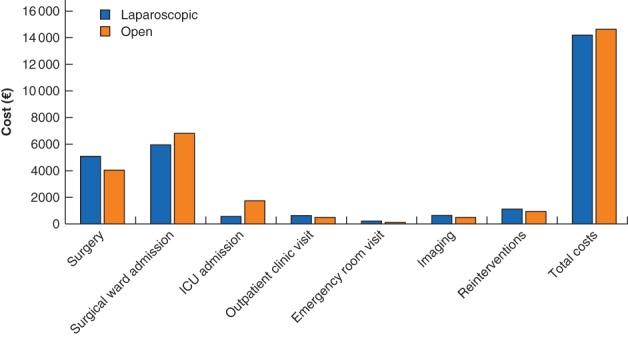
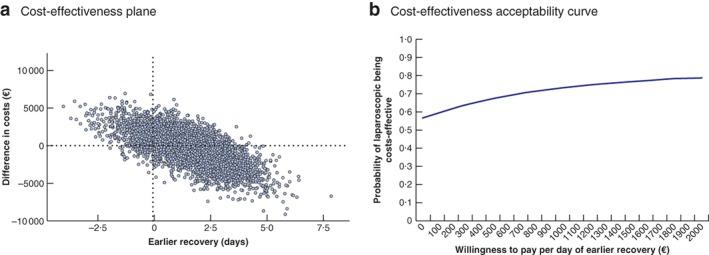
All 104 patients who had a distal pancreatectomy (48 minimally invasive and 56 open) in the trial were included in this study. Patients who underwent a robot-assisted procedure were excluded from the cost analysis. Total medical costs were comparable after laparoscopic and open distal pancreatectomy (mean difference €-427 (95 per cent bias-corrected and accelerated confidence interval €-4700 to 3613; P = 0·839). Laparoscopic distal pancreatectomy was shown to have a probability of at least 0·566 of being more cost-effective than the open approach at a willingness-to-pay threshold of €0 per day of earlier recovery, and a probability of 0·676 per additional quality-adjusted life-year at a willingness-to-pay threshold of €80 000. There were no significant differences in cosmetic satisfaction scores (median 9 (i.q.r. 5·75-10) versus 7 (4-8·75); P = 0·056) and disease-specific quality of life after minimally invasive (laparoscopic and robot-assisted procedures) versus open distal pancreatectomy.
CONCLUSION
Laparoscopic distal pancreatectomy was at least as cost-effective as open distal pancreatectomy in terms of time to functional recovery and quality-adjusted life-years. Cosmesis and quality of life were similar in the two groups 1 year after surgery.
背景
与开腹胰体尾切除术相比,微创胰体尾切除术可缩短患者的功能康复时间,但微创胰体尾切除术的成本效益和对疾病特异性生活质量的影响尚未确定。
方法
LEOPARD 试验于 2015 年 4 月至 2017 年 3 月在 14 个荷兰中心将患者随机分配至微创(机器人辅助或腹腔镜)或开腹胰体尾切除术组。记录手术 1 年后的住院医疗资源使用情况、并发症和疾病特异性生活质量。确定住院医疗资源的单位成本,并进行成本效益和成本效用分析。主要结局为每提前 1 天功能恢复的成本和每增加 1 个质量调整生命年的成本。
结果
本研究纳入了该试验中 104 例接受胰体尾切除术(48 例微创,56 例开腹)的患者。机器人辅助手术患者被排除在成本分析之外。腹腔镜和开腹胰体尾切除术的总医疗费用相当(平均差值 €-427(95%偏倚校正和加速置信区间 €-4700 至 3613;P=0.839)。腹腔镜胰体尾切除术在功能恢复提前 1 天的意愿支付阈值为 0 欧元/天时,其具有 0.566 以上的概率比开腹手术更具成本效益,在意愿支付阈值为 80000 欧元/时,其具有 0.676 以上的概率可增加 1 个质量调整生命年。微创(腹腔镜和机器人辅助手术)与开腹胰体尾切除术相比,术后 1 年美容满意度评分(中位数 9(四分位距 5.75-10)与 7(4-8.75);P=0.056)和疾病特异性生活质量无显著差异。
结论
在功能恢复时间和质量调整生命年方面,腹腔镜胰体尾切除术与开腹胰体尾切除术的成本效益至少相当。两组患者术后 1 年的美容效果和生活质量相似。



 Zotero 插件