Salmani Ibrahim, Seyedin Hesam, Ardalan Ali, Farajkhoda Tahmineh
Department of Disasters and Emergency Health, Research Center of Accidents Prevention and Dealing with Disasters, Shahid Sadoughi University of Medical Sciences, Yazd, Iran.
Department of Health in Emergencies and Disasters, School of Health Management and Information Sciences, Iran University of Medical Sciences, Tehran, Iran.
BMC Health Serv Res. 2019 Apr 24;19(1):241. doi: 10.1186/s12913-019-4073-6.
Shortage of specialized healthcare volunteers is a major challenge during disasters and one solution could be pre-identified healthcare volunteers. This study aimed to develop a conceptual model of managing Iranian healthcare volunteers in disasters.
This mixed method study was designed in two phases. A qualitative study using semi-structured interviews was conducted with 22 health professionals and key informant. The interviews were analyzed by framework analysis. In the second phase, concepts derived from the first step were evaluated in a two round Delphi study by an expert panel comprised of 42 experts.
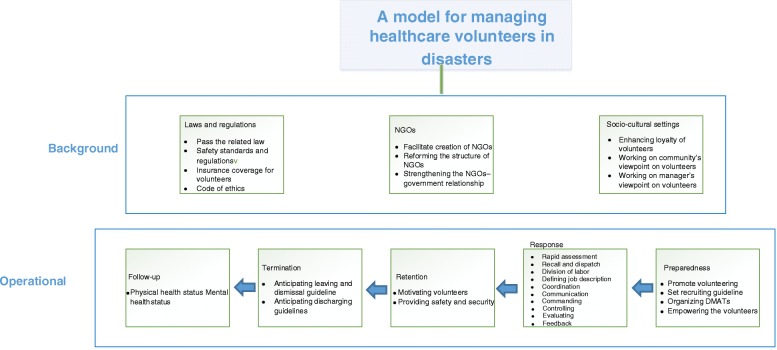
Two themes and eight subthemes were identified based on the results of the first phase. The theme of background requirements included three sub-themes of laws and regulations, NGOs and socio-cultural factors. The second theme was called operational requirements which included six subthemes of preparedness, response, retention, relocation, terminating and follow-up. According to the results of the Delphi study, all of the concepts were confirmed.
In addition to the need for supportive legal framework and building the culture of volunteering, it seems it is crucial to identify and prepare the health care volunteers in the preparedness phase and assign them appropriately in the response phase. Furthermore, the necessary measures should be prioritized to enhance volunteers' retention rate and motivation. Plans should also be implemented for volunteers' termination and volunteers' physical and mental health follow up after their mission.
在灾难期间,专业医疗志愿者短缺是一项重大挑战,一种解决方案可能是预先确定医疗志愿者。本研究旨在建立一个管理伊朗灾难期间医疗志愿者的概念模型。
这项混合方法研究分两个阶段进行。采用半结构化访谈对22名卫生专业人员和关键信息提供者进行了定性研究。通过框架分析对访谈进行分析。在第二阶段,由42名专家组成的专家小组在两轮德尔菲研究中对第一步得出的概念进行了评估。
根据第一阶段的结果确定了两个主题和八个子主题。背景要求主题包括法律法规、非政府组织和社会文化因素三个子主题。第二个主题称为操作要求,包括准备、应对、留用、重新安置、终止和跟进六个子主题。根据德尔菲研究的结果,所有概念均得到确认。
除了需要支持性的法律框架和建立志愿服务文化外,在准备阶段识别和准备医疗志愿者,并在应对阶段进行适当分配似乎至关重要。此外,应优先采取必要措施提高志愿者的留用率和积极性。还应制定志愿者终止服务计划以及任务完成后对志愿者身心健康进行跟进的计划。