Department of Microbiology and Immunology, University of Michigan, Ann Arbor, Michigan, USA.
Cellular and Molecular Biology Program, University of Michigan, Ann Arbor, Michigan, USA.
mBio. 2019 Apr 23;10(2):e00668-19. doi: 10.1128/mBio.00668-19.
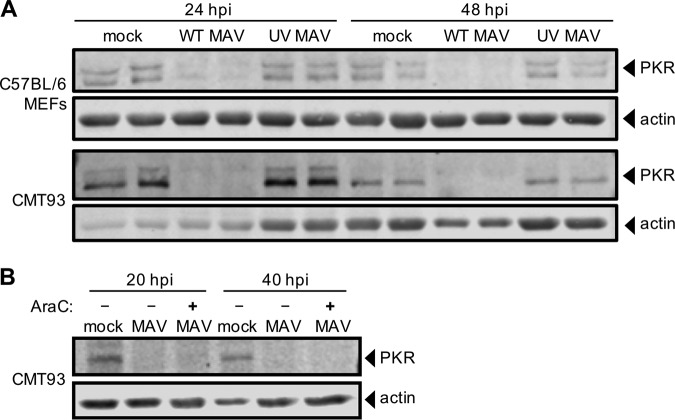
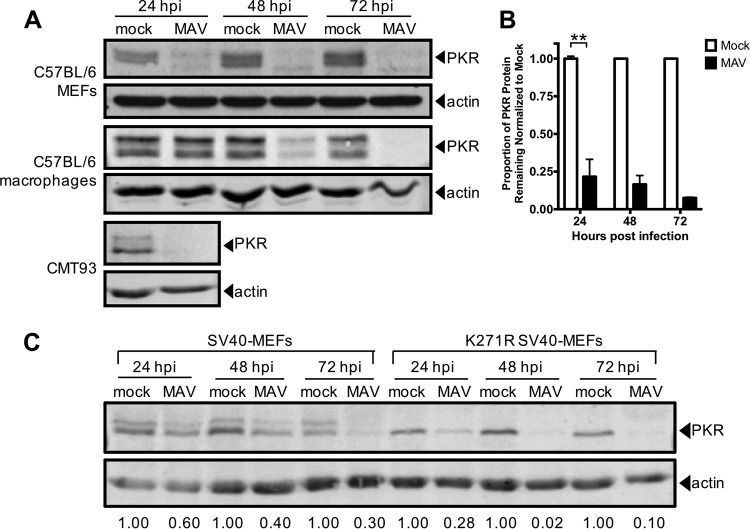
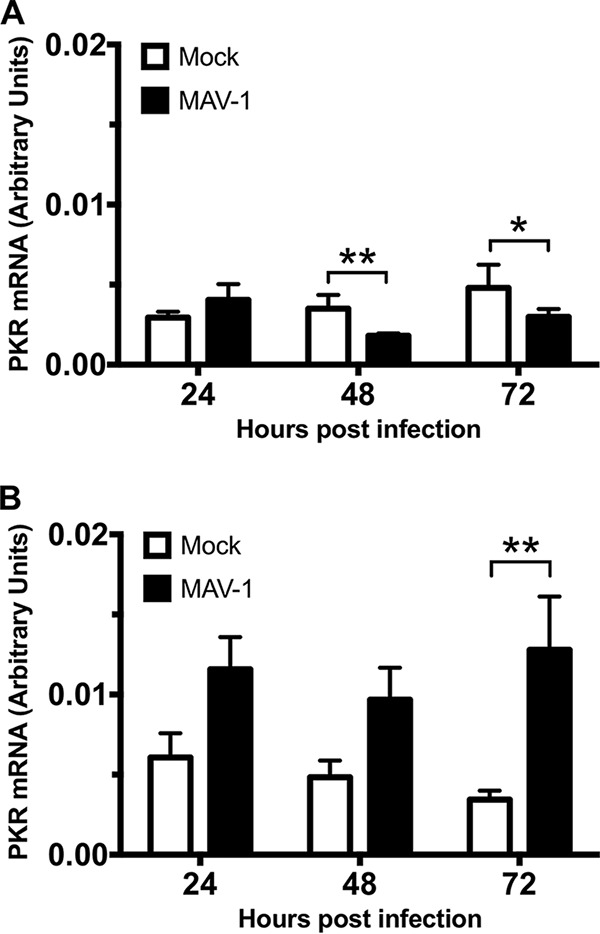
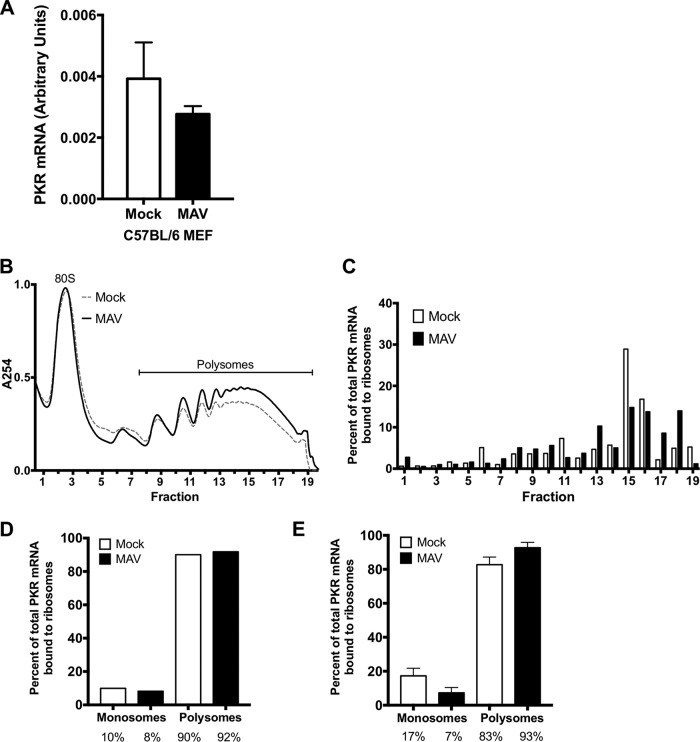
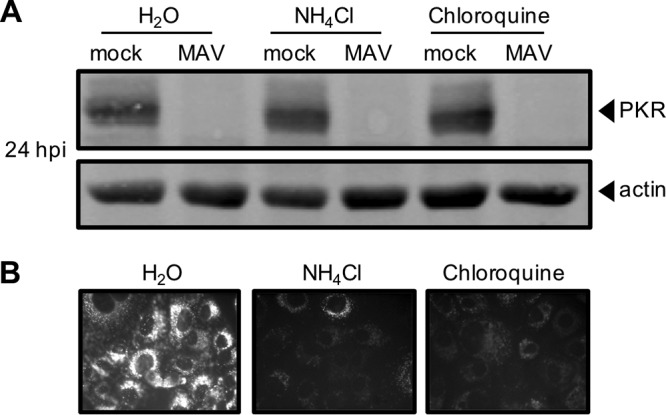
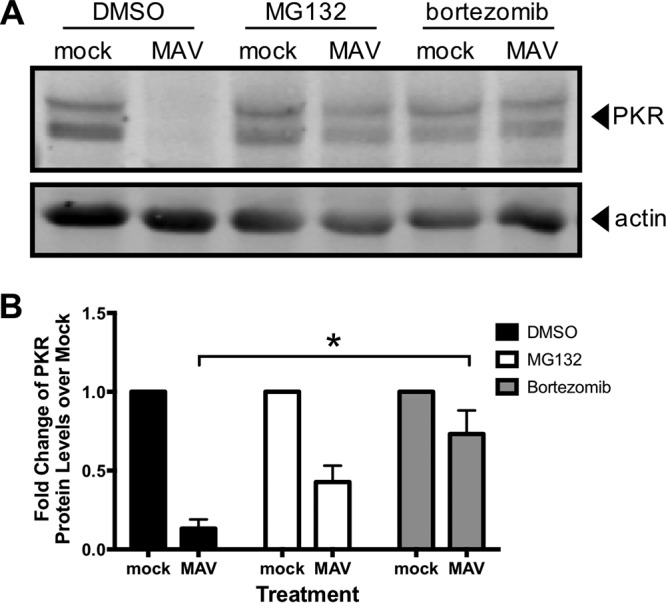
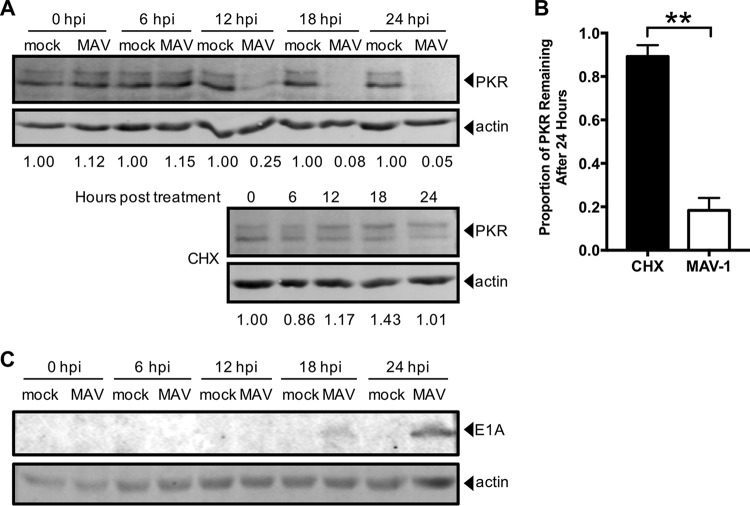
Protein kinase R (PKR) plays a major role in activating host immunity during infection by sensing double-stranded RNA (dsRNA) produced by viruses. Once activated by dsRNA, PKR phosphorylates the translation factor eukaryotic initiation factor 2α (eIF2α), halting cellular translation. Many viruses have methods of inhibiting PKR activation or its downstream effects, circumventing protein synthesis shutdown. These include sequestering dsRNA or producing proteins that bind to and inhibit PKR activation. Here we describe our finding that in multiple cell types, PKR was depleted during mouse adenovirus type 1 (MAV-1) infection. MAV-1 did not appear to be targeting PKR at the transcriptional or translational level, because total PKR mRNA levels and levels of PKR mRNA bound to polysomes were unchanged or increased during MAV-1 infection. However, inhibiting the proteasome reduced the PKR depletion seen in MAV-1-infected cells, whereas inhibiting the lysosome had no effect. This suggests that proteasomal degradation alone is responsible for PKR degradation during MAV-1 infection. Time course experiments indicated that the degradation occurs early after infection. Infecting cells with UV-inactivated virus prevented PKR degradation, whereas inhibiting viral DNA replication did not. Together, these results suggest that an early viral gene is responsible. Degradation of PKR is a rare mechanism to oppose PKR activity, and it has been described in only six RNA viruses. To our knowledge, this is the first example of a DNA virus counteracting PKR by degrading it. The first line of defense in cells during viral infection is the innate immune system, which is activated by different viral products. PKR is a part of this innate immune system and is induced by interferon and activated by dsRNA produced by DNA and RNA viruses. PKR is such an important part of the antiviral response that many viral families have gene products to counteract its activation or the resulting effects of its activity. Although a few RNA viruses degrade PKR, this method of counteracting PKR has not been reported for any DNA viruses. MAV-1 does not encode virus-associated RNAs, a human adenoviral defense against PKR activation. Instead, MAV-1 degrades PKR, and it is the first DNA virus reported to do so. The innate immune evasion by PKR degradation is a previously unidentified way for a DNA virus to circumvent the host antiviral response.
蛋白激酶 R (PKR) 在病毒感染期间通过感应双链 RNA (dsRNA) 来激活宿主免疫方面发挥着重要作用。一旦被 dsRNA 激活,PKR 就会磷酸化翻译起始因子真核起始因子 2α (eIF2α),从而阻止细胞翻译。许多病毒都有抑制 PKR 激活或其下游效应的方法,从而避免蛋白质合成关闭。这些方法包括隔离 dsRNA 或产生与 PKR 结合并抑制其激活的蛋白质。在这里,我们描述了在多种细胞类型中,在小鼠腺病毒 1 (MAV-1) 感染期间 PKR 被耗尽的发现。MAV-1 似乎并没有在转录或翻译水平上靶向 PKR,因为在 MAV-1 感染期间,PKR 的总 mRNA 水平和与多核糖体结合的 PKR mRNA 水平没有变化或增加。然而,抑制蛋白酶体减少了 MAV-1 感染细胞中观察到的 PKR 耗竭,而抑制溶酶体则没有影响。这表明单独的蛋白酶体降解负责 MAV-1 感染期间 PKR 的降解。时程实验表明,这种降解发生在感染后早期。用紫外线失活的病毒感染细胞可防止 PKR 降解,而抑制病毒 DNA 复制则没有。综上所述,这些结果表明是一种早期的病毒基因负责。PKR 的降解是一种罕见的拮抗 PKR 活性的机制,仅在六种 RNA 病毒中描述过。据我们所知,这是第一个通过降解 PKR 来对抗 PKR 的 DNA 病毒的例子。病毒感染期间细胞的第一道防线是先天免疫系统,它被不同的病毒产物激活。PKR 是先天免疫系统的一部分,由干扰素诱导并由 DNA 和 RNA 病毒产生的 dsRNA 激活。PKR 是抗病毒反应的重要组成部分,许多病毒家族都有基因产物来拮抗其激活或其活性的结果。尽管少数 RNA 病毒会降解 PKR,但尚未有报道称任何 DNA 病毒会采用这种方法来拮抗 PKR。MAV-1 不编码病毒相关 RNA,这是人类腺病毒对抗 PKR 激活的防御机制。相反,MAV-1 会降解 PKR,它是第一个被报道这样做的 DNA 病毒。通过 PKR 降解来逃避先天免疫是 DNA 病毒规避宿主抗病毒反应的一种以前未被识别的方式。