Center for Clinical Management Research, VA Ann Arbor Healthcare System, Ann Arbor, MI, USA
Department of Internal Medicine, University of Michigan Medical School, Ann Arbor, MI, USA.
BMJ Qual Saf. 2019 Sep;28(9):741-749. doi: 10.1136/bmjqs-2018-009111. Epub 2019 Apr 23.
Despite focused initiatives to reduce device-associated infection among hospitalised patients, the practices US hospitals are currently using are unknown. We thus used a national survey to ascertain the use of several established and novel practices to prevent device-associated infections.
We mailed surveys to infection preventionists in a random sample of nearly 900 US acute care hospitals in 2017. Our survey asked about the use of practices to prevent three common device-associated infections: catheter-associated urinary tract infection (CAUTI), central line-associated bloodstream infection (CLABSI) and ventilator-associated pneumonia (VAP). Using sample weights, we estimated the percentage of hospitals reporting regular use of each practice. We also conducted multivariable regression to determine associations between selected hospital characteristics (eg, perceived support from leadership) and use of CAUTI, CLABSI and VAP prevention practices.
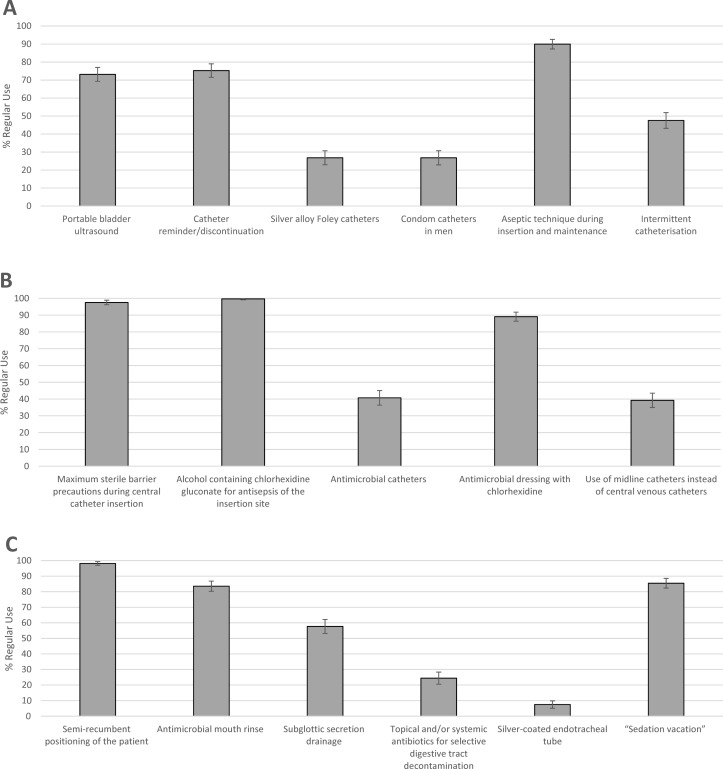
The response rate was 59%. Several practices are reportedly used in over 90% of US hospitals: aseptic technique during indwelling urethral catheter insertion and maintenance (to prevent CAUTI); maximum sterile barrier precautions during central catheter insertion and alcohol-containing chlorhexidine gluconate for insertion site antisepsis (to prevent CLABSI); and semirecumbent positioning of the patient (to prevent VAP). Antimicrobial devices are used in the minority of hospitals for these three device-associated infections.
We provide an updated snapshot of the practices US hospitals are currently using to prevent device-associated infections. Compared with previous studies using a similar design and questions, we found that the use of recommended practices increased in US hospitals, especially for CAUTI prevention.
尽管医院集中精力采取措施来降低与器械相关的感染,但目前尚不清楚美国医院正在使用哪些措施。因此,我们使用一项全国性调查来确定采用几种已确立和新颖的方法来预防与器械相关的感染。
我们在 2017 年向近 900 家美国急性护理医院的感染预防人员邮寄了调查问卷。我们的调查询问了用于预防三种常见的与器械相关感染的措施的使用情况:导尿管相关尿路感染(CAUTI)、中心静脉导管相关血流感染(CLABSI)和呼吸机相关性肺炎(VAP)。使用样本权重,我们估计了报告常规使用每种措施的医院比例。我们还进行了多变量回归分析,以确定选定的医院特征(例如,领导支持的感知程度)与 CAUTI、CLABSI 和 VAP 预防措施的使用之间的关联。
回复率为 59%。有几种措施据称在美国 90%以上的医院中使用:留置导尿管插入和维护期间的无菌技术(预防 CAUTI);中心导管插入和含酒精的葡萄糖酸氯己定进行插入部位消毒(预防 CLABSI)期间的最大无菌屏障预防措施;以及患者半卧位(预防 VAP)。对于这三种与器械相关的感染,只有少数医院使用抗菌器械。
我们提供了美国医院目前用于预防与器械相关感染的措施的最新情况。与之前使用类似设计和问题的研究相比,我们发现美国医院推荐措施的使用有所增加,尤其是在预防 CAUTI 方面。