Ralph M. Parsons Laboratory, Department of Civil and Environmental Engineering, Massachusetts Institute of Technology, Cambridge, MA, 02139, USA.
Institute for Environmental Engineering, Department of Civil, Environmental and Geomatic Engineering, ETH Zurich, 8093, Zurich, Switzerland.
Nat Commun. 2019 Apr 23;10(1):1877. doi: 10.1038/s41467-019-09521-2.
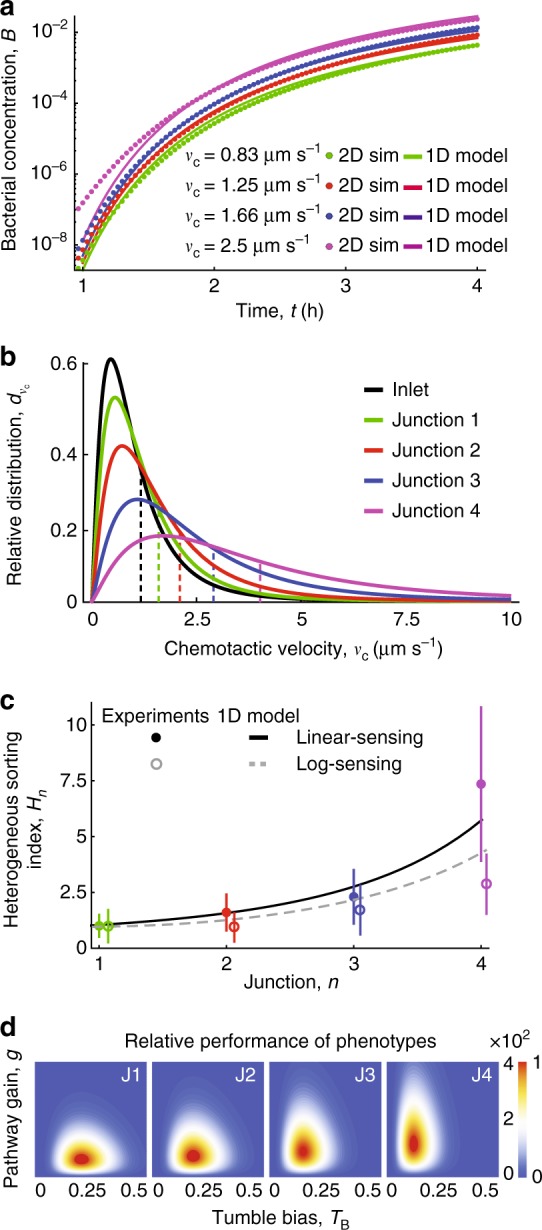
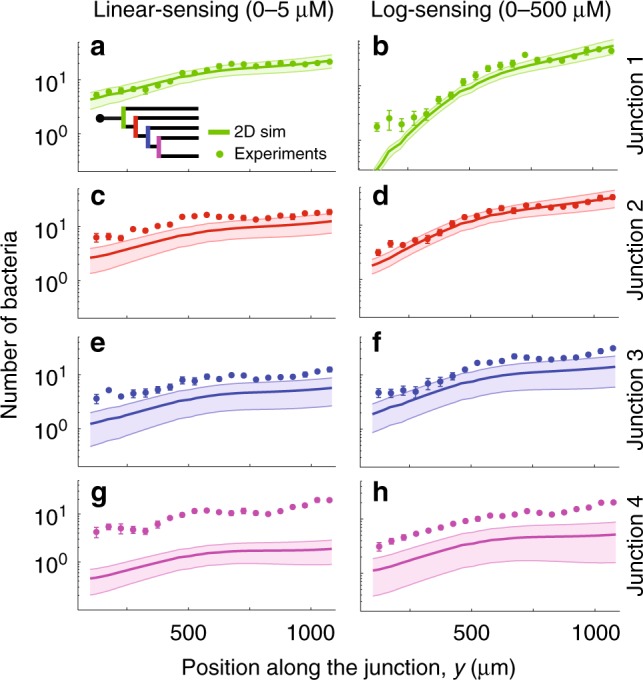
Many microorganisms have evolved chemotactic strategies to exploit the microscale heterogeneity that frequently characterizes microbial habitats. Chemotaxis has been primarily studied as an average characteristic of a population, with little regard for variability among individuals. Here, we adopt a classic tool from animal ecology - the T-maze - and implement it at the microscale by using microfluidics to expose bacteria to a sequence of decisions, each consisting of migration up or down a chemical gradient. Single-cell observations of clonal Escherichia coli in the maze, coupled with a mathematical model, reveal that strong heterogeneity in the chemotactic sensitivity coefficient exists even within clonal populations of bacteria. A comparison of different potential sources of heterogeneity reveals that heterogeneity in the T-maze originates primarily from the chemotactic sensitivity coefficient, arising from a distribution of pathway gains. This heterogeneity may have a functional role, for example in the context of migratory bet-hedging strategies.
许多微生物已经进化出趋化策略来利用微生物栖息地中经常出现的微观尺度异质性。趋化作用主要被研究为群体的平均特征,很少考虑个体之间的可变性。在这里,我们采用动物生态学中的一种经典工具 - T 型迷宫 - 并通过微流控技术在微观尺度上实现它,使细菌暴露于一系列决策中,每个决策都由向上或向下沿着化学梯度的迁移组成。在迷宫中对克隆大肠杆菌的单细胞观察,结合数学模型,揭示了即使在细菌的克隆种群中,趋化敏感性系数也存在很强的异质性。对不同潜在异质源的比较表明,T 型迷宫中的异质性主要源于趋化敏感性系数,源于途径增益的分布。这种异质性可能具有功能作用,例如在迁徙赌注避险策略的背景下。